
Tuesday, August 18, 2026

Metaplanet Just Bought a Gaming Company's Stock Ticker With Bitcoin

Metaplanet Super League press release announcing Superplanet Bitcoin treasury platform

Metaplanet corporate branding. Super League to be renamed Superplanet, Inc. Source: metaplanet.jp

By BitBrainers Editorial

Metaplanet just put 2,100 Bitcoin into a gaming media company nobody outside a small Discord server had heard of a week ago. The company that holds roughly 43,000 BTC and claims the title of world's third-largest corporate treasury just bought a Nasdaq-listed gaming shell instead of buying more Bitcoin. Same week, Strategy sat on $4.8 billion in cash and bought nothing, for the third consecutive filing period running. Metaplanet is deploying capital into new structures. Strategy is holding cash like a company bracing for something. Both call themselves Bitcoin treasury operations, but they are behaving differently right now.

The Mechanics

2,100 Bitcoin plus $2.5 million cash, exchanged for 44,859,400 newly issued shares at $3.00 each, total aggregate value around $134.6 million. Metaplanet ends up owning 95.7% of common stock, or 93.6% if every pre-funded warrant eventually gets exercised. Existing Super League shareholders are left holding roughly 4.3% between all of them. That's not a typo. Most of the company just changed hands in one afternoon.

The deal is not closed. It is expected to close in Q4 2026, subject to Super League stockholder approval, Nasdaq review, and U.S. and Japan regulatory clearances. The five-year lock-up applies to Metaplanet's shares. The BTC itself was priced using Coinbase's closing rate at 4:00 p.m. New York time on August 14th, fixed at that number regardless of where the market moves before closing, a detail that matters more than it sounds like it should.

There is more structure underneath the headline. The deal includes convertible perpetual preferred stock, long-term warrants allowing Metaplanet to acquire up to roughly 381 million additional shares at stepped prices from $3.00 to $33.50, and Evo Fund warrants. Metaplanet also has a 24-month option to inject another approximately $210 million via junior preferred stock. Board control is explicit: Metaplanet will nominate five of nine directors. This is not a passive investment. It is a takeover with extra steps and a five-year lock-up.

Why a Gaming Shell?

Super League is a Nasdaq-listed gaming media company, ticker SLE, and the actual gaming business apparently stays intact through all of this. Press materials keep repeating a figure about 3.3 billion video game players worldwide like that's supposed to make the acquisition feel more grounded. (It doesn't really, not when the whole point of the transaction has nothing to do with gaming and everything to do with an existing Nasdaq ticker that already clears listing requirements, the entire appeal of this structure in the first place.) The gaming business provides a regulatory wrapper and an existing shareholder base, but the Bitcoin will be the primary driver of shareholder value according to the release itself.

Buying a listing through a functioning shell skips the IPO process, skips the SPAC timeline, skips basically every slow, expensive, scrutiny-heavy path a company would normally take onto a US exchange. Company gets renamed Superplanet. Gaming media becomes a footnote attached to a balance sheet built around Bitcoin.

SLE's pre-market reaction was a 20% jump on tiny float. The existing equity was small enough that a headline move does not require much volume. Post-rename, the float dynamics will be dictated by the 4.3% residual holders and whatever warrants get exercised. A 95.7%-owned vehicle is not a normal Nasdaq listing. It is a controlled subsidiary with a ticker symbol.

The Yield Angle

Predictably, the press language leans hard into terms like "income-generating Bitcoin strategies" and "Bitcoin financial management," phrases that sound careful and professional and mean something closer to: we're not just going to sit on this, we're going to try to make it produce yield somehow. That's a meaningfully different pitch than Strategy's original model, which for years amounted to buy it, hold it, never touch it, repeat. Whether "income-generating" ends up meaning lending, options overlays, or something more exotic isn't spelled out anywhere public yet. These vague strategy phrases usually turn into a much riskier product a year later, when someone actually has to explain quarterly numbers to shareholders.

This detail got buried under the headline. It is the most important operational difference between Metaplanet's approach and Strategy's original accumulation model. Lending or structured products on a corporate treasury introduce counterparty risk that a pure hold strategy avoids. The risk profile is different, even if the press release makes it sound like an upgrade.

The Lock-Up and Concentration

Five years is longer than most institutional mandates. It signals that Metaplanet is building a long-term treasury platform, not a trading vehicle. The lock-up also prevents immediate arbitrage between the Tokyo and Nasdaq listings, which matters because the consolidated group will have two listed entities in different jurisdictions.

Concentrated ownership is a risk. At 95.7%, Metaplanet controls the entity completely. Minority shareholders have no governance leverage. The Tokyo and Nasdaq platforms are supposed to have different investor bases, but the capital structure is a single consolidated group. The press release calls it "compounding a single group-level Bitcoin position." That is accurate. It is also a single point of failure.

The 4.3% residual holders are along for the ride. They cannot block the transaction, cannot change the board, and cannot force a dividend. Their only exit is the market, and the market for a 95.7%-controlled shell is not a normal market.

The "Two Engines" Pitch

Metaplanet's presentation materials frame this as two capital markets feeding one Bitcoin position. Japan and the United States, each with its own investor base and currency, compounding a single group-level stack. The attributable Bitcoin per Metaplanet share is supposed to increase as the group issues securities and buys more Bitcoin. The math is straightforward in the slides: raise capital at 100% of BTC net asset value, buy more Bitcoin, boost attributable BTC per share by roughly 4.7% with no new common dilution.

BitBrainers Weekly Briefing

One email every Monday. Market structure, key levels, on-chain signals, positioning notes. No hype.

Subscribe $9/month

Cancel anytime. No questions.

This is the Strategy playbook from 2020. The premium to net asset value is the engine. If the market prices the vehicle above the value of the underlying Bitcoin, the company can issue more securities, buy more Bitcoin, and the loop continues. The loop breaks when the premium collapses. Strategy's premium is gone. MSTR trades at a discount to its Bitcoin holdings. Metaplanet is betting the premium shows up again on a smaller, fresher vehicle.

The problem is that spot Bitcoin ETFs now exist. Direct custody is easier. The premium for a leveraged corporate structure is shrinking. Metaplanet is launching the 2020 playbook in a 2026 market where the wrapper is no longer the only way to get exposure.

Macro Context

None of this is happening in a calm macro backdrop back home. Japanese bond yields have been spiking, and the country's life insurers are sitting on close to $200 billion in unrealized losses on their bond holdings this same week, a genuinely large number for an industry that's supposed to be the boring, stable end of the financial system.

Metaplanet itself moved $322 million in Bitcoin across its own wallets just four days before this announcement, a transfer the company already had to publicly clarify wasn't a sale. Capital looking for somewhere to go during a period of real domestic financial stress tends to look for exits, and a US-listed Bitcoin treasury platform is one very specific kind of exit. The Japanese macro situation is the accelerant. Yen volatility, BOJ normalization, domestic insurers bleeding. Japanese capital wants dollar-denominated Bitcoin exposure without the yen risk.

The Contrast With Strategy

This is fresh capital deployment into a Bitcoin treasury vehicle at a time when Strategy has paused accumulation for three consecutive filing periods. Strategy is issuing stock to pay preferred dividends and buy back STRC shares. Metaplanet is issuing stock to acquire Bitcoin. The direction is different.

Metaplanet is running the MicroStrategy playbook from 2020. They are building the treasury first and letting the narrative premium follow. Strategy built the premium first and is now managing the liabilities. The $4.8 billion cash reserve at Strategy could buy roughly $1.5 billion in Bitcoin at current prices without issuing new shares. No indication they will. Metaplanet just deployed $134.6 million into a new vehicle with a $210 million follow-on option waiting.

Strategy has paused. Metaplanet has accelerated.

What Happens Next

Turns out the actual test here isn't the deal itself. It is what SLE stock does once it reopens as Superplanet and the market gets a chance to price a 95.7%-owned Bitcoin treasury wrapped inside a gaming company's old ticker. Strategy's original 2020 playbook worked because the premium to net asset value stayed real for years before anyone seriously questioned it. Whether that premium shows up here too is an open question. The company is smaller, the lock-up is five years, and the yield strategy is unclear. Nobody has answered this yet, least of all the two companies involved.

Metaplanet will get a premium initially because the vehicle is small and the accumulation story is fresh. The test is whether they can sustain it through the first Bitcoin drawdown. Strategy's premium collapsed when the price stopped going up. Metaplanet's will face the same test.


Sources

Globe Newswire / StockTitan Metaplanet to Invest 2,100 Bitcoin in Super League to Launch U.S. Bitcoin Treasury Platform, Superplanet

SEC EDGAR Super League Enterprise, Inc. Form 8-K, August 18, 2026

Nikkei Asia Japan's Life Insurers' Unrealized Bond Losses Near $200bn as Rates Soar

CryptoTimes Metaplanet Moves 5,014 BTC for $8 in Fees, CEO Says No Bitcoin Sold

BitBrainers Strategy Raised $334 Million and Bought Zero Bitcoin

BitBrainers Metaplanet Just Moved $322M in Bitcoin

Tools: Kraken for trading. Trezor for storage.

This is market commentary, not financial advice. Nothing here is a recommendation to buy or sell any asset. Do your own research.

Strategy Raised $334 Million and Bought Zero Bitcoin

Strategy corporate dashboard, August 18, 2026. Bitcoin drawdown from ATH: 49.1%. Fear & Greed Index: 41. Source: strategy.com

By BitBrainers Editorial

Strategy sold $333.7 million in MSTR stock last week, between August 10 and August 16. 3,458,866 shares at roughly $96.48 each. The cash reserve is now $4.8 billion. And the Bitcoin count did not move. Still 840,447 BTC. Same number as late June. Same number as the filing before that. The last time they actually bought anything meaningful was 520 BTC in late June. Since then, nothing.

For five years this company issued debt, diluted shareholders, and turned every dollar it could find into Bitcoin. Prices ranged from $10,000 to $108,000. Michael Saylor became the most famous corporate treasurer in finance because of it.

BitBrainers Weekly Briefing

One email every Monday. Market structure, key levels, on-chain signals, positioning notes. No hype.

Subscribe $9/month

Cancel anytime. No questions.

Where the Cash Went

The money went somewhere else. $52.4 million to fund dividends on the STRC preferred stock. $132.2 million to buy back roughly 1.39 million STRC shares. $149 million added to the dollar reserve. called it extending "USD Duration" to 2.8 years. The cash buffer is now large enough to cover preferred dividends and debt interest for a while without touching the Bitcoin stack.

Strategy CREDIT dashboard. USD Reserve: $4,800M. Total Debt + Preferred: $21,815M. Source: strategy.com

That sounds like a good thing until you read what Saylor told CoinDesk this week. He said the company could sell Bitcoin if necessary to keep the STRC dividend stable. Two years ago that sentence would have been unthinkable from this company. Now it barely makes headlines. The support under the price is thinner than it looks. When your largest consistent buyer starts talking about selling, even conditionally, the market notices.

MSTR vs. BTC: The Leverage Trade Is Broken

MSTR closed Friday at $94.85, down 38.6% year-to-date. Bitcoin is up roughly 1% over the same stretch. The company built entirely around leveraged Bitcoin exposure is getting crushed while the asset it holds is basically flat. The leveraged-exposure story is broken. The gap between market value and underlying Bitcoin value keeps widening, and at some point that gap creates problems for the preferred dividend coverage, the debt covenants, and the story that made this trade attractive.

840,447 BTC at an average cost of roughly $75,385. Total cost basis around $63.4 billion. Current value near $53.4 billion. About $10 billion in unrealized losses. The stack still represents roughly 4% of the eventual 21 million supply. Everything else in this picture has moved except that number.

They are not quitting the Bitcoin thesis. Strategy has a complex capital structure now, multiple preferred classes with dividend obligations, and management is prioritizing balance-sheet survival over accumulation speed. The treasury strategy is still there, it just looks different when the liabilities have scaled this far. One corporate buyer does not move Bitcoin as much as Twitter thinks it does, but the signal of Strategy pausing after years of relentless buying is hard to ignore in a market that already lost its directional conviction.

Macro Calendar and Sidelines

The calendar is full this week. White House crypto meeting on Wednesday, Trump with Coinbase, Ripple, Gemini, and Robinhood CEOs plus the SEC and CFTC chairs. Treasury Secretary Bessent and Commerce Secretary Lutnick may show up. Wyoming Blockchain Symposium through August 20. Jackson Hole opens August 27. Core PCE and GDP drop August 26. No FOMC meeting this month. Four events in two weeks, and none of them are legislation actually passing anything.

Saylor also published a 110-point essay against BIP-110 over the weekend. Miner support sits at 0.86%, nowhere near the 55% threshold for early lock-in. A hundred and ten points for a proposal that is going nowhere on its own numbers. The essay got more attention than it deserved. People talked about a protocol argument instead of the balance sheet story sitting right next to it.

Meanwhile a stablecoin broke again, and almost nobody cared. Neutrl froze roughly $53.6 million in its NUSD token and paused minting and redemptions. No confirmed insolvency, no confirmed fraud, and no real explanation either. The industry has become numb to this kind of headline, which is exactly the complacency that makes these events dangerous when they eventually matter.

Bitcoin Levels

Bitcoin has been stuck between $62,500 and $65,500 for five weeks. The August 18 bounce to around $64,150 was driven by short liquidations, not fresh spot buying. About $22.35 million in futures shorts got wiped out against less than $800,000 in long liquidations. ETF flows turned negative last week after an $853 million surge earlier in August. Fear & Greed at 41. Futures open interest near $49 billion. Funding mildly positive. 60-day realized volatility compressed to roughly 1.47%, which historically means expansion is coming, not continuation.

$62,500 has held as a floor so far. A daily close below that weakens the structure and opens a path toward $60,000. On the upside, $65,000 to $65,500 is the first hurdle. Above that, the July 22 high at $66,601 and the 100-day EMA near $67,600. You need $70,000 to argue the downtrend from the $93,000 yearly high is broken.

The Cash Pile Question

Strategy has $4.8 billion in cash. They could buy roughly $1.5 billion in Bitcoin without issuing new shares. No indication they will. The real question is whether ETF flows and other corporate treasuries can make up for the absence of the market's most reliable buyer. This month, they have not.


Sources

CoinDesk Strategy Leaves Bitcoin Untouched, Raises $334M Selling MSTR Stock

The Block Saylor Urges Bitcoin to Reject BIP-110 in 110-Point Essay

Cointelegraph What Happened in Crypto Today

Decrypt Strategy Leaves Bitcoin Untouched, Raises $334M Selling MSTR Stock

SEC Filings Form 8-K and 10-Q filings, Strategy Inc.

TradingView BTC/USD technical data

Coinglass Futures liquidations, open interest, funding rates

strategy.com Corporate dashboard and CREDIT tab data

Tools: Kraken for trading. Trezor for storage.

This is market commentary, not financial advice. Nothing here is a recommendation to buy or sell any asset. Do your own research.
Monday, August 17, 2026

The FOMC Cheat Sheet: Three Charts That Matter Before Every Fed Meeting

The FOMC Cheat Sheet: Three Charts That Matter Before Every Fed Meetings

Every FOMC decision moves Bitcoin within minutes of the release. The problem is that most traders watch the headline rate and miss the three signals that actually determine the direction. This cheat sheet fixes that.

I built it after seven years on a regulated desk where the difference between a profitable macro read and a losing one was knowing which data points the Fed itself watches. The desk did not trade on the headline. The desk traded on the divergence between the headline and the underlying signals. This sheet does the same thing for Bitcoin.

What the Cheat Sheet Covers

1. The PCE Print

The Fed does not watch CPI. The Fed watches core PCE. The cheat sheet breaks down the month-on-month and year-on-year prints, flags the direction versus consensus, and scores whether the print is hawkish, neutral, or dovish for risk assets. It also notes the energy base effect, which is the single most common reason why a "soft" CPI print is actually meaningless.

2. ETF Flows

Institutional money does not move on Fed day. It moves in the weeks before, and the ETF flow data shows you exactly where it is going. The cheat sheet tracks BlackRock IBIT, Fidelity FBTC, and the aggregate category flows. It flags concentration risk (when 80% of inflows go to one fund, the category is fragile) and reversal patterns (five-day inflow streaks that end in single-day outflows are not conviction, they are rotation).

3. The Dissent Count

The FOMC vote is not always unanimous. When members dissent, the minutes reveal how close the committee came to a different decision. The cheat sheet tracks the dissent count, the direction (hawkish or dovish), and the historical pattern of what happens to Bitcoin when the Fed is divided versus when it is unified. A 9-0 vote means the market already knows the path. A 7-2 or 9-3 vote means the path is contested, and contested paths create volatility.

How to Use It

Score each of the three signals before the meeting. Add the scores. A combined read of +3 or -3 gives you directional conviction. A combined read of 0 or +1 means the market is priced for confusion and you should size down. The cheat sheet fits on one page. You can print it, save it to your phone, or tape it to your monitor. I have seen traders do all three.

Who This Is For

This is for people who are tired of guessing which way Bitcoin breaks after a Fed decision. It is for holders who want to know whether to add, reduce, or do nothing. It is not for day traders looking for a scalping edge. The cheat sheet gives you a framework, not a signal.

Download the Cheat Sheet

The FOMC Cheat Sheet is free. One page. No email required. No upsell. Just the three charts that matter.

Download the Free FOMC Cheat Sheet

Want more? I write a weekly Bitcoin briefing for people who care about macro, not memes. One email. Every Monday. Key levels, derivatives positioning, on-chain signals, and the macro events that matter for the week ahead.

BitBrainers Weekly Briefing — $9/month, cancel anytime


Buy Bitcoin on Kraken — the exchange we use for spot purchases.

Store it on Trezor — hardware wallet, offline, no counterparty risk.

These are affiliate links. We only link to products we use.

This is market commentary, not financial advice. Nothing here is a recommendation to buy or sell any asset. Do your own research.
Weekly Brief: Bitcoin Range-Bound at $63,400 Ahead of Wednesday FOMC Minutes

Weekly Brief: Bitcoin Range-Bound at $63,400 Ahead of Wednesday FOMC Minutes

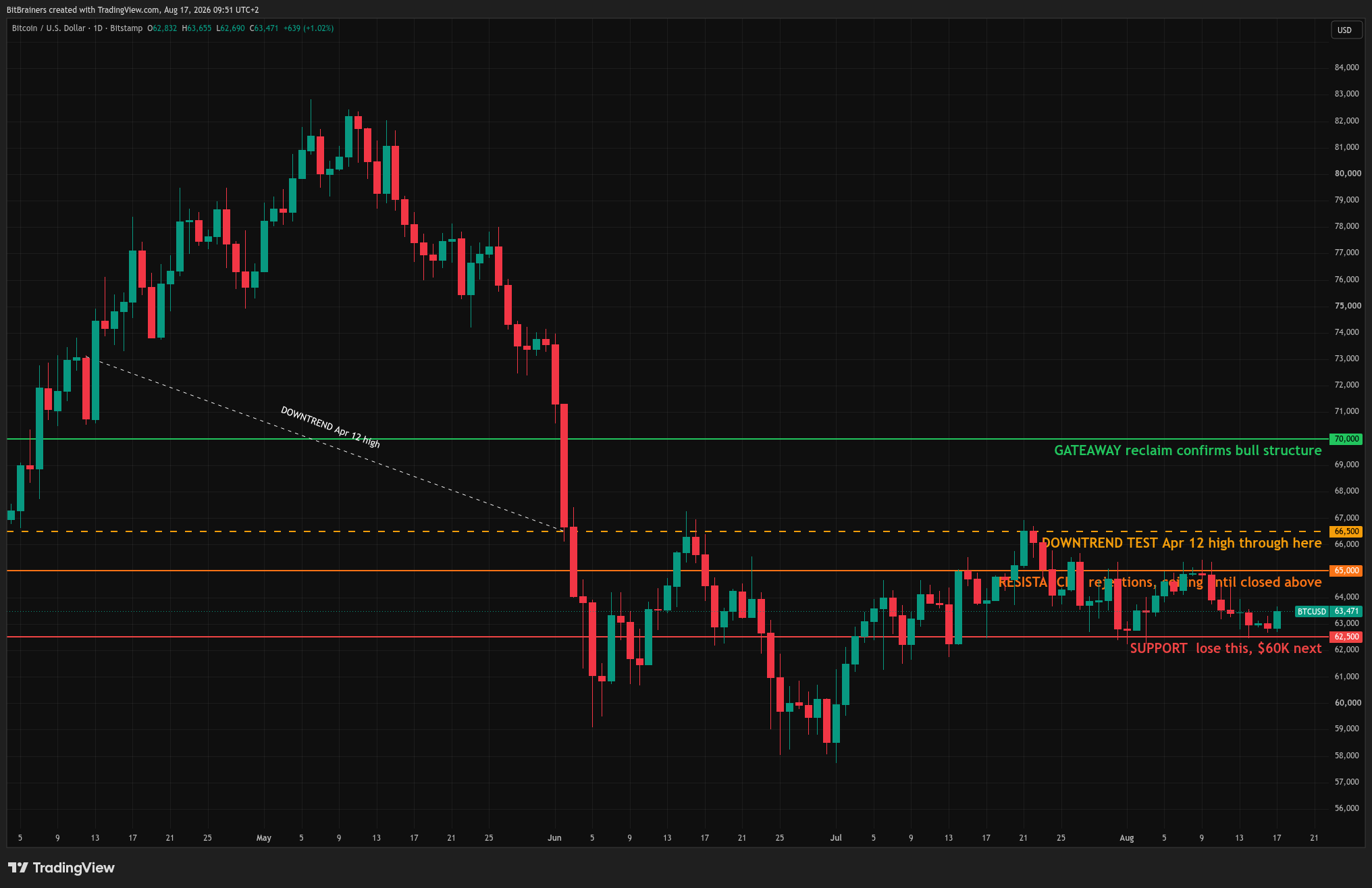
Bitcoin daily chart August 2026 showing compression between $62,500 support and $65,000 resistance.

By BitBrainers Editorial

Bitcoin has spent eleven days inside the same $62,600–$65,000 range and the market is waiting for Wednesday's FOMC minutes to provide a directional catalyst.

Support at $62,600 has been defended multiple times over the past two weeks. Resistance at $65,000 has produced three separate rejections. The structure is clean compression, not distribution.

The derivatives picture shows de-risking rather than bearish positioning. Open interest declined over the past week while price stayed flat. Funding rates are moderate. The market is not crowded long and not aggressively short. It is waiting for a macro trigger.

That trigger arrives Wednesday at 2:00 PM ET, when the Federal Reserve releases the minutes from its July 28–29 meeting. Three members dissented in favor of a rate hike. The language in those minutes around inflation, the neutral rate, or September guidance will move risk assets within minutes of release.

For holders, the priority is whether the $62,500 floor holds through the FOMC release and into the Jackson Hole symposium next week. If it does, the next test is $65,500. If it does not, the correction extends toward $60,000.

The full breakdown of this range, including the annotated TradingView chart with the four key levels, the Coinglass liquidation heatmap showing the $1.1 billion long exposure below $65K and the $750 million short cluster above $68K, the open interest and funding rate analysis, the Deribit Max Pain data for the September quarterly, the ETF flow breakdown with IBIT concentration data, and the complete macro calendar through Jackson Hole, is available in this week's BitBrainers Weekly Briefing.

Get the Weekly Briefing — $9/month, cancel anytime

Tools: Kraken for trading. Trezor for storage.

This is market commentary, not financial advice. Nothing here is a recommendation to buy or sell any asset. Do your own research.

Sunday, August 16, 2026

Morgan Stanley Bought More Bitcoin the Same Week Galaxy Cut the CLARITY Act to 10%

Morgan Stanley Bought More Bitcoin the Same Week Galaxy Cut the CLARITY Act to 10%

Morgan Stanley headquarters, Times Square. Photo: Ajay Suresh / Wikimedia Commons (CC BY 2.0)

By BitBrainers Editorial

Morgan Stanley increased its position in BlackRock's IBIT by 23% in its Q2 2026 13F filing, bringing its holdings to roughly 16.5 million shares. The firm also carries $43.3 million in its own Morgan Stanley Bitcoin Trust, a line item nobody is talking about because it is smaller and less exciting than the BlackRock number. Combined bitcoin and ether ETF inflows hit roughly $1.1 billion in the first week of August, the strongest since April. Real money moving through regulated wrappers while retail sentiment sits somewhere between bored and terrified.

The same week, Galaxy Digital cut its odds on the CLARITY Act passing to 10%.

My read is that the buy side is not confused. They are just looking at a different chart. The allocators are reading the price. The oddsmakers are reading the calendar. Neither is wrong.

BitBrainers Weekly Briefing

One email every Monday. Market structure, key levels, on-chain signals, positioning notes. No hype.

Subscribe — $9/month

Cancel anytime. No questions.

What the Buy Side Sees

Bitcoin trading near $63,000 against an October 2025 high of $126,000 looks like half off. Institutional allocators have never once in the history of allocators been shy about buying something at half off when the long thesis has not changed for them internally. Whether the long thesis should have changed after a 50% drawdown is a separate question. Nobody on a trading desk gets paid to answer it honestly. That's a strategist's job, and strategists do not run the allocation meetings.

The ETF structure does real work here. Custody is handled. Compliance is handled. The CFO does not need to explain seed phrases to the audit committee or firmware updates at 2 AM. It's just a ticker symbol behaving like every other ticker symbol on the desk. That is why the wrapper matters. It turns a protocol into a line item.

What the Oddsmakers See

Predictably, the people pricing regulatory odds are reading a completely different chart. Galaxy's 10% number on CLARITY is not pulled from nowhere. The Senate calendar keeps sliding. The House already passed its version in July 2025. An SEC that just canceled its own rulemaking vote on August 14 — over what it called a "scheduling issue" — does not inspire confidence that the bigger legislative piece moves any faster.

Ten percent. Not "still possible." Technically alive.

For readers who have not followed the legislative thread, the CLARITY Act is the bill that would draw the jurisdictional line between the SEC and CFTC for digital assets. It would tell issuers, exchanges and custodians which regulator actually owns their filing. Without it, the industry operates on staff guidance and enforcement actions, both of which can be reversed by the next chairman with a memo.

Wednesday's Meeting

None of this waits for Wednesday, August 19. Trump is scheduled to meet with the CEOs of Coinbase, Ripple, Gemini and Robinhood, alongside the sitting SEC and CFTC chairs, at the Eisenhower Executive Office Building. Treasury Secretary Bessent and Commerce Secretary Lutnick may sit in depending on scheduling that day.

The meeting will not produce a bill, a vote or a finalized rule. It is a conversation dressed up with enough titles in the room to sound bigger than it is. The CFTC's Innovation Advisory Committee holds its inaugural meeting the very next day, August 20, which puts two rooms full of important people talking this week and zero rooms producing anything that changes an actual filing requirement.

You have read enough of these readouts to know how this goes. A photo. Some language about "constructive dialogue." A policy priority list that reads like it was written by committee, because it was.

If the CLARITY Act fails to pass before the Senate adjourns, the executive agencies will keep moving on parallel tracks. The SEC and CFTC have already been doing this — see the canceled vote and the new advisory committee as evidence. But agency rules can be challenged in court and reversed by future administrations. A statute would survive election cycles. At 10% odds, that durability is not coming soon.

The Stablecoin That Quietly Broke

Somewhere in the middle of all this, a stablecoin broke. Neutrl paused minting and redemptions on its NUSD token, roughly $53.6 million currently locked, over reserve issues the protocol has not actually explained yet. Neutrl's Twitter account has 847 followers. Most of them are bots. No confirmed insolvency. No confirmed fraud. Just silence where an explanation should be.

Silence is its own kind of answer, if you have sat through enough of these freeze-first, explain-later, sometimes-never events.

Not the biggest number this week. Still the one real security story, buried under two much louder macro headlines.

Levels to Watch

Bitcoin has been stuck between $62,000 and $66,000 for five weeks now, going nowhere with real conviction in either direction. That is a signal on its own, even if "the market is bored" is not a thesis anyone gets to publish with a straight face.

Watch $62,000 as the floor. It has held through two separate rounds of bad regulatory news this month already. Below that, the next real test is lower, and probably uglier than this one. Above $66,000, the range finally breaks and some of that ETF money sitting on the sidelines has an actual reason to move.

My personal opinion is that $62,000 holds until something actually breaks, not just until someone tweets about it.

We will update after the White House readout on Wednesday.


Get the Weekly Brief

One email. Monday morning. The stories that actually move your bitcoin's security, not just its price.

Subscribe

Sources

Yahoo Finance Morgan Stanley, JPMorgan Increase Crypto ETF Holdings

CoinDesk Trump Expected to Attend White House Meeting With Crypto CEOs

The Block Bitcoin, Ether ETFs Draw $1.1 Billion in Best Inflow Week Since April

Galaxy Digital / Alex Thorn CLARITY Act odds cut to 10%, August 2026

Blockhead SEC Cancels Friday's Regulation Crypto Vote

DeFi Llama Neutrl NUSD Protocol Data

Tools: Kraken for trading. Trezor for storage.

This is market commentary, not financial advice. Nothing here is a recommendation to buy or sell any asset. Do your own research.
Weekly Brief: The War Reached the Ten-Year. Bitcoin Answered the Yield

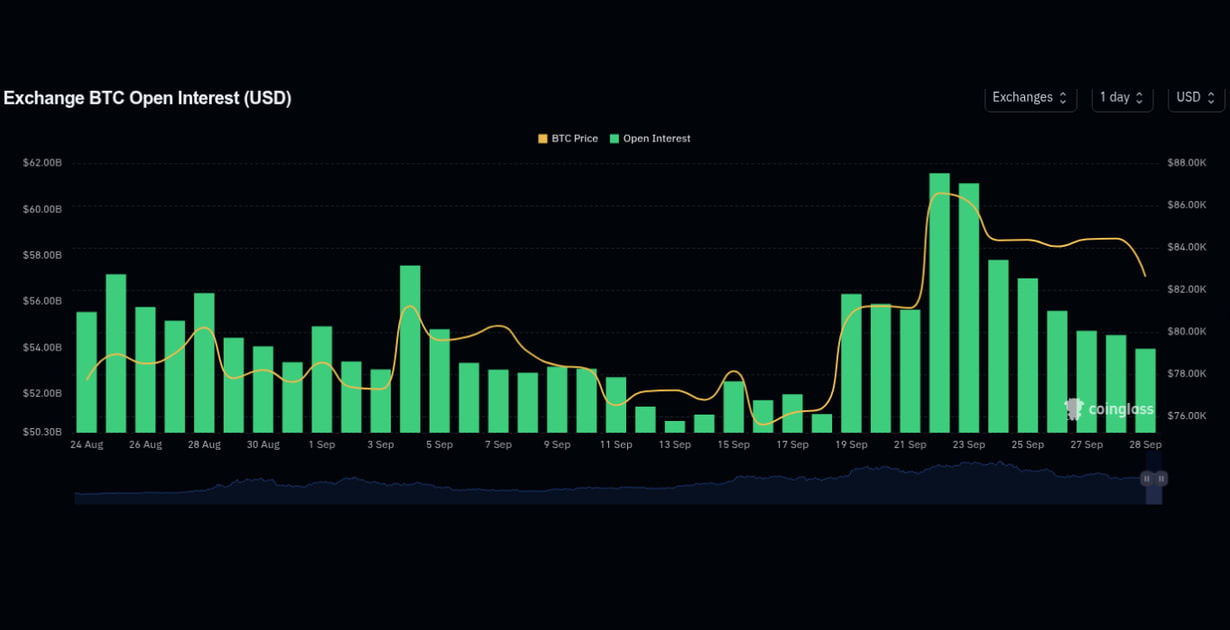
Bitcoin futures open interest, CoinGlass, late Aug to Sep 28, 2026. Peaked near $61.5B on Sep 22, stepped down through the pullback. Sourc...

Weekly Brief: The War Reached the Ten-Year. Bitcoin Answered the Yield