Saturday, August 22, 2026

The SEC Filed a Rule While Congress Was on Vacation

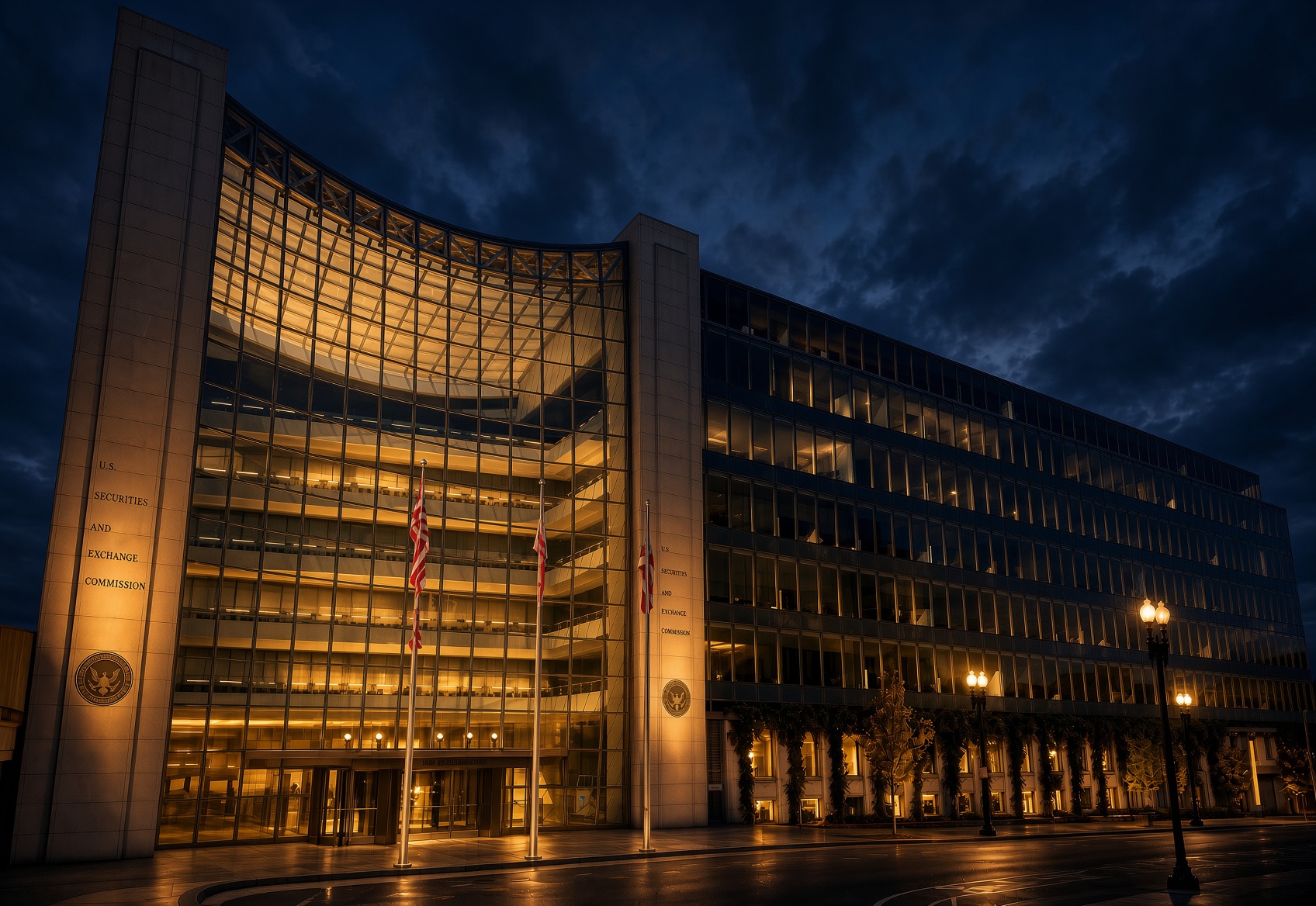
SEC headquarters at night - Regulation Crypto Assets proposal August 2026

By BitBrainers Editorial

The SEC proposed Regulation Crypto Assets on August 18 while Congress was already gone for summer recess. The CLARITY Act's cloture motion filed August 7 sits parked until a procedural vote on September 15 if it even happens. Congress stopped moving. The SEC moved instead. That is the only story that matters.

What's actually in it

The proposal contains three pieces. A startup exemption lets projects raise up to $5 million over four years without full registration. A fundraising exemption goes to $75 million per year with more paperwork. A conditional safe harbor lets a token exit investment-contract status once the issuer stops the managerial work it promised. That last piece is imperfect and self-serving, but it's real progress after a decade of enforcement theater. The 60-day comment period runs to October 20. Treat it as a formality. The SEC already knows the direction it's going.

What Atkins said

Chair Paul Atkins called it "minimum effective dose, maximum freedom to build, and durable clarity under existing law." It's a better pitch than anything Gensler ever offered, and he still admitted Congress needs to pass something lasting. An SEC rule can be erased by the next chair the same way this one is undoing the last regime. This package is a temporary bridge built by people who no longer trust the legislature to finish the road, and they're right not to trust it.

The Senate isn't coming

Senators left town without advancing CLARITY. The cloture motion needs 60 votes in a chamber where Republicans hold 53. Nothing has changed in three weeks and nothing will change before September 15. Anyone still waiting for Congress to deliver market-structure legislation is performing optimism, not reading the calendar.

Two regulators building the real framework

CFTC Chairman Mike Selig told his Innovation Advisory Committee the agency will not sit idle. If CLARITY stalls, the CFTC will use existing authority to write its own crypto rules. Atkins is doing the same from the SEC side. This is two agencies racing to plant flags because the bill is the most likely to never pass. Regulatory clarity in crypto has always arrived as a turf war dressed up as policy, and we are watching the next round begin in real time.

Political theater

Brian Armstrong went on CBS the day before the proposal and endorsed CLARITY. Trump backed the bill at a White House meeting. None of it moves a single vote or advances the schedule by a day. Political statements and floor votes are different animals, and only the floor vote is real.

Illinois shows the same pattern

The Crypto Council for Innovation and the Blockchain Association sued Illinois over its 0.2 percent tax on every digital-asset transaction, transfer, or storage event. The tax is crude and will almost certainly face serious constitutional problems. When Congress refuses to act, states and agencies fill the vacuum with whatever authority they already have, and more of that is coming.

This is the same pattern we saw on August 19 when the Treasury was forced to double long-term debt buybacks to calm a 19-year yield high. Washington agencies are stepping in because the legislature has stopped. We flagged the FOMC deadlock and the CLARITY Act stall in the August 17 Weekly Brief. The SEC proposal is the next logical move in that sequence.

By the time senators return the SEC will have a fully commented framework that can function as a standalone regime if Congress fails, the CFTC is preparing its own parallel version, and the market will operate under agency-made rules that can be rewritten by the next administration layered on top of a growing patchwork of state taxes and restrictions.


BitBrainers Weekly Briefing

One email every Monday. Market structure, key levels, on-chain signals, positioning notes. No hype.

Subscribe $9/month

Cancel anytime. No questions.

Sources

SEC Regulation Crypto Assets Proposal

Reuters US SEC Proposes New Rules for Crypto Assets

CoinDesk U.S. SEC Proposes First Major Crypto Rule in Surprise Announcement

CBS News Coinbase CEO Says CLARITY Act Will Protect Crypto Users From Another FTX Collapse

Tools: Kraken for trading. Trezor for storage.

This is market commentary, not financial advice. Nothing here is a recommendation to buy or sell any asset. Do your own research.
Friday, August 21, 2026

Bitcoin Surges 27% in Four Days, Best Weekly Gain Since March 2024

Bitcoin 4-day rally August 2026

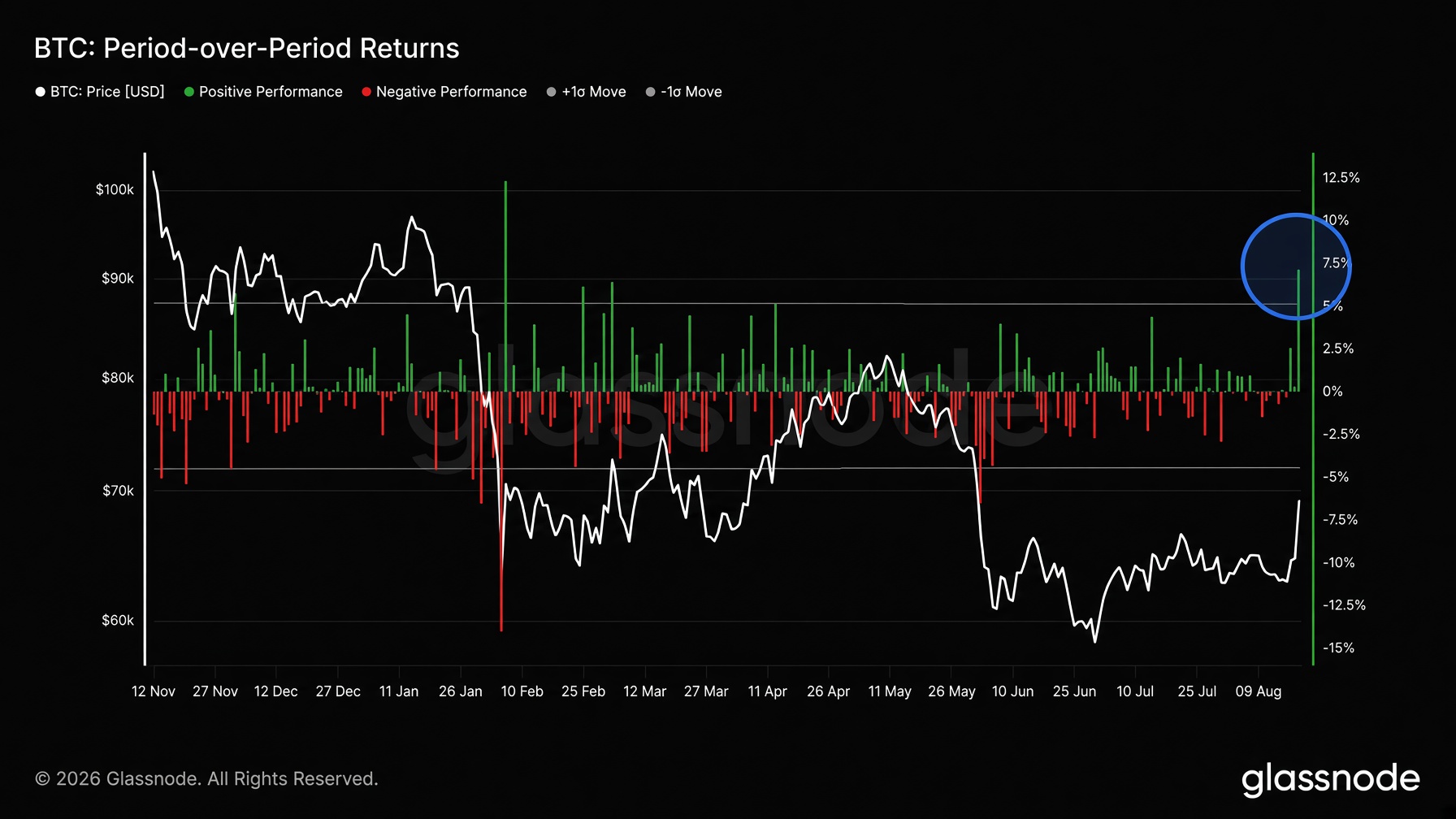
Bitcoin’s August 19 close was a 5.8-sigma move against 30-day volatility, the largest upside spike since October 2023, and it occurred without a prior crash. Glassnode.

By BitBrainers Editorial

Bitcoin touched $79,500 intraday on Thursday, then settled back near $76,800 by Friday. Four sessions earlier it was sitting at $62,687. That is roughly a 27 percent range from low to high in four trading days, and the best weekly gain since March 2024.

The Treasury lit the match

On August 19, Treasury Secretary Scott Bessent announced the department would at least double its liquidity support buybacks for 10, 20, and 30 year Treasury bonds, from $2 billion to $4 billion per operation. He told CNBC the figure could go higher. The operations start September 9 and run through November 4.

The 30 year yield had hit a 19 year high two days earlier, the highest since 2007, while U.S. debt crossed $40 trillion. Treasury stepped in because the bond market was genuinely under pressure. The buyback was reactive. No one had it on a calendar.

Yields dropped to about 4.64 percent on the announcement. By Wednesday they had climbed back above 4.7 percent. The dollar weakened and gold rallied on the same signal. This was a liquidity and dollar trade, and bitcoin got carried along same as gold did.

A move with no crash behind it

Glassnode measured the August 19 spike at 5.8 sigma against 30 day volatility, the largest upside move since October 2023. The part that matters is what is missing from it. These moves usually follow a crash. Something breaks, price capitulates, then the snapback happens. None of that happened here. Bitcoin had been sitting bored in the $63,000 to $65,000 range the week before, intact but going nowhere.

CoinGlass put short liquidations at $3.1 billion across August 19 and 20, with bitcoin alone accounting for $1.65 billion. Thursday was the single largest day of short liquidations on record. By Friday the running two day total had climbed closer to $3.8 billion.

CryptoQuant showed short term holders, wallets under 155 days old, sending 43,300 BTC to exchanges at a profit. That was the largest profit-taking move of 2026 for that cohort. Their SOPR ratio hit 1.01, the highest reading since April. The shorts were squeezed and existing holders took profit into the move.

The Fear and Greed Index went from 46 to 62 in a single day. That is a mechanical flip, and it moved because the price moved. The price did not move because of the index.

What a 1932 market book has to do with this

There is an old observation from Robert Rhea's writing on the Dow Theory that fits this move uncomfortably well. Countertrend rallies inside a bear market tend to move faster and more violently than the decline they are reacting against, and they take less time to unfold than the move they are partially undoing. Speed fails to confirm a real trend change. Speed is the signature of a secondary reaction inside a larger downtrend when it finally lets go.

A four day, roughly 27 percent vertical move through several resistance levels matches that description on paper. Matching the description differs from confirming it. After watching retail traders get liquidated into violent rallies for the better part of five years, this pattern is familiar. Speed alone has never been the thing that separates a real trend change from a short covering event that ran out of shorts.

$67,000 or $80,000, and what actually decides it

The real question is whether spot demand shows up to replace the forced buying that got bitcoin here. Short covering creates no new buyers. It forces existing sellers to become buyers for a few days, and then it is done.

ETF inflows hit $517 million on August 19, which is a real number and also just one day. One day does not establish a trend.

What would actually confirm this: sustained ETF inflows across multiple weeks instead of one good print. STH-SOPR holding above 1 for consecutive sessions instead of spiking once and rolling back over. Bitcoin holding above the short term holder cost basis near $68,700 without a retest that fails. None of that has happened yet. It is an open question sitting on the table.

Evercore ISI's Krishna Guha called the Treasury move "a weak form of Operation Twist" that "changes almost nothing in terms of the fundamentals." $14 billion in expanded buyback capacity against $40 trillion in national debt is too small a number to fix anything structural. It is the kind of number that buys a few weeks of better sentiment, exactly what it has done so far.

The two dates that matter more than the candle

September 9 is when the expanded buybacks actually start. September 15 is the CLARITY Act's procedural vote in the Senate, which needs 60 votes and currently has 53 Republicans committed at best. Grayscale's head of research has called 2026 passage unlikely, citing the Senate calendar and the midterms eating up floor time.

A stall on either date could send this back toward the $67,000 to $70,000 zone fast. That is the same zone this whole move started from four days ago.

The headline number can be ignored for a week. What matters is whether ETF flows repeat instead of spiking once, whether STH-SOPR holds above 1 without a second sharp move, and whether September 9 and September 15 pass without reopening the yield pressure that started all of this to begin with.

BitBrainers Weekly Briefing

One email every Monday. Market structure, key levels, on-chain signals, positioning notes. No hype.

Subscribe $9/month

Cancel anytime. No questions.


Sources

Bloomberg Treasury buyback announcement, yield data, market commentary

Glassnode 5.8 sigma move measurement, on-chain volatility data

CoinDesk Short liquidation totals, ETF inflow figures

TradingView Price levels, technical chart data

CoinGlass Liquidation data, derivatives positioning

CryptoQuant Short-term holder exchange flows, SOPR ratio

Evercore ISI Krishna Guha commentary on Treasury operations

Grayscale Research CLARITY Act legislative outlook

Treasury.gov Buyback operation announcements

CNBC Bessent interview, yield reaction coverage

Tools: Kraken for trading. Trezor for storage.

This is market commentary, not financial advice. Nothing here is a recommendation to buy or sell any asset. Do your own research.
Thursday, August 20, 2026

Bitcoin Hit $72,000 After the Treasury Was Forced to Act

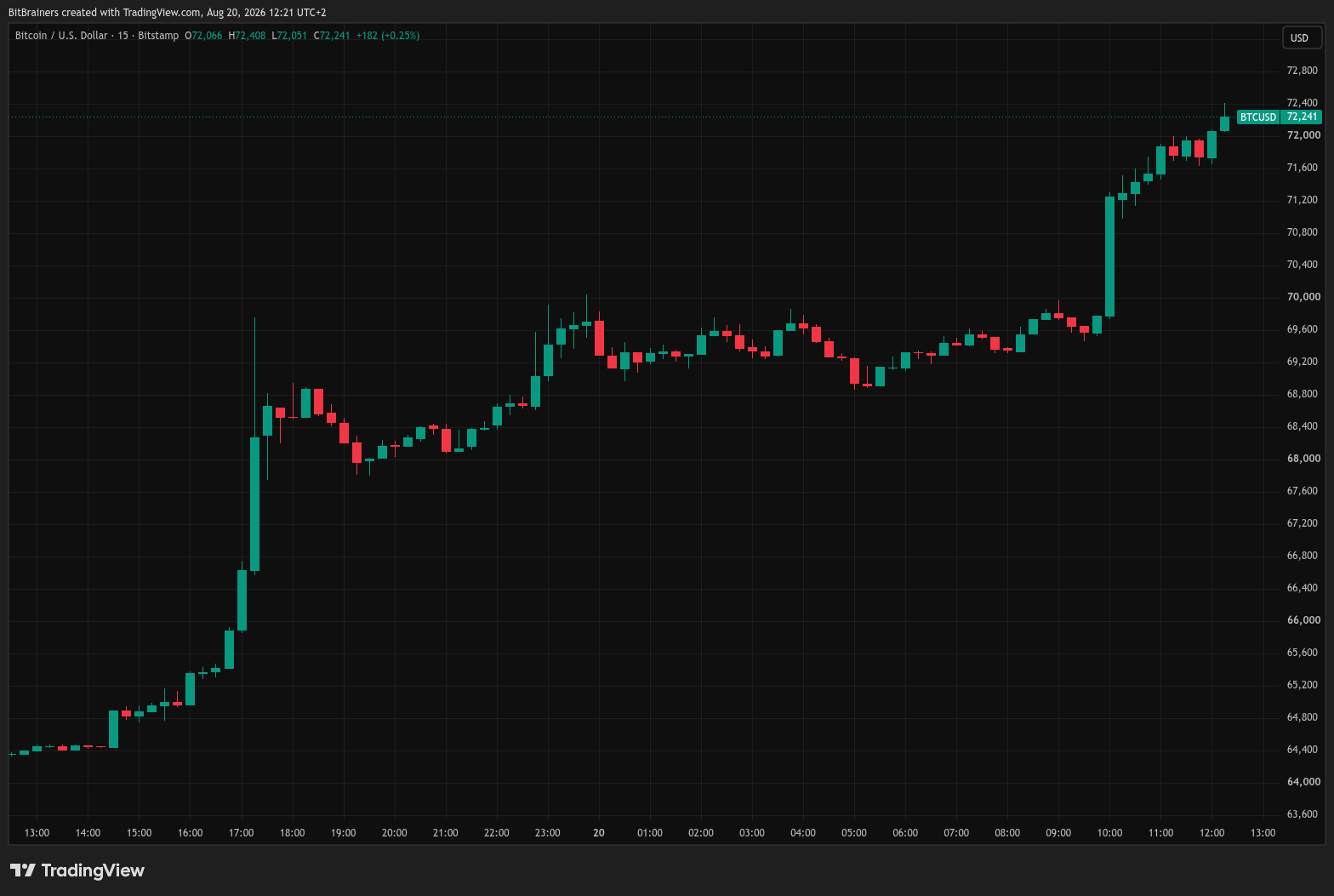
Bitcoin 15-minute chart showing August 19-20, 2026 surge to $72,000

Bitcoin / U.S. Dollar, 15-minute chart, August 20, 2026. BTC surged from $64,686 to $72,590. Source: TradingView

By BitBrainers Editorial

The 30-year Treasury yield hit a 19-year high on Tuesday. War fears and U.S. debt crossing $40 trillion pushed it there. The Treasury stepped in and doubled its long-term bond buyback operations from $2 billion to $4 billion or more per operation, effective around September 9. The buybacks target the 10-to-30-year segment, yields came back down to 5.18%. The debt problem is not solved, the can is just kicked further.

Bitcoin opened at $64,686 on Tuesday and ran to an intraday high of $69,749. Over $1 billion in Bitcoin shorts were liquidated. Some estimates put total crypto short liquidations at $2.7 to $3 billion. The 15-minute chart went near-vertical. The Treasury buyback was the match.

The move did not stop there. Bitcoin extended to $72,590 on Wednesday. This was follow-through, not a new catalyst. The heavy lifting happened on Tuesday. Wednesday was the market still working through the same impulse.

Washington Kept It Going

The White House crypto summit happened Tuesday afternoon. Trump met with Coinbase, Ripple, Gemini, Robinhood, Polymarket, and Kalshi executives, plus the SEC and CFTC chairs. The administration signaled it would move forward on crypto policy regardless of the CLARITY Act and floated possible sizable U.S. Bitcoin purchases. Supportive, but secondary. The Treasury move did the real work.

The SEC's "Regulation Crypto Assets" proposal, released on August 18, includes a conditional safe harbor where crypto assets can cease to be classified as securities, plus fundraising exemptions up to $75 million. The market is still digesting it as a potential structural shift. It sits behind the Treasury announcement in importance.

Crypto equities performed strongly. MSTR and COIN rallied alongside Bitcoin. ETF inflow momentum continued ($517 million on the 19th). All of that is just the same liquidity impulse showing up in different places.

What Happens Now

The question is whether $70,000 holds as support now that the forced buying has largely played out. Bitcoin is trading near $72,000. The former resistance zone between $65,000 and $66,000 is far below. If $70,000 holds on a retest, the path toward $75,000 to $80,000 opens. If it fails, the move was a liquidity grab and the range-bound conditions return.

The Treasury buyback expansion is scheduled to start September 9. That gives the market six weeks to price the liquidity injection. Long-term yields are the variable to watch. If the 30-year Treasury yield reverses because inflation data surprises to the upside, the Treasury's own operation becomes a source of pressure.

The BOJ is still tightening while the Fed leans the other way, and the Treasury just added long-end liquidity because the bond market forced the issue. The match was lit on Tuesday. The squeeze did the rest.

Sources

Bloomberg Treasury to Double Size of Long-Term Debt Buybacks

CoinDesk Bitcoin Short Liquidations, ETF Flow Data

TradingView BTC/USD Technical Data

Federal Reserve July FOMC Meeting Minutes, August 19, 2026

SEC Regulation Crypto Assets Proposal, August 18, 2026

Tools: Kraken for trading. Trezor for storage.

This is market commentary, not financial advice. Nothing here is a recommendation to buy or sell any asset. Do your own research.
Wednesday, August 19, 2026

Bitcoin Hit $69,700 Because the Treasury Moved First

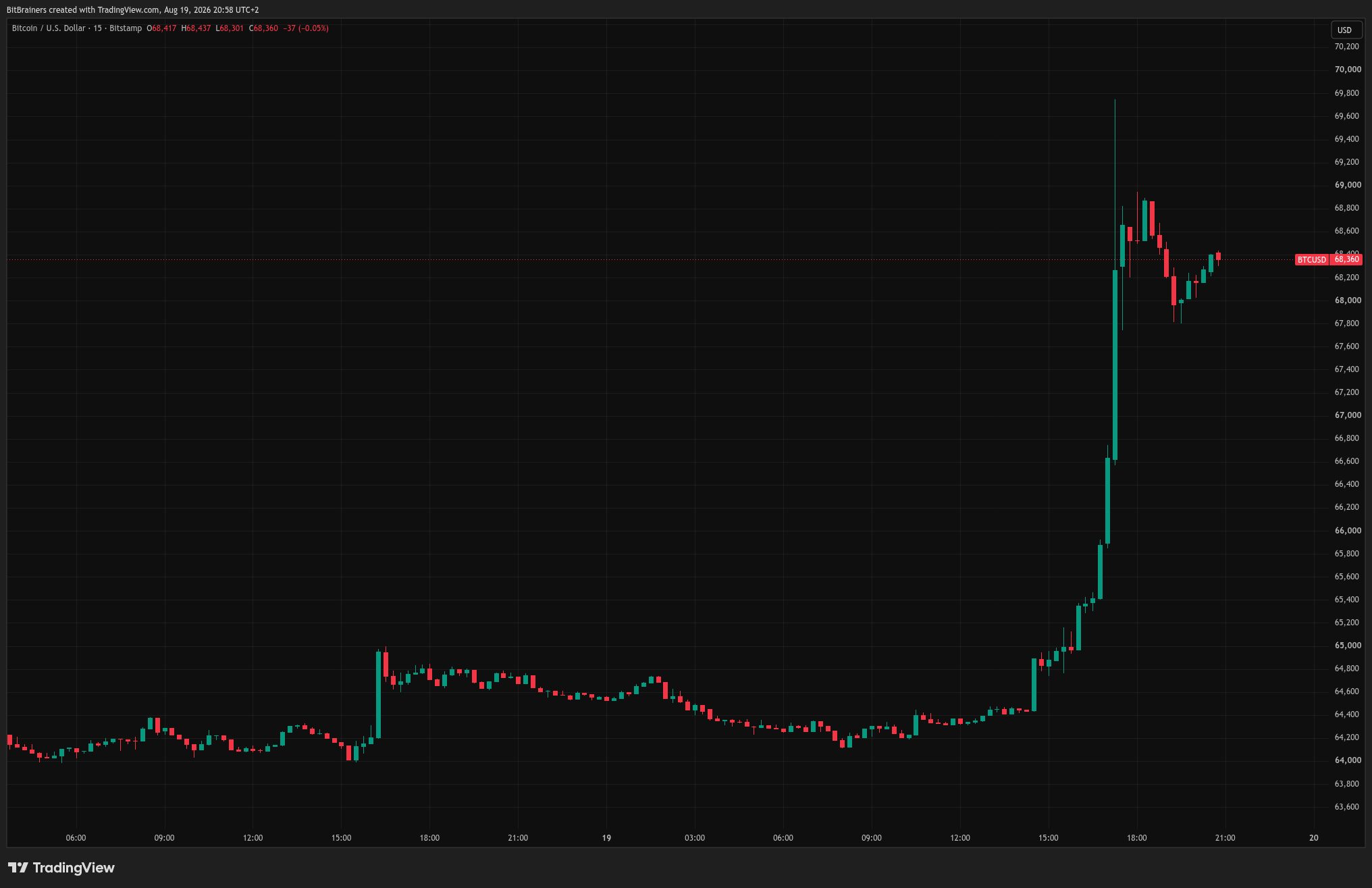
Bitcoin 15-minute chart showing August 19, 2026 surge

Bitcoin / U.S. Dollar, 15-minute chart, August 19, 2026. BTC surged from $64,600 to an intraday high of $69,749. Source: TradingView

By BitBrainers Editorial

Bitcoin opened at $64,686 on Tuesday and ran to an intraday high of $69,749. The move added roughly $100 billion in market cap in a matter of hours. Over $1 billion in short positions were liquidated, heavily skewed to the short side. The 15-minute chart looks like a vertical line. Everyone is crediting the White House crypto summit or ETF flows or some vague regulatory optimism. The actual move started in the Treasury market.

What the Treasury Did

The U.S. Treasury announced it would at least double the size of its long-term government debt buyback operations. The current $2 billion per operation will rise to $4 billion or more, effective around September 9. The buybacks target the 10-to-30-year segment of the curve. Long-term Treasury yields dropped sharply on the news. The 30-year yield fell from multi-decade highs. The dollar weakened. Risk-on sentiment returned across the board. Lower yields reduce the opportunity cost of holding non-yielding assets. Bitcoin, gold, and growth equities all rallied on the same mechanism. The Treasury did not call it quantitative easing. The market treated it that way anyway.

The Squeeze

Bitcoin had been stuck between $62,000 and $65,000 for weeks. The $65,000 to $66,000 zone was a hardened resistance level. When the Treasury news broke, BTC punched through that zone and kept going. Short covering created a feedback loop. Volume spiked. Forced buying from liquidated shorts amplified the move beyond what spot demand alone could have produced — the candle went near-vertical in minutes.

The White House Summit Was a Sideshow

The crypto summit happened this afternoon at 2:30 p.m. ET. Trump met with Coinbase, Ripple, Gemini, Robinhood, Polymarket, and Kalshi executives, plus the chairs of the SEC and CFTC. Nate Geraci reported that the administration has already decided to move forward on crypto policy regardless of the CLARITY Act. That is constructive for the medium-term regulatory environment. It did not move Bitcoin $5,000 in an afternoon. The Treasury did. ETF flows also reversed. After three straight days of outflows totaling roughly $248 million, Bitcoin ETFs posted $137.3 million in net inflows on August 17. Fidelity's FBTC led with $111.9 million. That is supportive. It is not the kind of flow that produces a vertical candle. The move was macro-driven, then amplified by derivatives.

The FOMC Minutes

The July FOMC minutes dropped this afternoon at 2:00 p.m. ET, half an hour before the summit. The meeting produced a 9-3 vote to hold rates at 3.50%–3.75%, with Hammack, Kashkari, and Logan dissenting for a hike. The minutes revealed the three dissenters were isolated. The broader committee acknowledged softer inflation and labor market data since the meeting. "Many" participants still flagged upside inflation risks. September policy remains data-dependent.

What Happens Next

The Treasury buyback expansion is scheduled to start September 9. That gives the market six weeks to price the liquidity injection before it actually begins. Long-term yields are the variable to watch. If the 30-year Treasury yield continues to fall, the risk-on environment has legs. If yields reverse because inflation data surprises to the upside, the Treasury's own operation becomes a source of pressure. Bitcoin is now trading near $68,200, having pulled back from the $69,749 high. The former resistance zone between $65,000 and $66,000 needs to hold as support on any retest. Bitcoin's 30-day correlation to the Nasdaq has stayed above 0.7 for most of the past three months. BTC remains a risk asset trading on dollar liquidity conditions. The BOJ is tightening into a Fed that wants to cut, and now the Treasury is injecting liquidity into the long end.

BitBrainers Weekly Briefing

One email every Monday. Market structure, key levels, on-chain signals, positioning notes. No hype.

Subscribe $9/month

Cancel anytime. No questions.

Sources

Bloomberg Treasury to Double Size of Long-Term Debt Buybacks

Bitcoin Magazine Treasury Buybacks and Bitcoin Price Action

CoinDesk Bitcoin Short Liquidations, ETF Flow Data

Federal Reserve July FOMC Meeting Minutes, August 19, 2026

TradingView BTC/USD Technical Data

BitBrainers Japan's Nikkei Drops for a Second Day as Bond Yields Spike

Tools: Kraken for trading. Trezor for storage.

This is market commentary, not financial advice. Nothing here is a recommendation to buy or sell any asset. Do your own research.
Japan's Nikkei Drops for a Second Day as Bond Yields Spike

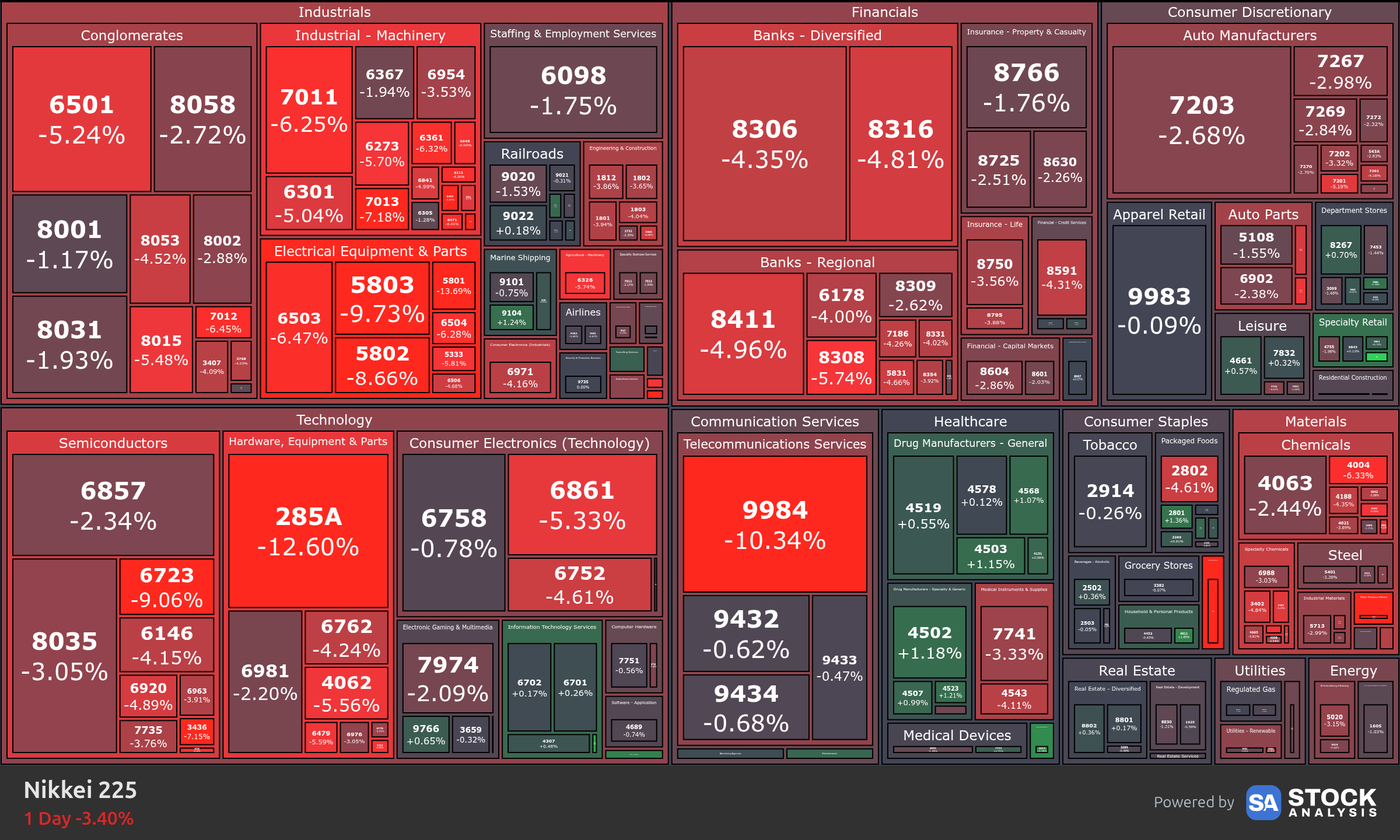
Nikkei 225 constituents heatmap showing broad-based selling across Japanese sectors

Nikkei 225 constituents heatmap, August 19, 2026. Broad-based selling across financials, industrials, and technology sectors. Source: stockanalysis.com

By BitBrainers Editorial

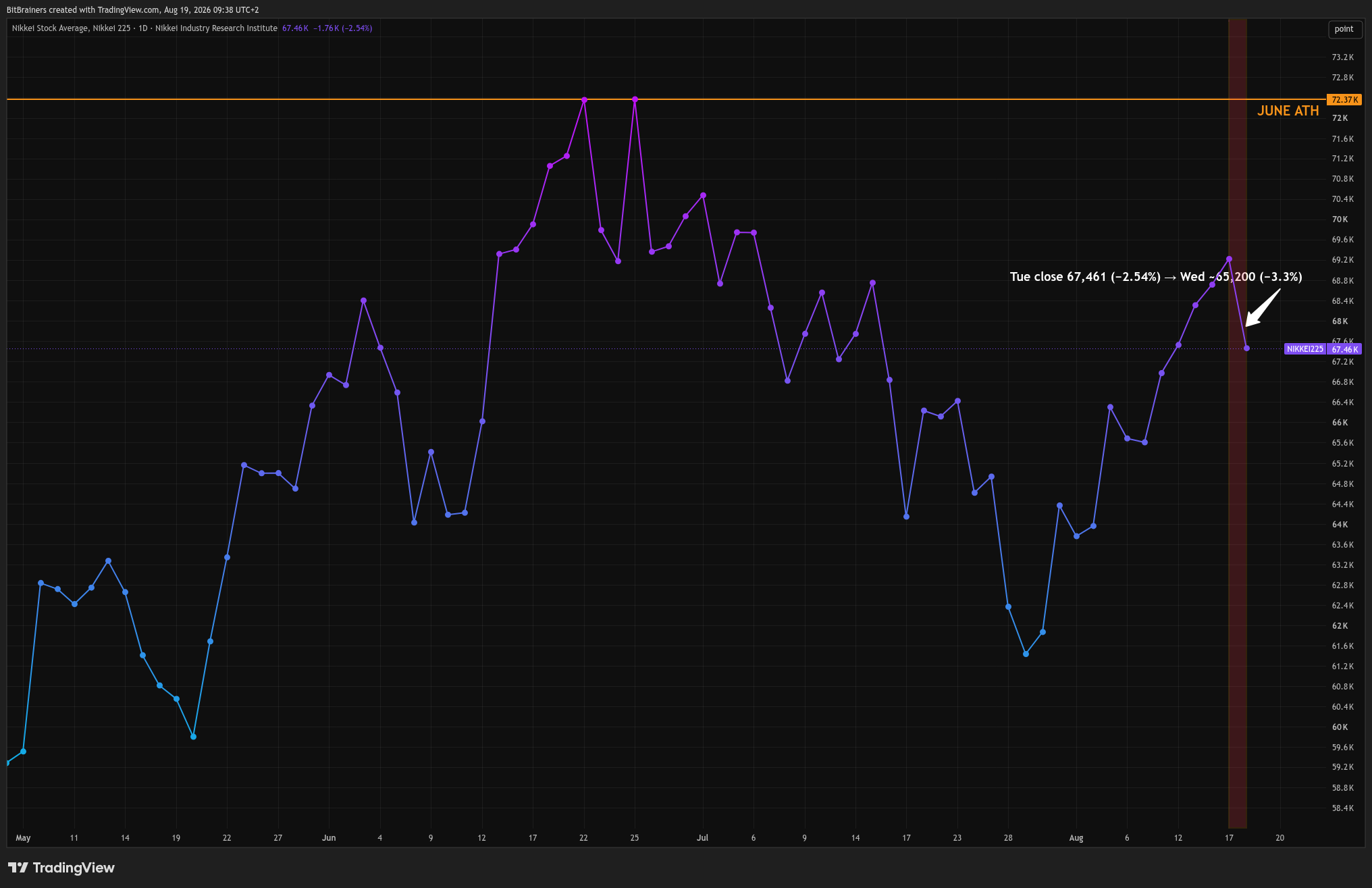
Japan's Nikkei 225 dropped 2.54% on Tuesday, closing at 67,460.73. On Wednesday the selloff accelerated. The index is trading near 65,200, down roughly 3.3%. The all-time high of 72,366.34, set in June, is now about 10% away. Over two sessions, Japanese equities have shed an estimated $220 to $230 billion in market value, per Bloomberg and Nikkei Asia calculations. The index remains up roughly 52% year-over-year. The base was never weak. The speed of the unwind matters for leveraged accounts and yen carry positions that some estimates put in the $300 to $500 billion range.
Nikkei 225 daily chart showing August 19, 2026 selloff

Nikkei 225 daily chart, August 19, 2026. The index dropped 3.3% to near 65,200. Source: TradingView

What the Bond Market Is Saying

Japanese government bond yields are at levels last seen roughly 30 years ago. The 10-year JGB yield eased to 2.90% on Wednesday from 2.94%. The 2-year yield hit approximately 1.694% on August 18 and sits near that level. The Bank of Japan owns roughly 54% of outstanding JGBs. The debt-to-GDP ratio is 250%. Domestic life insurers are sitting on close to $200 billion in unrealized bond losses, per Nikkei Asia reporting this week. The BOJ wanted to normalize policy. The market is now testing how far that normalization can go before something breaks.

The BOJ Has No Clean Exits

Hiking rates further would accelerate carry-trade unwinds and torch pension funds that hold long-duration bonds. Selling U.S. Treasuries to defend the yen would push U.S. yields higher at a time when the Treasury is already issuing heavily to fund deficits. Leaning on the Federal Reserve's FIMA repo facility would supply dollars to buy yen, but that mechanism expands the Fed's balance sheet and U.S. inflation expectations rise with it. After watching this policy cycle for years, my conclusion is that each path has a concrete second-order effect that makes the underlying problem worse. There is no configuration where the BOJ normalizes, the yen stabilizes, and global liquidity stays calm.

Metaplanet's Move

On Tuesday, Metaplanet contributed 2,100 Bitcoin — less than 5% of its roughly 43,000 BTC treasury and subject to a five-year lock-up, to acquire a controlling stake in Super League, a Nasdaq-listed gaming shell that will be renamed Superplanet, in a transaction valued at roughly $134.6 million. This looks like one corporate treasury trying to get dollar-denominated exposure outside yen volatility. One deal does not prove a broad trend. It is worth watching whether more Japanese corporates follow.

BitBrainers Weekly Briefing

One email every Monday. Market structure, key levels, on-chain signals, positioning notes. No hype.

Subscribe $9/month

Cancel anytime. No questions.

What Happens Today

The FOMC July meeting minutes drop at 2:00 p.m. ET. The meeting produced a 9-3 vote to hold rates, with Hammack, Kashkari, and Logan dissenting in favor of a 25-basis-point hike. That is the first three-way same-direction dissent since September 2016. The White House crypto summit follows at 2:30 p.m. ET. Trump is scheduled to meet with CEOs from Coinbase, Ripple, Gemini, and Robinhood, plus the chairs of the SEC and CFTC. Treasury Secretary Bessent and Commerce Secretary Lutnick may attend. Senator Cynthia Lummis has scheduled the CLARITY Act for a Senate vote on September 15 at 2:00 p.m.

Bitcoin and the Dollar

Bitcoin is trading near $64,300, stuck in a $62,000 to $65,000 range for the past week. The Japanese stress is a supply-side shock to global dollar liquidity. The BOJ is tightening into a Fed that wants to cut. That tension creates messy conditions for risk assets. Bitcoin's 30-day correlation to the Nasdaq has stayed above 0.7 for most of the past three months. When dollar liquidity gets squeezed, both tend to move in the same direction. The leverage is in Tokyo.


Sources

Nikkei Asia Nikkei 225 market data, JGB yields, life insurer unrealized losses

Bloomberg Japanese equity market cap calculations

TradingView Nikkei 225 technical levels, JGB yield data

Bank of Japan JGB holdings, debt-to-GDP statistics

Globe Newswire / StockTitan Metaplanet Super League transaction

BitBrainers Metaplanet Just Bought a Gaming Company's Stock Ticker With Bitcoin

Tools: Kraken for trading. Trezor for storage.

This is market commentary, not financial advice. Nothing here is a recommendation to buy or sell any asset. Do your own research.
Weekly Brief: The War Reached the Ten-Year. Bitcoin Answered the Yield

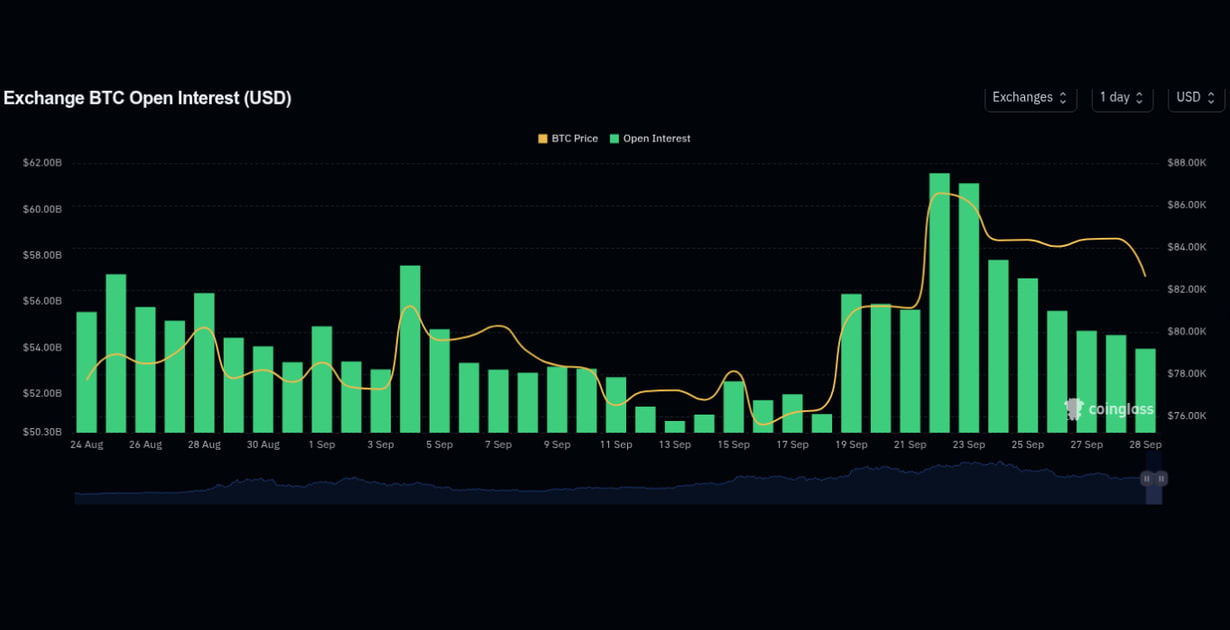
Bitcoin futures open interest, CoinGlass, late Aug to Sep 28, 2026. Peaked near $61.5B on Sep 22, stepped down through the pullback. Sourc...

Weekly Brief: The War Reached the Ten-Year. Bitcoin Answered the Yield