By BitBrainers Editorial
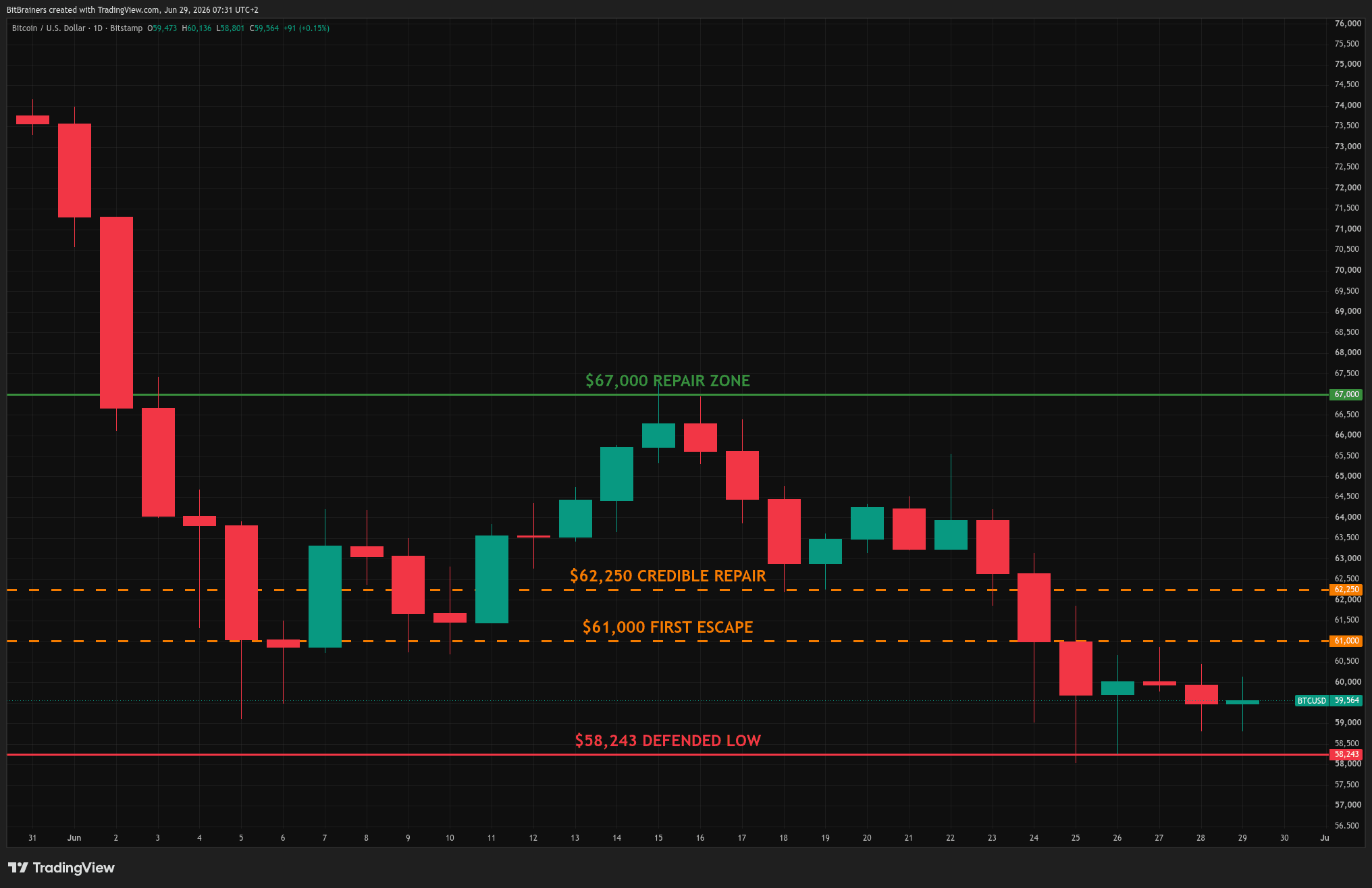
Bitcoin closed the week below $60,000 for the fifth straight day, sitting on a $58,243 low that buyers have defended since Wednesday. Volume on the way down kept thinning. A Friday options expiry that everyone thought would yank price toward $72,000 did nothing of the sort. And the most interesting thing about all of it is that none of it was caused by a crypto problem.
Where Bitcoin Actually Closed The Week
The range tells the story without needing a narrative. BTC opened Monday around $63,000, slipped through midweek as hot inflation data hit, made a $58,243 low on Wednesday, bounced toward $60,500, and faded back. Five sessions, one defended floor, no decisive break. The $10 billion Deribit quarterly expiry on Friday cleared with max pain at $72,000 and spot at $59,500. Nothing pinned. Nothing pulled.
What did move: ETF outflows kept bleeding, with combined US spot crypto ETF assets falling from roughly $104 billion to $94 billion over the past few weeks. Fear and Greed sat in extreme fear all week, ticking from 13 to 18 by Sunday, which is the kind of marginal improvement that means buyers are exhausted, not that anything has turned. Realized losses ran around $1.35 billion per day. The bleed is real. It is just slow.
Why This Bear Has No Crypto Trigger
Every prior Bitcoin bear had a crypto-native cause. 2011 was the Mt Gox hack. 2013 was the China PBoC ban. 2018 was the ICO bubble unwinding. 2022 was Luna collapsing and FTX going under. Each one had a moment, an event, a date on a Wikipedia page.
This one does not.
What pushed Bitcoin from $73,000 to $58,243 over the last two weeks was a hot PCE inflation print, a Fed that may now be re-hiking instead of cutting, and capital rotating into AI infrastructure on a structural multi-year capex story. None of those are about Bitcoin. They are about every risk asset that ever borrowed against a low-rate liquidity backdrop. The shape of the chart looks like the prior bears. The cause looks like nothing the prior bears had.
One qualifier worth saying out loud. Spot ETFs are a new transmission mechanism that didn't exist in any prior cycle, and the outflows we've seen this month are crypto-specific in the sense that they show up directly in BTC sell pressure. That's not the same as a Mt Gox or an FTX, but it is a piece of plumbing the prior bears didn't have. Macro causes the risk-off impulse. The ETFs translate it into daily forced supply faster and more visibly than before.
That distinction matters because the playbook traders inherit from prior cycles assumes a known trigger and a known resolution. Mt Gox, ICOs, FTX, those all eventually washed through and the next leg began. There is no equivalent washout coming here, because there is nothing crypto-native to wash. The bottom, when it arrives, will not be marked by a single event. It will be marked by a quiet change in flow.
Macro Did The Work
The May PCE inflation report came in hot on June 25, headline 4.1% year over year, the highest reading since 2023. Markets repriced the odds of a December Fed rate hike to roughly 77%, with Bank of America now expecting three hikes in 2026 and Deutsche Bank modeling two starting as early as September. The day's print triggered around $1.48 billion in crypto-wide liquidations within 24 hours, Bitcoin alone taking roughly $665 million of that.
Underneath the inflation story, a quieter rotation is doing the structural damage. The five largest US hyperscalers have committed to spending about $725 billion on AI infrastructure in 2026, a 77% jump from the prior year. Nvidia is guiding to about $91 billion in revenue this quarter alone. AI-exposed names now account for roughly 45% of the S&P 500's market cap. Excluding AI, the rest of the index has barely moved since February. The growth capital that used to chase Bitcoin on good weeks is finding a different home, and until that flow reverses, BTC is bidding for a marginal buyer that is currently busy elsewhere.
This is the kind of read you get weekly.
No hype. No "this coin will 100x." Just honest macro on Bitcoin, gold, and the market.
The Absorption Question Is Still Open
The character of this leg down is what makes it worth watching, separate from the price. February took Bitcoin from the low $80,000s to $60,000 in five trading days on heavy volume, the kind of move that liquidates leveraged longs in bulk. This time, the same trip down took 26 days on a fraction of the volume, then bled another 11 days into the $58,243 low we are still defending.
Slower decline on lighter volume can mean absorption, the most leveraged sellers already cleaned out in February with less forced supply left to push. It can also mean buyers simply have no urgency, letting price drift lower because nothing is stopping them. The volume tells you effort is dropping. It does not tell you whose effort. An independent analyst at InvestingLive flagged the same read on Sunday, calling it a "bearish lower-value reset with early absorption, not confirmed accumulation." Same question, two desks, no answer yet.
What would settle it is a real reaction. A reclaim of $67,000 that holds with volume expanding behind it. Not a weak bounce that fades back into the range on light volume, no matter how relieved that bounce might feel.
Key Levels
| Level | Type | Significance |
|---|---|---|
| $67,000 | Repair zone | A reclaim and hold here on rising volume is what flips absorption from question to confirmation |
| $61,750 to $62,250 | Credible repair | Reclaiming this band starts to show value migration back toward the prior structure |
| $60,750 to $61,000 | First escape gate | The immediate ceiling. Above it, the score starts improving from bearish toward neutral |
| $58,115 to $58,400 | Defended low | Where buyers have shown up for five sessions. Losing it cleanly opens $55,000 |
What This Adds Up To
This is the first Bitcoin bear without a crypto-native cause and the first to happen with a major competing growth trade actively pulling capital the other direction. The drawdown is shallower than prior cycles. The character is slower. The drivers are macro and structural, not native to crypto. That does not make a bottom call. It changes the signal you should be watching for. Volume on the next meaningful bounce will say more than any of this week's headlines. Until something gives, the chart is asking a question, and nobody on either side has earned the answer yet.
Sources
CoinGecko. Bitcoin Price Today
InvestingLive. Bitcoin Analysis Over the Weekend, 28 June 2026
Reuters. May PCE Inflation Report and Fed Rate Expectations
Disclosure: This is market commentary, not financial advice. We hold Bitcoin. Always do your own research.