
₿ BTC Loading... via Binance

Monday, June 8, 2026

Extreme Fear Index at 8: The Last 3 Times This Happened, Here's What Bitcoin Did Next

BitBrainers - Extreme Fear Index at 8 The Last 3 Times This Happened Here's What Bitcoin Did Next

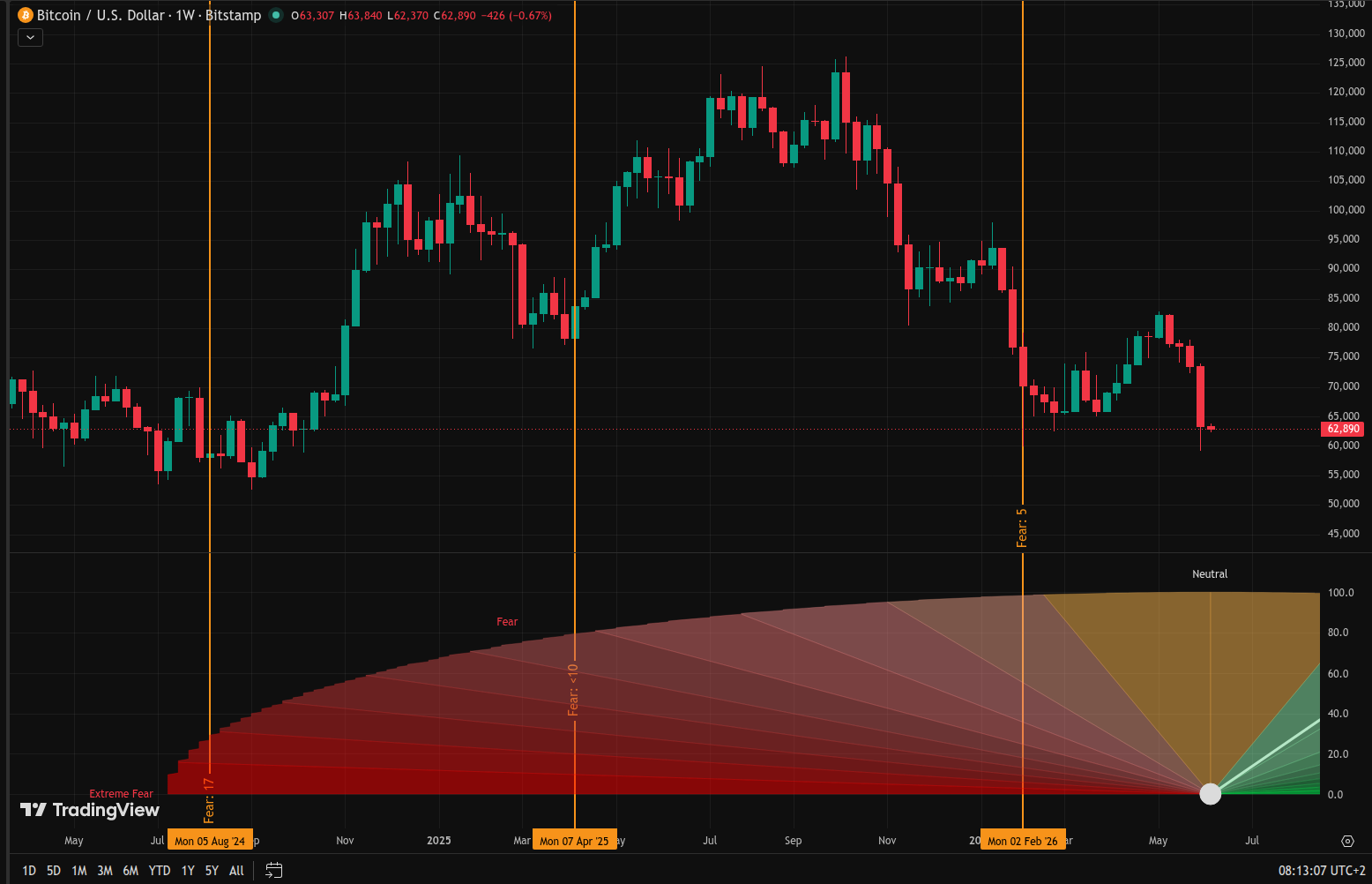
The Fear & Greed Index is sitting at 8. Not 28. Not 18. Eight. That is not a bad week. That is panic. That is people rage-selling at the bottom, closing longs they should have held, and swearing off crypto until the next bull run reminds them why they came back.

Friday, June 5, 2026

The AI Industry Needs Power. Bitcoin Miners Already Have It

BitBrainers - Bitcoin Miners Are the Power Landlords of AI. Bernstein Just Made It Official.

Bernstein published a research note this week that reframes two Bitcoin miners as something Wall Street has been struggling to name. The firm initiated coverage on TeraWulf and Cipher Digital with Outperform ratings and a label that might stick: "power landlords of AI."

The Thesis in Plain Terms

Bernstein set price targets of $36 for TeraWulf and $32 for Cipher Digital, projecting aggregate AI revenue across its Bitcoin miner coverage to grow ninefold from $1.2 billion in 2026 to $10.7 billion by 2030.

The logic is simple. Hyperscalers want sites that are fast to deploy, and building a data center from scratch often takes years. Miners already own the land, grid connections, and substations. That is the landlord position. The asset was secured before the tenant market showed up.

TeraWulf: The Numbers

TeraWulf holds a 3.8 gigawatt power portfolio built through brownfield site acquisitions. Bernstein projects AI revenue growing from $14 million in 2025 to $1.7 billion by 2030, with EBITDA margins reaching approximately 84%.

The company has contracted 643 gross megawatts to Fluidstack and Core42 under deals spanning 10 to 25 years, representing roughly $13 billion in total contracted revenue. Q1 2026 revenue came in at $34 million, with 60% already from HPC leases rather than Bitcoin mining. The pivot is not coming. It is already happening.

Cipher Digital: The Structure

Cipher Digital carries an $11.4 billion order book backed 67% by hyperscalers. Its triple-net lease structure shifts operating costs entirely to tenants, producing margins above 99%.

That is not a mining company. That is a real estate play with a crypto origin story.

Wall Street Was Already Here

Bernstein is not the first. Morgan Stanley initiated Overweight coverage on both firms back in February 2026 with price targets between $37 and $38. Jefferies followed in May with Buy ratings. When Bernstein's note dropped, the market reaction was muted. Much of the AI pivot optimism was already priced in.

Bitcoin miners have signed 17 deals worth over $110 billion in the past two years, contracting 6 GW of power to AI hyperscalers. This is not a new story. It is a story Wall Street is finally telling with confidence.

What It Means for Bitcoin

Miners with long-term contracted AI revenue are less dependent on Bitcoin price cycles. That is structurally good for the network. Operators with diversified income are less likely to capitulate and sell BTC during downturns. Hash rate stays stable. The network stays secure.

As demand for AI computing accelerates, securing reliable electricity at scale has become as strategically important as the chips themselves. Every institutional desk covering AI infrastructure now has a reason to look at miners and by extension at Bitcoin.

The Contrarian Read

The "power landlord" framing turns these firms into utilities with AI exposure. That is the bull case. The bear case is that the same framing will be used to justify equity raises. Build more capacity, sell the AI infrastructure story to new investors, dilute existing shareholders. The sector has run similar plays before under different labels.

Project financing markets are now covering 75 to 85% of construction costs for these facilities at interest rates well below what the underlying contracts generate, which limits immediate dilution risk but does not eliminate it.

The underlying assets are real. The execution risk is also real.

On The Radar

  • TeraWulf Q2 earnings — watch for AI hosting revenue as a separate line item and whether the 60% HPC mix holds
  • Cipher Digital order book updates — any new hyperscaler additions will confirm the $11.4B figure is growing, not just a headline
  • Hash rate vs. miner BTC sales — if AI revenue is covering operating costs, miners should be holding more Bitcoin rather than selling

Sources

The BlockThe power landlords of AI: Bernstein initiates coverage on TeraWulf and Cipher Digital

DecryptBitcoin Miners Emerge as Power Landlords of AI Boom: Bernstein

Investing.comBernstein initiates TeraWulf stock with Outperform on AI growth

BitBrainers. We check the facts so you don't have to.

Disclosure: This post may contain affiliate links. BitBrainers may earn a commission at no extra cost to you. This is not financial advice.

— BitBrainers Editorial

Wednesday, June 3, 2026

Bitwise Model Screams $224K Bitcoin as Sovereign Default Hedge

BitBrainers - Bitwise Model Screams $224K Bitcoin as Sovereign Default Hedge analysis and insights

Sovereign debt is not a niche problem anymore. It is the macro story sitting underneath every asset price right now, and Bitwise just ran the numbers on what it means for Bitcoin.

The figure they landed on: $224,000 per coin.

That is not a moonboy target pulled from a Telegram channel. That is the output of a valuation model built around one of the most serious structural risks in global finance. Whether you think it is realistic or not, you need to understand the logic, because it changes how you think about BTC's floor.

Sovereign Debt Fear Is Not Abstract, It Is Accelerating

Governments globally are running deficits that compound faster than their economies can grow. The U.S. alone is adding over $1 trillion to its national debt roughly every 100 days. That is not a 2025 problem. That is a now problem, and bond markets are starting to price it in.

When sovereign debt becomes a credibility crisis rather than an accounting issue, capital moves. It does not sit still. It rotates into assets that cannot be inflated away, and the historical rotation playbook includes gold, real estate, and increasingly, Bitcoin.

Bitwise's model essentially asks: if that fear deepens, what does BTC look like as a reserve-level hedge? The answer they built toward is $224,000.

The Model Is Not Predicting a Price, It Is Identifying a Condition

This is where most coverage gets lazy. Headlines scream "$224K Bitcoin" and readers imagine a price forecast. That is not what a fair value model does.

What Bitwise is saying is that under specific macro conditions, specifically deepening sovereign debt fears, BTC's fair value converges around that number. It is a conditional output, not a timeline. The condition is the variable.

Right now BTC is sitting at $66,136. That is roughly a $158,000 gap between current price and the model's fair value output. That gap either represents massive upside or massive model error. Figuring out which one requires you to take sovereign debt risk seriously as an input.

What Happens When a Country Actually Defaults

Here is the case study most people wave past when this topic comes up. When Argentina defaulted on its sovereign debt in the early 2000s, citizens watched their peso-denominated savings evaporate. The government froze bank accounts. People lined up outside banks unable to access their own money. It was not a theoretical risk. It was a Tuesday.

The citizens who had assets outside the peso system, held offshore, held in gold, held in anything not tied to Argentine sovereign credit, survived the crisis with purchasing power intact. Those who trusted the system got crushed.

Bitcoin did not exist then. It exists now. That is the entire argument in one paragraph.

The Bitwise model is not predicting Argentina-style collapse in the U.S. or Europe. It is modeling what happens to BTC demand if sovereign debt fears move from background noise to front-page dread. Even a partial rotation out of long-dated sovereign bonds and into hard assets moves Bitcoin's valuation dramatically.

Most People Do Not Know This About Bitcoin's Correlation With Debt Markets

Here is the part most crypto blogs skip entirely. Bitcoin's correlation with traditional risk assets like equities was a feature of the zero-rate era. When money was cheap, everything moved together because capital was chasing yield everywhere simultaneously.

That regime ended. Rate cycles have repriced risk across every asset class. In a high-rate, high-debt environment, Bitcoin's behavior starts to diverge from equities and converge with gold. Not perfectly. Not linearly. But the direction of drift matters for how you model BTC's role in a portfolio.

Bitwise's fair value framework appears to be built on this divergence. If BTC increasingly acts as a sovereign risk hedge rather than a tech-adjacent growth asset, its valuation inputs change completely. And most retail traders are still pricing it like it is a Nasdaq-correlated momentum trade.

The Contrarian Read Nobody Wants to Hear

Here is the angle that gets buried. If sovereign debt fear is the catalyst for $224K Bitcoin, then a resolution of sovereign debt fear is the catalyst for a massive BTC selloff. A credible U.S. fiscal consolidation plan, a surprise deficit reduction, a structural shift in government spending, any of these would deflate the exact thesis Bitwise is modeling.

Bitcoin is not inherently a $224,000 asset. It becomes one under specific macro stress. The same model that outputs $224K under fear conditions could output something much lower under stability conditions. That is not a reason to ignore the model. It is a reason to be honest about what you are buying when you buy BTC at these levels.

You are placing a bet on continued macro dysfunction. In 2025 and into June 2026, that has been a reasonable bet. But call it what it is.

This Week's Market Context Makes the Timing Interesting

Over the past 7 days, bond markets in several major economies have shown renewed volatility, with yields on long-dated government debt pushing higher as investors question the long-term trajectory of debt servicing costs. That is exactly the environment Bitwise's model treats as a precondition for BTC fair value expansion.

BTC at $66,136 is holding a level that has historically represented meaningful support. If the macro backdrop continues drifting toward sovereign stress rather than away from it, the distance between current price and the Bitwise model output starts to look less theoretical.

Holding BTC Through a Sovereign Crisis Requires Actual Cold Storage

If the thesis here is right, if BTC is your hedge against the financial system behaving badly, then holding it on an exchange defeats the purpose. An exchange is still inside the financial system. It is still a counterparty. It is still subject to regulatory action, bankruptcy proceedings, and operational risk.

A hardware wallet removes that counterparty entirely. Trezor is the standard recommendation for a reason. If you are holding BTC as a sovereign risk hedge and your keys are not in cold storage, you have not actually hedged anything. You have traded one systemic risk for another.

For actually executing buys in size, Kraken remains one of the more reliable platforms with genuine liquidity depth. That matters when you are not buying round numbers and timing matters.

The Assumption You Need to Drop Before Reading Another Price Target

Most people reading a $224K Bitcoin forecast assume the path there looks like the path to previous all-time highs. A bull run, a mania phase, retail FOMO, euphoric peaks. That is the wrong frame for what Bitwise is modeling.

A sovereign debt-driven move to $224K would look nothing like a speculative mania. It would likely be slower, more grinding, more contested, and accompanied by genuine macroeconomic pain. It would not feel like winning. It would feel like everything else losing. That is a fundamentally different psychological experience than watching Bitcoin rip in a bull market, and most traders are not mentally prepared for it.

The one thing to watch right now: Monitor 10-year and 30-year Treasury yields weekly. If long-duration yields continue rising despite rate expectations stabilizing, that is the sovereign debt fear signal Bitwise's model is built on. That spread behavior is your leading indicator, not BTC price action itself.


On The Radar This Week

The Bitwise $224K model is only valid if sovereign debt fear keeps accelerating. The next test is the U.S. Treasury auction cycle this week. Watch the bid-to-cover ratio on long-dated notes. Weak demand with yields pushing above 4.8% on the 10-year is the signal that institutional allocators are starting to price in what Bitwise is modeling.

Bitcoin is holding near $67,000 after the fear gauge posted its biggest single-day spike since the February crash. The $65,000 level remains the line that matters. A high-volume close below it opens the path toward $62,500. Above $70,000 the sovereign hedge narrative gains momentum fast.

BOJ decides June 15-16. Three board members voted for an immediate hike to 1.0% in April. Markets are pricing that at 64.4% probability. Watch USD/JPY on the evening of June 14. A sharp yen strengthening before the announcement is the carry trade unwind starting and historically that hits Bitcoin within hours.

The tokenized Treasury market crossed $1.5 billion in total AUM this week. If sovereign debt fear is the thesis, that number is the on-ramp being built in real time.

Sources
Cointelegraph. Bitcoin's $224K 'fair value' may emerge if sovereign debt fears deepen: Bitwise

BitBrainers. Follow the data, not the noise.


Disclosure: This post contains affiliate links to Trezor and Kraken. BitBrainers may earn a commission at no extra cost to you. This is not financial advice.

— BitBrainers Editorial
The AI Is Not Predicting a Bitcoin Crash. It Is Predicting You.

BitBrainers - AI predicting human behavior Bitcoin market analysis

Multiple AI models just flagged Bitcoin as a high-probability continuation breakdown. The target prices vary. The consensus does not. Every model trained on historical crypto data is currently pointing in the same direction: lower.

Before you act on that, you should understand what those models actually learned and where they consistently fail.

What the Data Actually Contains

When an AI analyzes Bitcoin price history, it is not reading charts. It is reading human behavior compressed into numbers. The 2018 crash from $20,000 to $3,200 is in there. So is the March 2020 COVID flush to $3,800. The 2022 collapse from $69,000 to $15,500. Every single one of those events was driven by the same mechanism: humans reaching a psychological threshold where holding became more painful than selling.

The AI learned that when RSI hits extreme lows, when ETF outflows accelerate, when sentiment reads Extreme Fear, prices tend to go lower before they go higher. That is what the training data shows. And right now, every one of those signals is firing simultaneously.

So the models output bearish targets. They are not wrong to do that. They are doing exactly what they were built to do.

The Variable the Model Cannot Price

Here is what no AI model trained on historical data can tell you: when the last seller sells.

Capitulation is not a technical event. It is a human one. It happens when the final wave of overleveraged longs gets liquidated, when the last retail holder who bought near the top finally gives up, when the news cycle shifts from "Bitcoin crashes" to "Bitcoin is dead" and the people who were going to sell have already sold.

That moment does not appear in the training data as a signal. It appears as the candle immediately before the reversal. The AI cannot see it coming because it has never been able to see it coming. Every bottom in Bitcoin history was invisible to the models until it was already over.

What History Shows About AI and Algorithmic Models at Market Extremes

This is the part that does not get written about enough, because it is inconvenient for everyone selling AI-powered trading tools.

In November 2018, Bitcoin was at $6,000 and every quantitative model was projecting continuation to $3,000 or lower based on momentum, volume, and sentiment data. The models were right about direction for exactly six more weeks. Then Bitcoin found its floor at $3,200 and every model that had been confidently bearish had nothing useful to say about the reversal until it was already 40% complete.

In March 2020, Bitcoin dropped from $9,000 to $3,800 in 48 hours. Every algorithm designed to detect capitulation missed the actual bottom by days. The signals they were trained to recognize — sustained volume, RSI divergence, order book recovery — all lagged the actual price reversal by sessions. Traders following algorithmic signals bought back in after a 30% recovery from the low.

In June 2022, after the Luna collapse and the Three Arrows Capital implosion, sentiment was the worst it had been since 2018. Models trained on that 2018 data were projecting $10,000 Bitcoin. It bottomed at $15,500 in November and never saw $10,000 again. The models were wrong by 55% on the downside target.

The pattern is consistent. AI and algorithmic models trained on historical crypto data are reasonably good at identifying that a breakdown is in progress. They are systematically poor at identifying where it ends. The reason is structural: the data they were trained on does not contain the internal human experience of exhaustion that precedes a reversal. It only contains the price aftermath.

The Circular Problem With AI Price Predictions

Think about what the training data actually represents. Every price bottom in Bitcoin history was created by humans who believed the price was going lower. They sold. The price went lower. More people believed it was going lower. They sold too. That cycle continued until it stopped.

The AI learned that pattern. Now it is applying it. But in doing so, it is potentially becoming part of the same cycle. When enough people read an AI prediction pointing lower and sell, the prediction becomes partially self-fulfilling. The model predicted human behavior and then influenced human behavior. The data that created the prediction is now being recreated by the prediction itself.

That is not a flaw. That is a feature of any widely distributed price prediction in a sentiment-driven market. And it is exactly why the most dangerous moment to follow an AI price model is when everyone else is already following it.

Here is the controversy nobody wants to engage with directly: if AI models are now sophisticated enough to move retail sentiment at scale, and retail sentiment is what creates the price data those models are trained on, then the models are no longer predicting markets. They are partially creating them. That feedback loop has no clean resolution and no one building these tools is publicly acknowledging it exists.

What This Actually Means for Your Decision

If you are holding Bitcoin right now and every AI model is telling you prices are heading lower, you have two choices. You can treat the prediction as information, or you can treat it as a mirror.

As information it tells you: historical patterns suggest further downside. RSI, sentiment, and flow data are aligned bearishly. Risk management matters here.

As a mirror it tells you something more uncomfortable: you are currently inside the exact psychological setup that created every Bitcoin bottom the AI was trained on. The discomfort you feel reading a bearish AI prediction is the same discomfort felt by every person who sold at the bottom of every previous cycle.

The AI is not predicting a crash. It is predicting that you will behave the way humans have always behaved at this point in the cycle. Whether you do is entirely up to you.

For anyone navigating this with real Bitcoin holdings, cold storage removes exchange risk entirely regardless of what happens on any platform during a flush. A Trezor hardware wallet means your stack stays yours. That is not a trade recommendation. It is basic asset hygiene at a moment when counterparty risk becomes real fast.

If you are actively trading around these levels, Kraken remains one of the more reliable platforms for execution when volatility is high.


Disclosure: This post contains affiliate links to Trezor and Kraken. BitBrainers may earn a commission at no extra cost to you. This is not financial advice.

BitBrainers. We check the facts so you don't have to.

Sources
Finbold — AI Bitcoin price prediction, June 2026
BeInCrypto — Bitcoin ETF outflow data, May 2026

The Fed Meets Tomorrow. Bitcoin Is Watching the Wrong Number.

By BitBrainers Editorial Tomorrow at 2pm ET, the Federal Reserve announces whether the fed funds rate holds at 3.50 to 3.75 percent o...

The Fed Meets Tomorrow. Bitcoin Is Watching the Wrong Number.