₿ BTC Loading... via Binance

Thursday, July 2, 2026

The FBI Director Bought Bitcoin Stock. He Just Forgot to Mention It for Six Months.

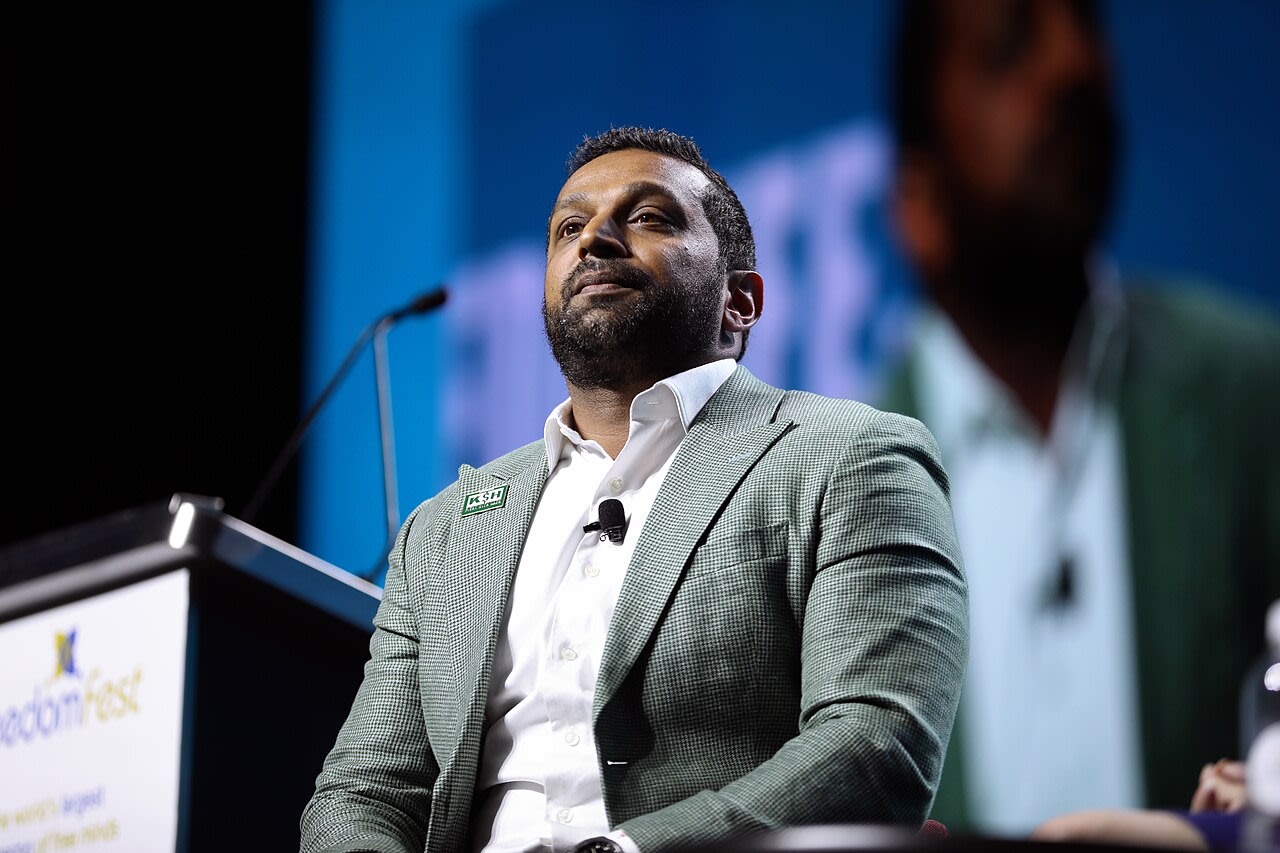
Kash Patel speaking with attendees at FreedomFest 2024

Photo: Gage Skidmore, CC BY-SA 2.0

By BitBrainers Editorial

The FBI director bought six figures of Bitcoin-adjacent stock, sat on the disclosure for six months, and the Justice Department's own ethics office says there's nothing to see here. The company he bought into does millions of dollars in business with his own agency. This is the kind of story that gets buried in a Wednesday news cycle, and it deserves better than that.

What Actually Happened

FBI Director Kash Patel purchased between $100,001 and $250,000 in Strategy stock, the company formerly known as MicroStrategy, on November 21. Strategy is the largest publicly listed corporate holder of Bitcoin in the world, built around aggressively accumulating BTC as its primary treasury asset. Patel did not disclose the trade to federal regulators until May 26, six months after the purchase and well past the 45-day window required under the STOCK Act.

His explanation, delivered in a letter to the Office of Government Ethics that same day, was that the trade had been "inadvertently omitted" from an earlier disclosure. Two days later, a Deputy Assistant Attorney General wrote to the same office stating the omission was caused by an unspecified "miscommunication." An FBI official told reporters the late filing was "not realized and unintentional."


Why The Company Matters As Much As The Delay

A late disclosure alone is a paperwork problem. What makes this one worth reading past the headline is who Patel bought stock in. Strategy has done millions of dollars in business with the Department of Justice over the past decade, and the FBI is part of the Department of Justice. Patel now personally holds a six-figure position in a company his own agency writes checks to.

The Deputy Assistant Attorney General who reviewed the case concluded there was no conflict of interest. Government watchdogs disagree with the framing entirely. Dylan Hedtler-Gaudette of the Project on Government Oversight put it in blunt terms: "That's violating the law, no other way to put it." He's referring specifically to the disclosure timeline, not the ethics question, but the two are hard to fully separate here. Late disclosure and financial entanglement with an agency contractor are not the same problem, but they compound each other.

Worth being fair about the baseline here. Senior officials holding stock in companies their agency interacts with is not automatically a scandal, Pentagon officials often hold defense contractor stock, HHS officials hold pharma stock. Passive investment in a publicly traded company isn't prohibited on its own, that's exactly why ethics offices exist to make case-by-case calls rather than ban the practice outright. No evidence has surfaced that Patel steered any DOJ contract toward Strategy, traded on non-public information, or received anything in return for the purchase. The documented complaint is narrower than "corruption": a six-figure trade, a company with agency ties, and a disclosure filed roughly 186 days late. That's still a real problem. It's just a specific one, not a vague one.

This also isn't Patel's first time drawing scrutiny for personal stock trades in office. He purchased shares in Krispy Kreme and ON Semiconductor in 2025, trades that already prompted questions from members of Congress before this latest disclosure issue surfaced. A pattern of individual stock trading while running a federal law enforcement agency is its own separate conversation from any single trade's merits.


The Rules Everyone Ignores

The STOCK Act exists for exactly this reason: to make sure senior officials disclose trades fast enough that the public can see potential conflicts before they compound. The threshold is low, any trade over $1,000, and the window is short, 45 days. Patel's trade sat undisclosed for roughly six times that window.

He is not alone. NOTUS, the outlet that first reported this story, has identified more than 30 members of Congress who filed STOCK Act disclosures late over the past year. The customary penalty for a first violation is a $200 fine, a number small enough that it functions less as a deterrent and more as a rounding error against a quarter-million-dollar trade. Patel has not been fined as of this writing, and multiple watchdog groups doubt he will be.

This is the kind of read you get weekly.

No hype. No "this coin will 100x." Just honest macro on Bitcoin, gold, and the market.

What This Says About Bitcoin's Position In Washington

Set aside the ethics question for a moment and look at what this story confirms about where things actually stand. A sitting FBI director felt comfortable putting a six-figure personal position into a Bitcoin treasury company, one connected to his own agency's contractor relationships, and the mistake that got him in trouble wasn't the trade itself, it was the paperwork. Nobody in this story is arguing Patel shouldn't have bought Strategy stock. The argument is entirely about timing.

That's a meaningful signal on its own. Bitcoin exposure has moved deep enough into Washington's bloodstream that a law enforcement official's personal stake in the largest corporate BTC holder barely registers as controversial, only the six-month delay in reporting it does. A few years ago this trade wouldn't have happened at all, or would have drawn scrutiny on the merits, not just the calendar.


Worth Watching Right Now

Strategy's stock itself remains under separate pressure. Canaccord cut its price target on the company this week even while maintaining a broadly bullish thesis on Bitcoin, part of a wider reassessment of Strategy's capital structure following its recently disclosed unrealized paper losses and new buyback authorization. Meanwhile Trump's own 2025 financial disclosure, released the same week, showed over $1.4 billion in crypto-related income, a separate and much larger story about the overlap between federal power and Bitcoin exposure that deserves its own treatment.

Sources

NOTUS. Kash Patel's Late Stock Disclosure Raises STOCK Act Questions

CoinDesk. FBI Director Kash Patel Caught Sleeping on Required Disclosure of Six-Figure MSTR Investment

Raw Story. Kash Patel Accused of 'Violating the Law' With Massive Undisclosed Stake in DOJ Contractor

BitBrainers. We check the facts so you don't have to.

Disclosure: This is market and policy commentary, not financial or legal advice. We hold Bitcoin. Always do your own research.

Wednesday, July 1, 2026

Why Your Exchange Wants You to Stay (And What Actually Fixes It)

BitBrainers - fractured Bitcoin coin with capital flowing toward AI infrastructure

By BitBrainers Editorial

Every exchange interface is built around one goal: keep your coins on their platform. Not because they're malicious by design, but because your balance sitting on their books is the entire business model. The friction to withdraw isn't an accident. It's revenue protection.

The Balance Sheet You Never See

When you deposit Bitcoin on an exchange, you don't hold Bitcoin anymore. You hold an IOU. The exchange holds the actual private keys, and your balance is just a number in their database. That number can be lent out, used as collateral, or in the worst case, gone before you ever try to withdraw it.

FTX proved this isn't theoretical. Sworn testimony and court filings later confirmed that Alameda Research, the trading firm founded by the same person who ran FTX, had been drawing on customer deposits for years before the collapse, using them as an open line of credit that reportedly ran into the tens of billions. The exchange marketed itself as the safest place to hold crypto while quietly reinvesting customer funds behind the scenes. When withdrawals spiked in November 2022, the gap between what customers thought they owned and what the exchange actually had on hand became impossible to hide. A U.S. court later ordered $12.7 billion in restitution and disgorgement, one of the largest judgments in the history of financial fraud enforcement. None of that money would have been at risk if it had never left customer wallets in the first place.

Three Ways They Profit While You Wait

Trading fees are the obvious one, but they're rarely the biggest. Spread markup on market orders quietly costs more than the stated fee on most retail trades. Interest on idle deposits is another: your uninvested cash or stablecoins often earn the exchange yield in the background while you earn nothing. And withdrawal friction, minimum amounts, network fee markups, occasional "verification delays," all nudge you toward leaving funds parked rather than moving them out.

None of this requires bad intent. It's just what happens when the platform's incentives and your incentives point in different directions. I watched this exact dynamic from the inside on a CFD brokerage desk. The house doesn't need you to lose. It just needs you to stay active and stay parked.

Worth saying plainly: not every exchange is FTX. Platforms like Kraken that publish proof-of-reserves and submit to third-party audits are a meaningfully different risk than one that hides its balance sheet entirely. Some withdrawal friction is also just regulation doing its job, KYC and AML checks exist to catch fraud and stolen funds, not only to slow you down. The incentive misalignment is still real. It's just not the whole story on every platform.

This is the kind of read you get weekly.

No hype. No "this coin will 100x." Just honest macro on Bitcoin, gold, and the market.

What Self-Custody Actually Fixes

Self-custody removes the middleman from the equation entirely. Your keys, your coins, no balance sheet risk, no lending desk, no "temporary" withdrawal freeze during a bank run. It doesn't eliminate risk, you take on the responsibility of not losing your own keys, but it converts counterparty risk into a risk you fully control.

A hardware wallet like a Trezor keeps your private keys offline, away from any exchange's balance sheet. Setup takes minutes. The habit of moving funds off-exchange after every trade takes longer to build, but it's the difference between owning Bitcoin and owning a promise.

Be honest with yourself about the tradeoff. More people lose crypto to their own mistakes, a lost seed phrase, a phishing link, a backup that was never written down, than to an exchange collapse. Self-custody removes one risk and hands you a different one. It's still the better trade for anything you're not actively using, but only if you take the seed phrase part seriously.

The Middle Ground

You don't need to self-custody every dollar you trade with. Keep active trading capital on the exchange, move everything else off. Treat the exchange like a checking account, not a savings account. That single mental shift changes how much risk you're actually carrying at any given time.

The Test That Actually Tells You Something

Forget reading the terms of service. There's a faster way to gauge how an exchange treats withdrawals: try one. Move a small, real amount off the platform and time it. A clean process, clear fees, and funds landing in your wallet within the stated window is a good sign. Repeated "verification required" prompts, minimums that conveniently sit above what you're trying to move, or support tickets that go nowhere are the same pattern that preceded past exchange failures, just earlier in the timeline. This costs you a few dollars in network fees. It's a cheap way to find out what a five-figure or six-figure withdrawal would actually look like before you need it to work.

Worth Watching Right Now

The EU's MiCA transitional licensing period expired today, July 1. Roughly 92 percent of the exchanges and crypto businesses that previously operated under older national licenses across Europe still lack full MiCA authorization, leaving them to either secure a license, wind down, or transfer clients to an already-licensed platform. Separately, Strategy authorized a new $2 billion buyback program alongside a mechanism that would let it sell bitcoin for liquidity if needed, a notable shift from its prior all-in accumulation stance. Bitcoin extended its slide below $58,500 this week, with roughly $320 million in leveraged positions liquidated in a single day.

Sources

CFTC, consent order and $12.7 billion judgment against FTX and Alameda Research, August 2024. Forbes, coverage of the FTX/Alameda restitution ruling, August 2024. Axios, FTX trial testimony on Alameda's use of customer funds, October 2023.

BitBrainers. We check the facts so you don't have to.

Disclosure: This post contains affiliate links. We may earn a commission at no extra cost to you.

Monday, June 29, 2026

Bitcoin Weekly Brief: June 29 — The First Bear Without a Crypto Trigger

BitBrainers - Bitcoin daily chart, five-day consolidation in the $58K to $60K range

By BitBrainers Editorial

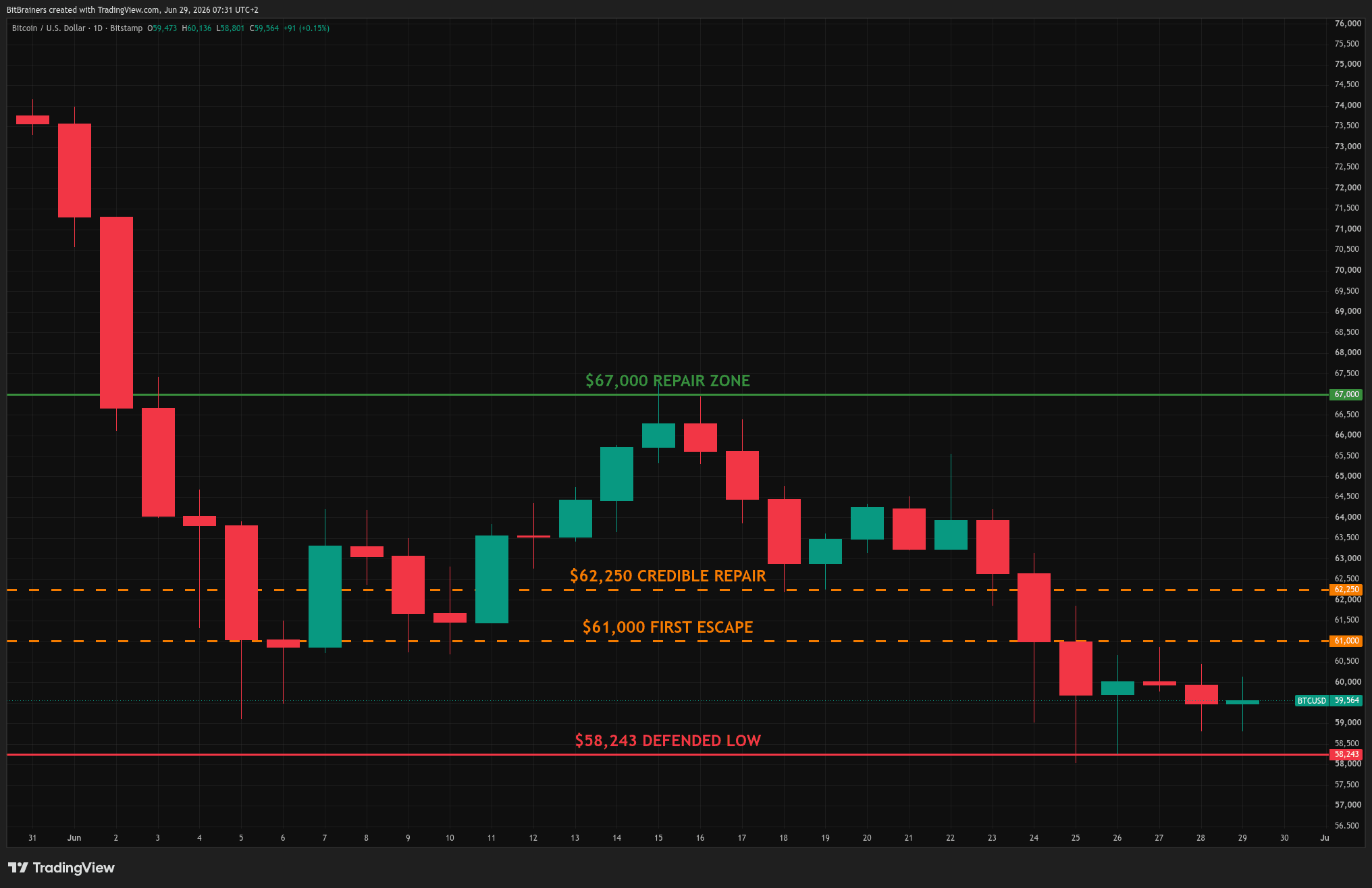
Bitcoin closed the week below $60,000 for the fifth straight day, sitting on a $58,243 low that buyers have defended since Wednesday. Volume on the way down kept thinning. A Friday options expiry that everyone thought would yank price toward $72,000 did nothing of the sort. And the most interesting thing about all of it is that none of it was caused by a crypto problem.

Where Bitcoin Actually Closed The Week

The range tells the story without needing a narrative. BTC opened Monday around $63,000, slipped through midweek as hot inflation data hit, made a $58,243 low on Wednesday, bounced toward $60,500, and faded back. Five sessions, one defended floor, no decisive break. The $10 billion Deribit quarterly expiry on Friday cleared with max pain at $72,000 and spot at $59,500. Nothing pinned. Nothing pulled.

What did move: ETF outflows kept bleeding, with combined US spot crypto ETF assets falling from roughly $104 billion to $94 billion over the past few weeks. Fear and Greed sat in extreme fear all week, ticking from 13 to 18 by Sunday, which is the kind of marginal improvement that means buyers are exhausted, not that anything has turned. Realized losses ran around $1.35 billion per day. The bleed is real. It is just slow.


Why This Bear Has No Crypto Trigger

Every prior Bitcoin bear had a crypto-native cause. 2011 was the Mt Gox hack. 2013 was the China PBoC ban. 2018 was the ICO bubble unwinding. 2022 was Luna collapsing and FTX going under. Each one had a moment, an event, a date on a Wikipedia page.

This one does not.

What pushed Bitcoin from $73,000 to $58,243 over the last two weeks was a hot PCE inflation print, a Fed that may now be re-hiking instead of cutting, and capital rotating into AI infrastructure on a structural multi-year capex story. None of those are about Bitcoin. They are about every risk asset that ever borrowed against a low-rate liquidity backdrop. The shape of the chart looks like the prior bears. The cause looks like nothing the prior bears had.

One qualifier worth saying out loud. Spot ETFs are a new transmission mechanism that didn't exist in any prior cycle, and the outflows we've seen this month are crypto-specific in the sense that they show up directly in BTC sell pressure. That's not the same as a Mt Gox or an FTX, but it is a piece of plumbing the prior bears didn't have. Macro causes the risk-off impulse. The ETFs translate it into daily forced supply faster and more visibly than before.

That distinction matters because the playbook traders inherit from prior cycles assumes a known trigger and a known resolution. Mt Gox, ICOs, FTX, those all eventually washed through and the next leg began. There is no equivalent washout coming here, because there is nothing crypto-native to wash. The bottom, when it arrives, will not be marked by a single event. It will be marked by a quiet change in flow.


Macro Did The Work

The May PCE inflation report came in hot on June 25, headline 4.1% year over year, the highest reading since 2023. Markets repriced the odds of a December Fed rate hike to roughly 77%, with Bank of America now expecting three hikes in 2026 and Deutsche Bank modeling two starting as early as September. The day's print triggered around $1.48 billion in crypto-wide liquidations within 24 hours, Bitcoin alone taking roughly $665 million of that.

Underneath the inflation story, a quieter rotation is doing the structural damage. The five largest US hyperscalers have committed to spending about $725 billion on AI infrastructure in 2026, a 77% jump from the prior year. Nvidia is guiding to about $91 billion in revenue this quarter alone. AI-exposed names now account for roughly 45% of the S&P 500's market cap. Excluding AI, the rest of the index has barely moved since February. The growth capital that used to chase Bitcoin on good weeks is finding a different home, and until that flow reverses, BTC is bidding for a marginal buyer that is currently busy elsewhere.

This is the kind of read you get weekly.

No hype. No "this coin will 100x." Just honest macro on Bitcoin, gold, and the market.

The Absorption Question Is Still Open

The character of this leg down is what makes it worth watching, separate from the price. February took Bitcoin from the low $80,000s to $60,000 in five trading days on heavy volume, the kind of move that liquidates leveraged longs in bulk. This time, the same trip down took 26 days on a fraction of the volume, then bled another 11 days into the $58,243 low we are still defending.

Slower decline on lighter volume can mean absorption, the most leveraged sellers already cleaned out in February with less forced supply left to push. It can also mean buyers simply have no urgency, letting price drift lower because nothing is stopping them. The volume tells you effort is dropping. It does not tell you whose effort. An independent analyst at InvestingLive flagged the same read on Sunday, calling it a "bearish lower-value reset with early absorption, not confirmed accumulation." Same question, two desks, no answer yet.

What would settle it is a real reaction. A reclaim of $67,000 that holds with volume expanding behind it. Not a weak bounce that fades back into the range on light volume, no matter how relieved that bounce might feel.


Key Levels

Level Type Significance
$67,000 Repair zone A reclaim and hold here on rising volume is what flips absorption from question to confirmation
$61,750 to $62,250 Credible repair Reclaiming this band starts to show value migration back toward the prior structure
$60,750 to $61,000 First escape gate The immediate ceiling. Above it, the score starts improving from bearish toward neutral
$58,115 to $58,400 Defended low Where buyers have shown up for five sessions. Losing it cleanly opens $55,000

What This Adds Up To

This is the first Bitcoin bear without a crypto-native cause and the first to happen with a major competing growth trade actively pulling capital the other direction. The drawdown is shallower than prior cycles. The character is slower. The drivers are macro and structural, not native to crypto. That does not make a bottom call. It changes the signal you should be watching for. Volume on the next meaningful bounce will say more than any of this week's headlines. Until something gives, the chart is asking a question, and nobody on either side has earned the answer yet.


Sources

CoinGecko. Bitcoin Price Today

InvestingLive. Bitcoin Analysis Over the Weekend, 28 June 2026

Reuters. May PCE Inflation Report and Fed Rate Expectations

BitBrainers. We check the facts so you don't have to.

Disclosure: This is market commentary, not financial advice. We hold Bitcoin. Always do your own research.
Sunday, June 28, 2026

Bitcoin Doesn't Have a Crypto Problem. It Has an AI Problem.

BitBrainers - Bitcoin's AI Problem

By BitBrainers Editorial

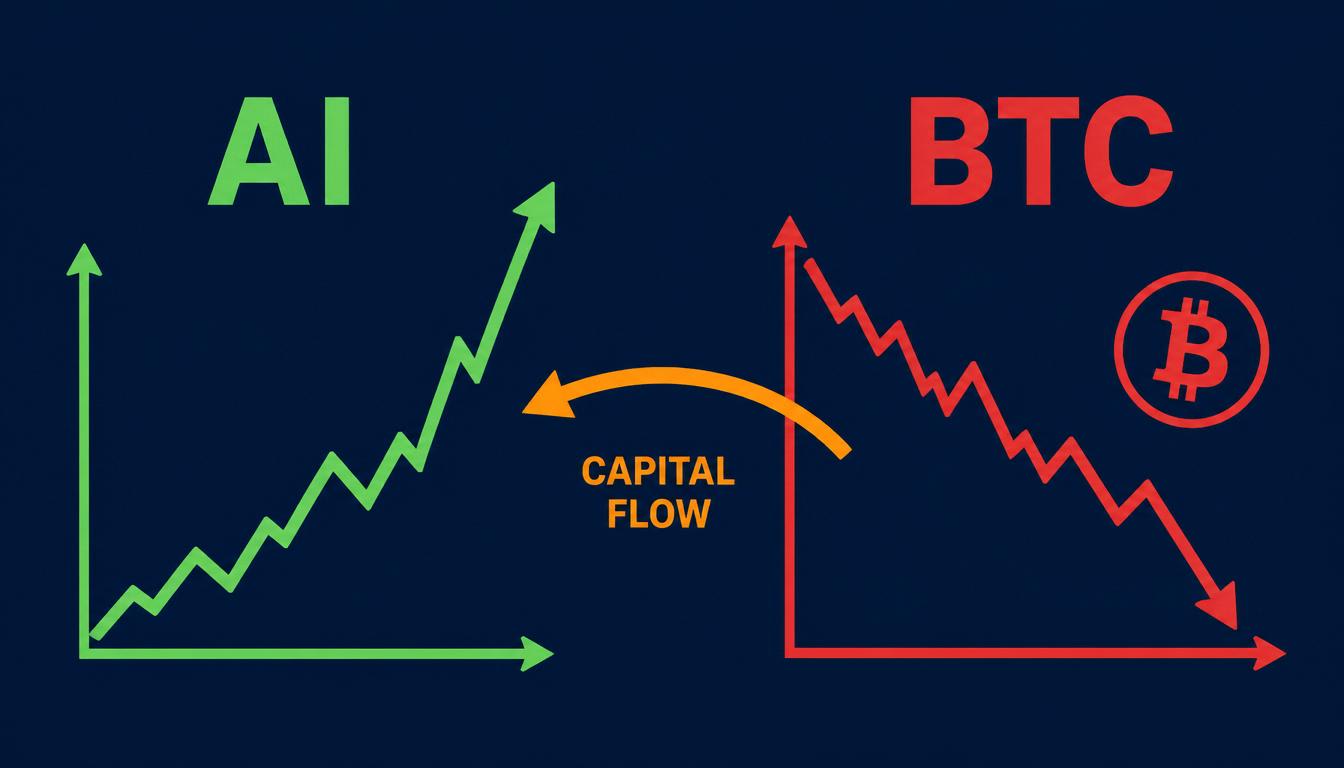
Most of the explanations for Bitcoin's slow grind to $58,000 are about Bitcoin. Inflation surprised the Fed, ETF outflows broke a record, max pain failed to pull. All true, all priced. But the simplest story is the one nobody on crypto Twitter is leading with: the capital that used to chase Bitcoin on good weeks is building data centers instead, and it's not coming back until that trade cools.

The Numbers Don't Compete, They Diverge

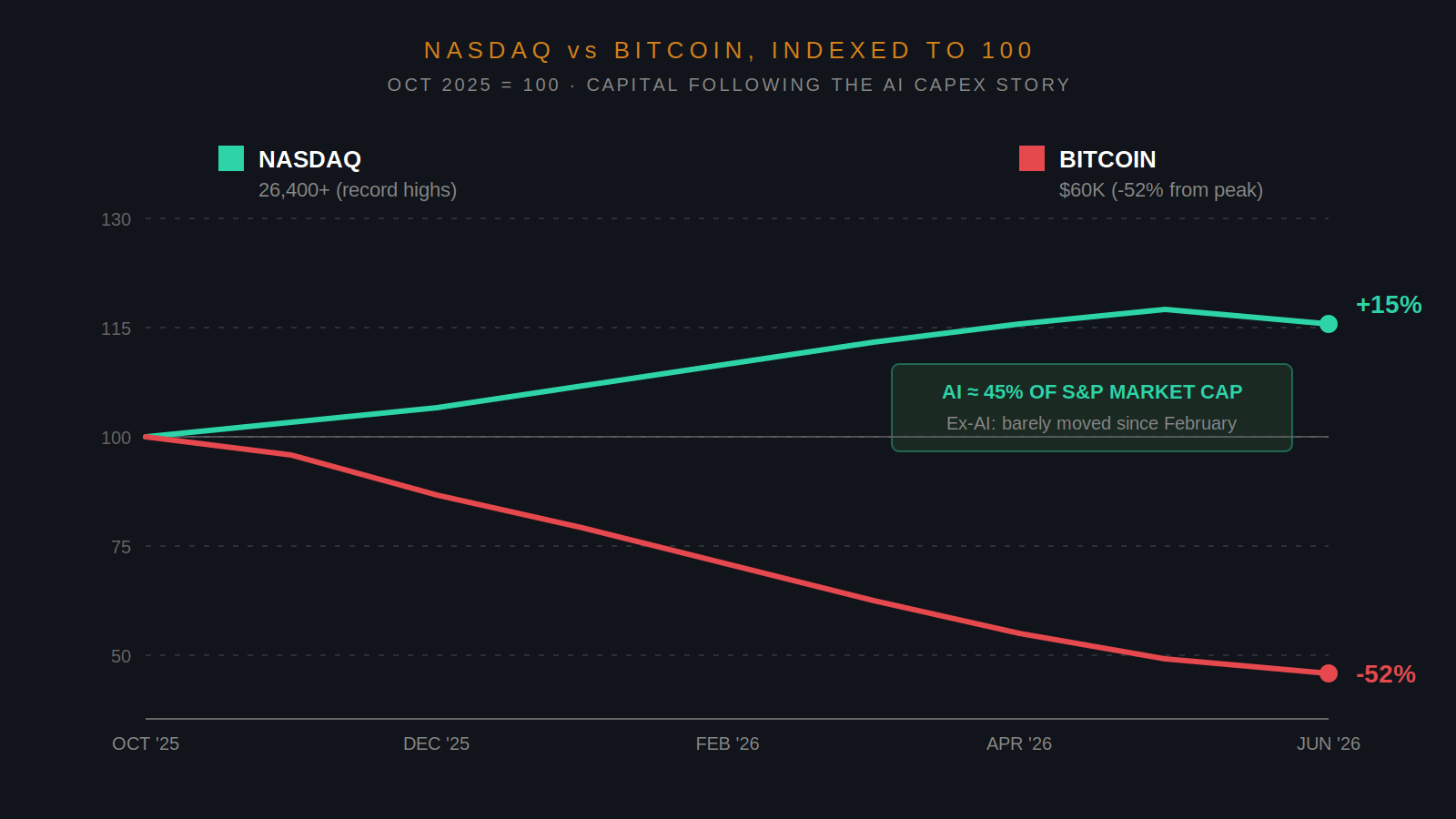
The Nasdaq Composite is sitting above 26,400, near record highs. Bitcoin is down roughly 50% from its October 2025 peak. That gap isn't a coincidence, it's a flow. Excluding AI-related stocks, the rest of the S&P 500 has barely moved since February. The index's gains this year have come almost entirely from a handful of names exposed to AI infrastructure. Nvidia, Microsoft, Meta, Alphabet, Amazon. Same names doing all the work.

On the spending side, the scale is genuinely hard to internalize. The five largest US hyperscalers, Microsoft, Alphabet, Amazon, Meta, and Oracle, have collectively committed to spending around $725 billion on capital expenditure in 2026. That's a 77% jump from the prior year's already record $410 billion. CreditSights estimates roughly 75% of that, close to $450 billion, flows straight into chips, servers, networking, and physical data center buildouts. Nvidia alone is guiding to about $91 billion in revenue for the current quarter, up 85% from a year earlier.

Half a trillion dollars is being committed to a single theme. Crypto doesn't have a competing capex story. It doesn't need one for the long-term thesis, but in the short term, it means the marginal investor's attention is somewhere else.


Same Wallet, Different Bet

The cleanest way to read crypto's drift lower this cycle is to stop thinking of it as a separate market. Crypto and high-growth tech share a marginal buyer, the kind of investor who wants asymmetric upside in volatile assets. When liquidity is loose and confidence is high, that buyer holds AI stocks, Bitcoin, crypto equities, and some smaller tokens all at once. When confidence cracks, the whole basket gets trimmed, but not evenly. The AI infrastructure trade has a story, a multi-year capex commitment, and earnings to point at. Bitcoin has a chart with no catalyst.

That's why so many of crypto's recent down legs haven't been triggered by crypto news. The June selloff lined up with the May PCE inflation surprise, the same surprise that hit tech harder than usual for one session before tech recovered and crypto didn't. The asymmetry isn't sentiment. It's positioning. When the same investor de-risks a portfolio, the asset with the weaker near-term narrative gets cut first, and right now that asset is Bitcoin.

BitBrainers - Nasdaq vs Bitcoin divergence indexed to October 2025

This shows up cleanly in flows. Combined US spot crypto ETF assets fell from around $104 billion to $94 billion over the past few weeks. The week of May 23 to 29 alone saw global crypto exchange-traded products bleed $1.67 billion, the second-largest weekly outflow of the year. ETF demand was the engine of the 2024 and 2025 rally. When that engine runs in reverse, spot price loses its most dependable marginal buyer, and right now the money that used to feed that engine has a different home.

One nuance worth saying directly so it doesn't get assumed away. This isn't a literal dollar transfer from Bitcoin ETFs into Nvidia shares. Hyperscaler capex is mostly funded by corporate cash flow and corporate debt, not by retail investors selling BTC to buy chip stocks. The transmission is allocator psychology and opportunity cost, not a direct one-to-one swap. When growth-oriented investors look at where the cleanest multi-year story lives, AI infrastructure wins that comparison right now, and Bitcoin loses the marginal attention even if no one explicitly moves a dollar between the two.

This is the kind of read you get weekly.

No hype. No "this coin will 100x." Just honest macro on Bitcoin, gold, and the market.

The Buildout Isn't Slowing, It's Accelerating

The first instinct, looking at a $725 billion number, is to assume it has to plateau or break. The data says otherwise. The buildout has moved past the point where it's funded purely from operating cash flow. Hyperscalers raised $108 billion in debt during 2025 alone to keep pace, and CreditSights projects roughly $1.5 trillion in cumulative debt issuance over the coming years to fund the rest.

This matters for crypto because debt-funded infrastructure cycles don't pause for sentiment. They pause when something physical breaks, power supply, grid capacity, chip lead times, or when the revenue side genuinely fails to materialize. Neither has happened. Microsoft just confirmed its AI business surpassed an annual revenue run rate of $37 billion, up 123% year over year. Commercial remaining performance obligations stand at $627 billion. The forward demand is there.

The implication is uncomfortable but worth saying out loud. If the AI infrastructure trade keeps working, the marginal capital that crypto needs back for a real rally is going to keep finding a better home. The competition isn't a single tech stock. It's an entire structural buildout with multi-year visibility.


What Would Actually Reverse This

Three things, and at least one of them probably has to happen for the rotation to flip.

First, AI leadership has to cool. Not collapse, just rotate. When the trade that's draining crypto starts losing momentum, risk capital has historically circled back. The early warning sign is the kind of session where a hot inflation print hits Nvidia harder than it hits Bitcoin, instead of the inverse. We're not there yet.

Second, ETF flows need to turn. Not a single positive day, a sustained run, especially in the largest vehicles like BlackRock's IBIT. That's the cleanest read on whether the marginal seller is finally exhausted. Persistent flat-to-positive flow in the biggest funds is the structural signal worth waiting for.

Third, the macro picture needs a different driver. As long as hot inflation prints repricing Fed expectations toward hikes are the dominant story, the dollar stays strong, risk assets stay pressured, and the higher-conviction trade keeps winning. Bitcoin doesn't need a bullish Fed to rally, but it does need one that isn't actively pushing the other way.

One thing worth noting about the eventual reversal, whenever it comes. Bitcoin's historical beta to risk assets cuts both ways. The same dynamic that's punishing it in this regime, lower liquidity hits it harder than tech, is exactly what could make it outperform on the way back. When the rotation does flip, the asset that fell furthest tends to move first and fastest. That doesn't make the timing easier, but it does mean the eventual recovery, if and when it arrives, may not look like a slow rebuild. It rarely has before.

On The Radar

Watch Nvidia's next earnings session, not for the number itself but for how Bitcoin trades on it. A Nvidia beat that doesn't lift BTC is one signal, an Nvidia miss that doesn't crush BTC is another. Watch the iShares Bitcoin Trust daily flow data as the closest available read on whether institutional appetite is genuinely turning. And watch the hyperscaler debt issuance pipeline. The moment that market starts demanding meaningfully wider spreads to fund the buildout is the moment the AI trade gets harder to extend, and crypto's marginal buyer might start looking for somewhere else to be.


Sources:
Investing.com: Bitcoin Can't Find a Floor While AI Quietly Soaks Up the Risk Capital
Futurum Group: AI Capex 2026: The $690B Infrastructure Sprint
Yahoo Finance: Meta, Microsoft, Amazon, and Alphabet's Shocking Spending to Dominate the AI Era
Benzinga: Money Is Flowing into AI Stocks While Bitcoin Liquidates

Disclosure: This is not financial advice. We hold positions in BTC and discuss our own trades publicly, wins and losses.

Saturday, June 27, 2026

Money Got Binance in the Room. A Record Kept It at the Door.

BitBrainers - The MiCA Filter

By BitBrainers Editorial

Three days before the MiCA enforcement deadline, the largest crypto exchange in the world withdrew its license application in Greece. Binance didn't fail because the application was too expensive, or because it lacked lawyers, or because it didn't understand the rules. It failed because of the part of compliance you can't pay your way out of: a record.

The Numbers Behind The Deadline

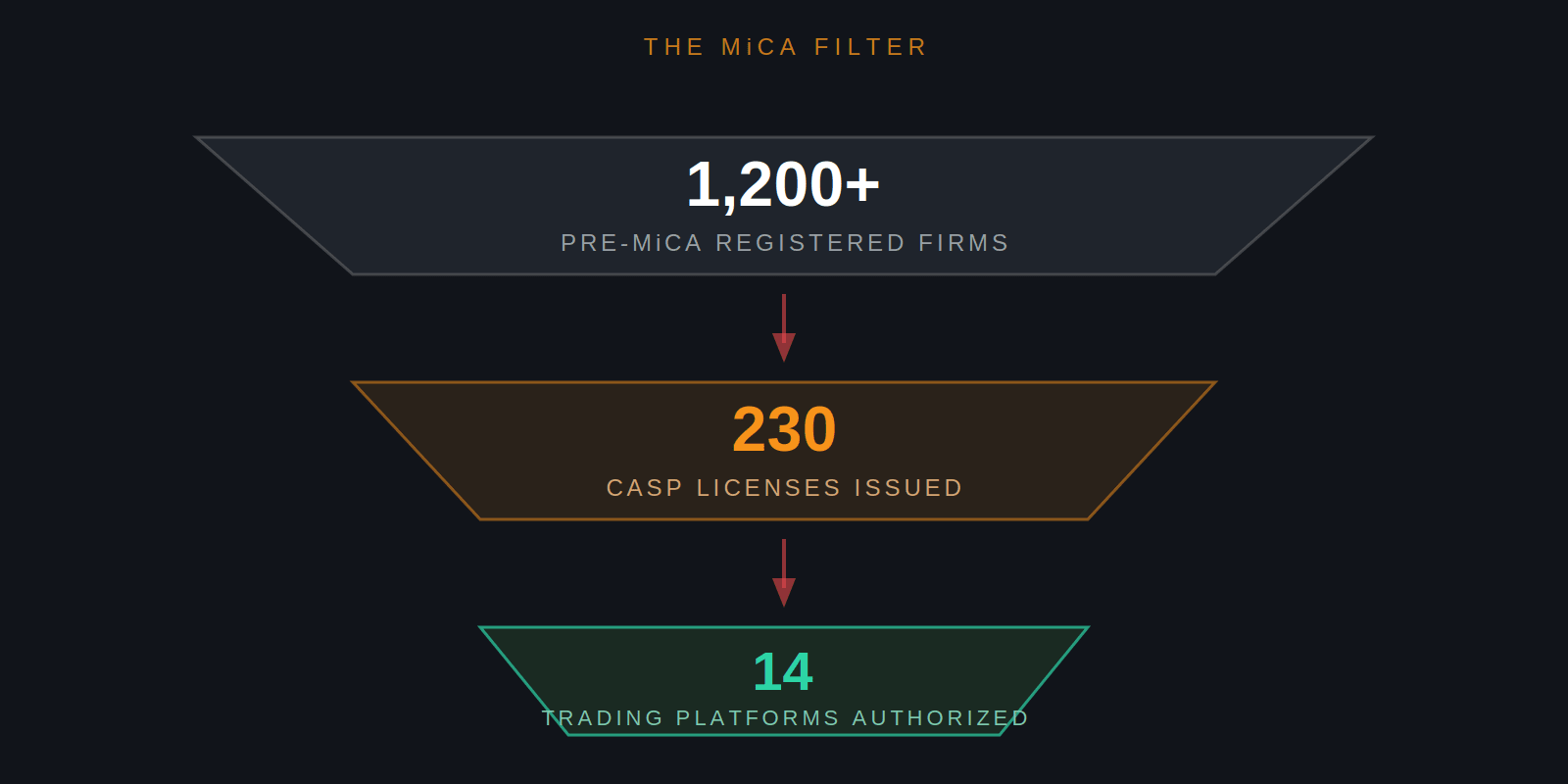
July 1, 2026 ends the 18-month transitional period under the EU's Markets in Crypto-Assets regulation. Around 230 firms now hold full CASP authorization across the bloc. Of those, only about 14 are cleared to run an actual trading platform. The pool they came out of was more than 1,200 firms registered under the old national rules.

That's a 19% conversion rate at the broad level, and roughly 1% at the trading-platform level. Ten EU member states haven't issued a single license. Estonia, which had 641 registered crypto firms in 2021, was down to about 40 by early 2025. France's regulator estimates that 40% of its registered providers never even submitted a MiCA application. Poland's national implementation law was vetoed for a third time in June, leaving Polish firms with no domestic path at all.

None of that is a story about firms running out of money. It's a story about firms running out of room.


What Money Couldn't Solve

The compliance cost of a MiCA authorization runs between €250,000 and €500,000 according to French regulators. For a small firm in Tallinn, that's existential. For Binance, it's a rounding error. So when Binance pulled its Greek application on June 24, the question wasn't budget. Reuters reported the Hellenic Capital Market Commission was preparing to reject the file. The reasons named in the reporting weren't capital or product gaps. They were past money-laundering penalties and corporate-structure issues, the kind of legacy concerns a fresh check can't paper over.

Binance has navigated this before. It holds a full MiCA passport through an EU entity it redomiciled and rebuilt in 2025, after rejections elsewhere on similar grounds. The Greek withdrawal isn't proof Binance can't get licensed; it already is, elsewhere. It's proof that even with the world's deepest war chest, you don't get a clean run at every jurisdiction. Some doors stay closed for reasons that pre-date the application.

That's the part of MiCA the headline numbers obscure. The framework didn't filter for size or balance sheet. It filtered for record. A clean compliance history, a manageable corporate structure, and the willingness to relocate to a jurisdiction that wants you became the actual currency.

This is the kind of read you get weekly.

No hype. No "this coin will 100x." Just honest macro on Bitcoin, gold, and the market.

The Map MiCA Drew

Look at where the licenses actually went, and a clear geography emerges. Germany leads with around 53 authorized entities. The Netherlands sits at 25 or 26. France, Malta, Cyprus, Ireland, and Luxembourg fill out most of the rest. Almost every major exchange that survived chose Ireland, Luxembourg, Malta, or the Netherlands as its EU base.

That's not random. Those are the jurisdictions that built a regulator willing to engage early, set realistic timelines, and process applications at scale. The countries that issued zero licenses weren't all small or hostile to crypto. Some were simply slow, understaffed, or politically conflicted about whether to compete for the business at all. Poland is the extreme case, but it's not the only one.

For users, that produces a strange map. After July 1, where you can legally trade crypto inside the EU depends less on where you live and more on where your exchange chose to redomicile. A Polish trader using a Polish-registered firm has a worse setup than a Polish trader using a firm passported in from Ireland, even though both users are sitting in the same country.


The Quiet Part Of The Stablecoin Story

The most visible casualty so far has been Tether. Tether didn't apply for MiCA authorization, and EU-licensed venues that continue listing non-authorized stablecoins risk losing their own CASP licenses. Coinbase began delisting USDT for EEA users in December 2024. Kraken followed in early 2025. Crypto.com delisted it alongside nine other tokens. Binance geofenced its EEA USDT pairs.

What gets less attention is what filled the gap. Circle's USDC and EURC are the only top-10 stablecoins fully MiCA-compliant, which puts them in a near-monopoly position for compliant euro and dollar exposure inside the EU. That's not a small consequence. It's the regulatory equivalent of being handed the only umbrella when it starts raining. Whether that's a feature or a flaw of MiCA's design depends on how comfortable you are with one issuer holding that much of the regulated market.

On The Radar

Watch how unlicensed firms communicate to EU users in the next 72 hours. France's AMF has explicitly warned that operating without authorization after the deadline exposes firms to criminal prosecution, so legal-quality wind-down notices should accelerate. Watch where Binance lands next on the MiCA application front, after Greece. And watch whether the European Commission's proposal to centralize CASP supervision inside ESMA itself gains ground after July 1, which would be a structural shift away from the current member-state model and is already being opposed publicly by Malta.


Sources:
Bitcoin.com News: MiCA Deadline Hits July 1 as Unlicensed Crypto Platforms Face EU Shutdown Risk
Yahoo Finance: July 1 MiCA Deadline Looms: More Than 80% of EU Crypto Firms Still Unlicensed
Kraken Blog: MiCA Enforcement Begins July 1: What It Means for Institutional Counterparties

Disclosure: This is not financial advice. We hold positions in BTC and discuss our own trades publicly, wins and losses.

Weekly Brief: The Week FOMC Decides Everything

By BitBrainers Editorial Bitcoin hit $66,400 on Tuesday, its highest since June 17, on seven straight days of ETF inflows. By Friday it ...