₿ BTC Loading... via Binance

Wednesday, July 15, 2026

Bitcoin Pumped on Old News. Here Is What Actually Matters This Month.

BitBrainers - Bitcoin Pumped on Old News. Here Is What Actually Matters This Month.

By BitBrainers Editorial

Bitcoin pumped 4% on Tuesday after the June CPI print came in below expectations. Headline inflation landed at 3.5%, core at 2.6%. The crowd cheered. Price hit $65,000. ETF inflows showed up for the first day in two weeks. Nobody mentioned that the data was nine days old.

The Number That Moved the Market

June CPI measures prices collected through the end of June. The soft headline was driven by gasoline, which fell roughly 10% during the month after the US-Iran ceasefire took hold and oil pulled back sharply.

That ceasefire collapsed on July 8. US and Iranian forces exchanged fresh airstrikes, Trump declared the ceasefire over, and WTI crude surged toward $74 a barrel. The energy deflation that made Tuesday's print look friendly is already gone.

Core CPI, which the Fed actually targets through its PCE proxy, came in at 2.6%. That is cooler than the 2.9% May reading, which is genuinely good. But it does not change where the Fed sits today.


What the Fed Actually Sees

At the June meeting, Kevin Warsh held rates at 3.50 to 3.75%. Nine of eighteen FOMC officials project at least one rate hike before year-end. The cutting bias was removed from the statement entirely.

Warsh also scrapped forward guidance. There will be no fresh dot plot until September. The July 28-29 meeting is live, with no signals in either direction, and markets walking in blind.

One soft CPI print shifts the odds. It does not change the structure. The Fed's own 2026 inflation forecast is 3.6% headline. Tuesday's 3.5% barely clears that bar.


The data before the crowd reads it.

Weekly macro and Bitcoin analysis. No hype, no price targets pulled from thin air.

Subscribe

The Story Nobody Led With

While the market was celebrating the CPI print, Strategy filed its weekly Bitcoin disclosure. The company sold 3,588 BTC for $216 million during the week of June 30 to July 5, at an average price of roughly $60,000 per coin.

Strategy's average cost basis across its holdings is approximately $75,476 per coin. The company is underwater. It is selling Bitcoin to fund preferred stock dividends, which now exceed $1.5 billion annually.

This is the same company that built its identity on never selling. The first sale since 2022 happened six weeks ago: 32 coins, $2.5 million. Last week it was 3,588 coins and $216 million. The pace is accelerating.


ETF Flows: One Day Does Not Fix a Broken Quarter

Tuesday's CPI reaction brought one day of ETF inflows: $221 million, the largest single session in two months. Analysts at HashKey and LVRG Research both described it as cautious re-entry, not a trend reversal.

Year-to-date ETF outflows still stand at $5.4 billion. June alone saw $4.5 billion exit, the worst month since the funds launched in early 2024. One session recovered roughly 4% of the 2026 capital that has left.

Citigroup cut its 12-month Bitcoin target from $112,000 to $82,000 in June. The more important part of that note was not the price target. It was Citi's rationale: they reduced their 12-month net ETF inflow assumption to zero, citing outflows, stalled crypto legislation, and capital rotating into AI-related equities.

For the ETF inflow story to become structural, analysts need to see IBIT reverse, multiple issuers participating, and price holding higher lows across several sessions. None of that happened Tuesday.

For context on how this year's five previous CPI prints moved Bitcoin, see our earlier breakdown: Five CPI Prints, Five Bitcoin Reactions, and Why the Sixth Comes With a Catch.


What to Watch Now

July 28-29 is the date that matters. That is when Warsh's Fed meets again, with no pre-signaling, no fresh projections until September, and a market that just handed them one piece of softer inflation data against a backdrop of geopolitical oil risk.

Between now and then, watch ETF flows daily. A second and third consecutive inflow session, led by IBIT, would shift the picture. A single-day reversal back to outflows would confirm Tuesday as the relief bounce it looks like.

Watch Strategy's weekly filings. If the pace of selling continues to accelerate from 32 coins to 3,588 coins in six weeks, the math on their dividend obligations suggests this is not a one-off.

The market celebrated old news on Tuesday. The new news lands July 28.


Sources

CoinDesk Strategy Dramatically Ups Pace of Bitcoin Sales, Raising $216 Million

Brave New Coin Bitcoin ETF Flows Face CPI Test as Fed Rate-Hike Risk Returns

TechTimes Bitcoin ETF Outflow Streak Ends at $2.7B as June Jobs Data Cools Rate Risk

24/7 Wall St. Bitcoin Price Prediction for July 2026

Hex Trust Market Pulse: Macro Ceiling, On-Chain Floor

This is market commentary, not financial advice. BitBrainers holds Bitcoin and other digital assets. Nothing here is a recommendation to buy or sell any asset. Do your own research.

Tuesday, July 14, 2026

Today's Inflation Number Describes a World That Ended Six Days Ago.

BitBrainers - CPI Day and Bitcoin

By BitBrainers Editorial

Five times in 2026, the Bureau of Labor Statistics released a CPI number at 8:30am Eastern. Five times, Bitcoin moved more than it had any business moving on a single data point. Today is the sixth.

The June CPI lands today, July 14, and it arrives at one of the more uncomfortable setups of the year. Bitcoin is sitting at roughly $62,500, down more than 50% from its October 2025 all-time high of $126,080, with Extreme Fear dominating the sentiment readings and ETF outflows only recently showing signs of stabilising.

The number that drops at 8:30am ET is not really about June. It is about what the Fed does on July 28-29.

What the Chart Says Before the Print


Every CPI print in 2026 has moved Bitcoin in double digits, or close to it. The pattern is not random. The headline number moves algos in the first two minutes. The core number moves the market for the rest of the day. And the Fed's reaction at the next FOMC meeting moves the trend for weeks afterward.

Here is how each print played out:

Month Headline YoY Core YoY BTC Move Key Driver
February 2.4% 2.5% -5.77% In-line, rate cut hopes faded
March 3.3% 2.6% (below est.) +8.41% Cool core beat headline energy shock
April 3.8% 2.8% -4.00% Iran energy shock accelerating
May 4.2% 2.9% -27.60% Hottest since Apr 2023, ETF outflows, Strategy sale
June (post-May CPI) 4.2% 2.9% (below est.) +10.85% Core below forecast, Fed hold confirmed
Today (June data) ~3.9% est. ~2.9% est. TBD Energy reversal vs. Iran re-escalation
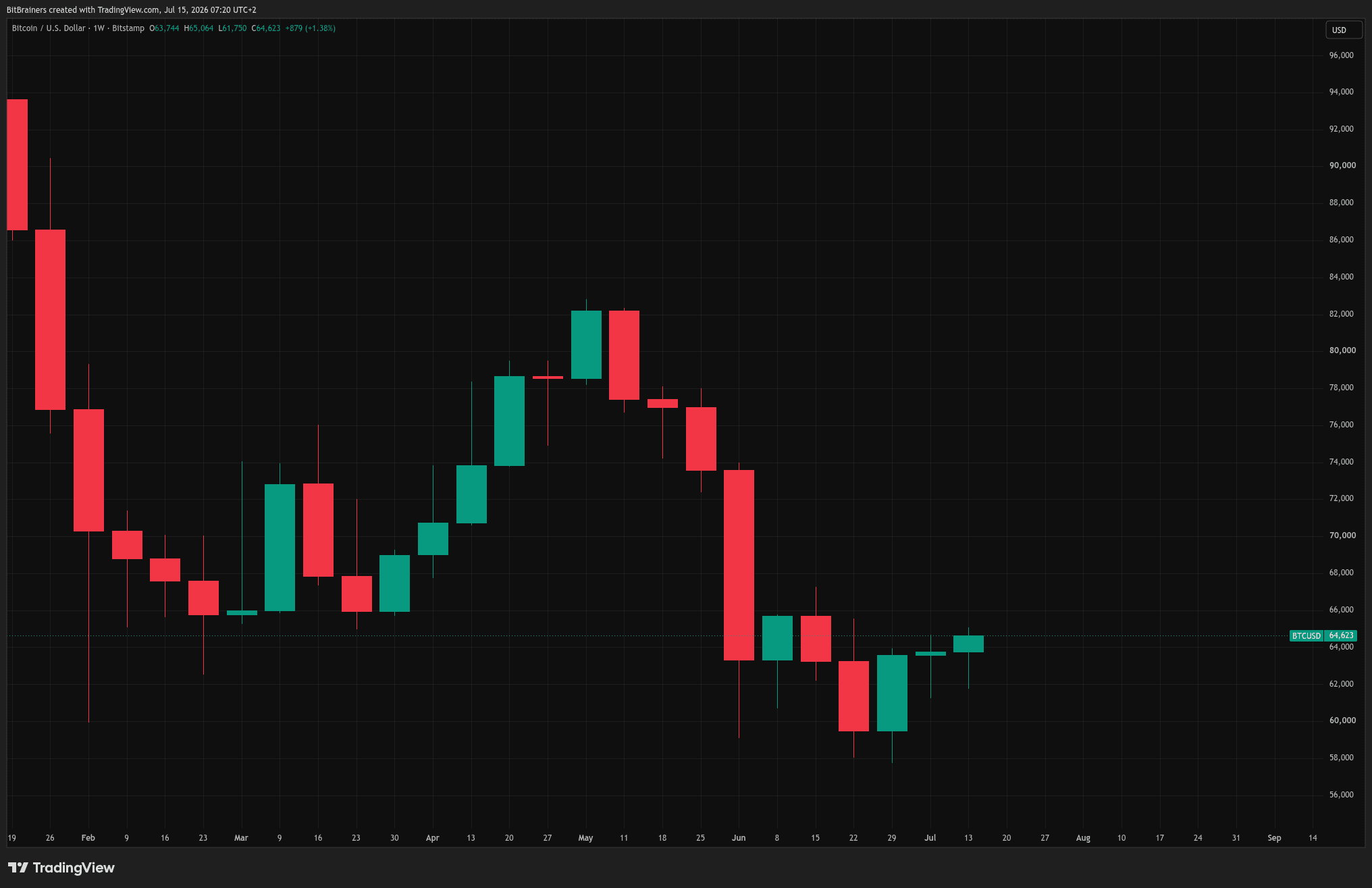
BitBrainers - BTCUSD Weekly Chart July 14 2026

The lesson from five prints: watch core, not headline. Every time core surprised to the downside, Bitcoin rallied regardless of what the headline showed. Every time headline drove the narrative without core relief, the market sold off.

What Today's Number Is Expected to Show


Consensus sits at headline CPI falling roughly 0.1% month-on-month for June, with the annual rate dropping from 4.2% to approximately 3.9%. The driver is straightforward: gasoline prices fell around 10% in June, the fourth largest monthly decline in a decade, as the US-Iran ceasefire temporarily reopened the Strait of Hormuz and reversed the oil spike.

Core CPI, the number the Fed actually targets, is expected to hold at around 2.9% year-on-year with a 0.2% monthly increase.

Here is the catch. The ceasefire ended on July 8. US airstrikes resumed over the weekend. Oil is back above $79 a barrel and the Hormuz situation is again contested. Whatever relief June energy prices provide to today's headline is a backward-looking snapshot of a price level that no longer exists. July's data, released in August, will look materially different.

Shelter costs and tariff pass-through are the other variables. Both remain sticky and neither moved in a helpful direction in recent months. A soft headline driven purely by gasoline reversal, with shelter and services holding firm, gives the Fed nothing to act on.

The macro picture changes faster than the headlines do.

Get BitBrainers analysis in your inbox before the market prices it in.

Subscribe

The Number That Actually Matters


Markets are not pricing today's CPI. They are pricing what Kevin Warsh does on July 28-29. That is the only question that matters for Bitcoin's next significant move.

The Fed meets in two weeks. Warsh has scrapped the practice of telegraphing moves in advance and emphasised data-dependence, which means the July 28-29 decision arrives with almost no preparation and outsized event risk. The market currently assigns roughly a 65% probability of a hold and is already pricing in a rate hike by September.

The two scenarios from here:

Soft print, patient Warsh: Core comes in at or below 2.9%, Warsh signals the Fed is watching but not yet moving. Liquidity narrative improves. Bitcoin recovery toward $64,000-$66,000 opens up, with a test of $70,000 possible if June PCE on July 25 confirms the trend.

Hot core, hawkish signal: Core surprises above 2.9%, Warsh leans into the September hike narrative. Dollar strengthens, risk appetite contracts. Bitcoin retests $58,000-$60,000 support, the zone that defined the June low. A break below $56,200 opens the $50,000-$53,000 range that aligns with the most bearish institutional forecasts.

ETF flows are the secondary signal to watch. Spot Bitcoin ETFs bled roughly $4.5 billion in May and June, the worst stretch since launch. Recent sessions have shown tentative inflows returning. If today's print is soft and inflows hold, the feedback loop that drove the crash can begin to reverse. If outflows resume, it doesn't matter what the headline says.

The CPI print is the short-term noise. The longer signal is liquidity, and Bitcoin has been tracking global M2 with a lag all year. We broke down that relationship in Bitcoin Follows M2 With a Lag Nobody Trades.

What to Watch Into the Close


Warsh delivers his first semiannual testimony to Congress today, ninety minutes after the CPI print. That two-punch combination makes July 14 one of the more consequential single days of the macro calendar this summer.

The levels to watch: $63,800 to the upside, where a break signals the downtrend is likely over. $56,200 to the downside, below which the $50,000-$53,000 zone opens. Bitcoin's weekly RSI is recovering from oversold territory and the 200-week moving average has been tested but not broken on a closing basis. These are not guarantees. They are the lines the market is watching.

Bitcoin has survived five CPI shocks this year. Today is the sixth test. The difference is that the Iran ceasefire that softens the headline has already broken down, and the data the market reads this morning describes a world that ended six days ago.

On The Radar


July 14 (today): June CPI at 8:30am ET. Fed Chair Warsh semiannual testimony to the House, approximately 10:00am ET. Senate testimony Wednesday July 15. JPMorgan, Goldman Sachs and Wells Fargo Q2 earnings today.

July 25: June PCE data, the Fed's preferred inflation gauge and the second inflation input before the FOMC decision.

July 28-29: FOMC meeting. No advance guidance from Warsh. No new dot plot until September. This is the decision that actually moves Bitcoin's next leg.

August: July CPI, which will capture the Iran re-escalation and oil rebound. Expected to look materially hotter than today's print.

Sources


Bureau of Labor Statistics - Consumer Price Index May 2026 Summary

BeInCrypto - Bitcoin Weathered 4 CPI Shocks in 2026: June's Print Lands Today

IG UK - US CPI June 2026 Preview

Yahoo Finance - Bitcoin Price Prediction July 2026

IG UK - Bitcoin Price After CPI: Three Scenarios June 2026

This is market commentary, not financial advice. BitBrainers holds Bitcoin and other digital assets. Nothing here is a recommendation to buy or sell any asset. Do your own research.
Sunday, July 12, 2026

The Loudest Fight in Bitcoin Has 0% of the Hashrate.

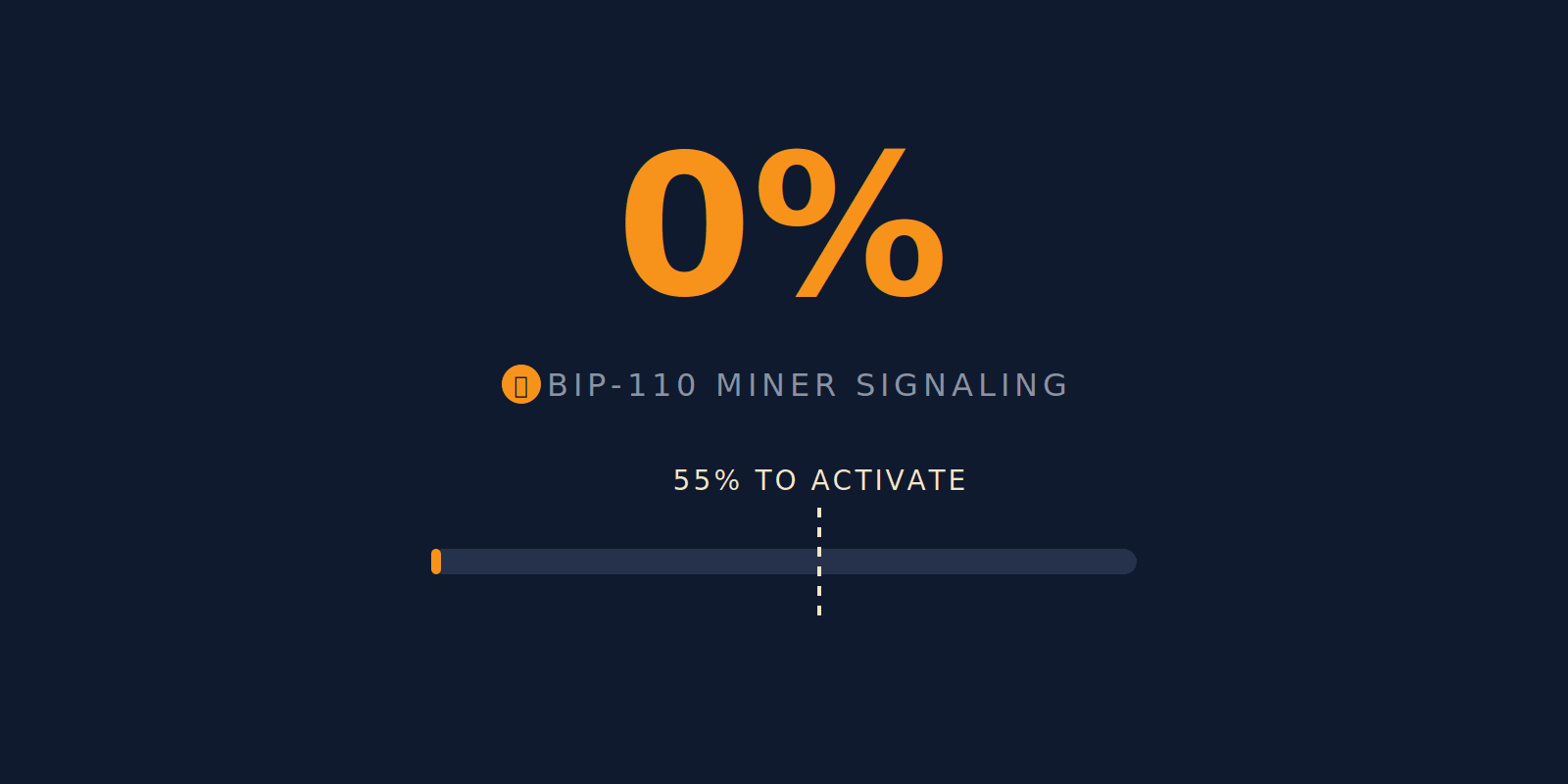
BitBrainers - BIP-110 by the numbers

By BitBrainers Editorial

If you spent any time in crypto feeds this weekend, you saw the war. Hashtags in display names, "power to the plebs," Michael Saylor and Adam Back wading in against it, accounts with six-figure followings declaring victory. The fight is over BIP-110, and judged purely by volume, it looks like the biggest thing happening to Bitcoin right now.

Then you look at the actual network, and the fight almost doesn't exist. That gap is the story.

What BIP-110 Actually Is

BIP-110, formally the Reduced Data Temporary Softfork, is a proposed one-year change to Bitcoin's consensus rules that would cap how much arbitrary data a transaction can carry. Most new outputs would be limited to 34 bytes, OP_RETURN to 83 bytes, and data pushes to 256 bytes. The targets are Ordinals inscriptions, BRC-20 tokens, Runes, and anything else that stores images or token data in block space. The rules would expire on their own after roughly a year.

It exists as a direct reaction to Bitcoin Core v30 removing the 80-byte OP_RETURN limit last October, a decision that split the community hard enough that Core's share of reachable nodes fell from around 98% to roughly 77%, with the stricter Bitcoin Knots client absorbing most of the difference. The proposal was published by a pseudonymous developer called Dathon Ohm, first circulated as BIP-444, and ships through Knots, not Core. Even the BIP editor who assigned it a number called it careless while publishing it anyway, because it met the repository's formal criteria.

One housekeeping note, because mainstream syndication is already garbling this: at least one widely republished article describes BIP-110 as a proposal to let miners vote on which valid block to accept. That is flatly wrong. It is a data-limit soft fork. If you see the miner-voting description, you are reading an outlet that did not check.

The Numbers The Hashtags Don't Mention

For BIP-110 to lock in, 55% of blocks in a single difficulty period need to signal support. That is 1,109 out of 2,016 blocks, and it is already a heavily discounted bar: traditional Bitcoin upgrades have used a 95% consensus standard.

Actual miner signaling has never risen above about 1% in any period since it began in March. In the current period it sits at zero. Not low. Zero.

No major mining pool has committed. Foundry USA, which controls about a third of network hashrate, has not moved. Antpool, at roughly 14%, has not moved. F2Pool refused outright. The signaling that does exist has come almost entirely from Ocean, the pool that mined the first supporting block on March 1.

Node numbers look better for supporters until you squint. Knots runs on somewhere between 8% and 23% of reachable nodes depending on the metric, but only an estimated 2% to 8% of listening nodes run software that can actually enforce BIP-110. Critics, including Jameson Lopp, point out that cheap Tor nodes make raw counts easy to inflate, and independent analysis suggests many BIP-110 nodes trace back to a small number of operators.

The Timeline Is Loud. The Data Is Quiet. We Read Both.

One weekly email separating what the feeds are shouting from what the network is actually doing.

Subscribe

Why The Big Names Picked This Weekend

The volume spiked now because the clock forces it. Enforcing nodes treat blocks 961,632 through 963,647 as a mandatory signaling window, which lands in early August, with activation projected around block 965,664 near September 1. This is the supporters' last stretch to build momentum, which is why the campaign is everywhere right now.

It is also why the heavyweights finally engaged. On Saturday, Michael Saylor posted that there are 110 things more dangerous to Bitcoin than spam, arguing the proposal turns a spam dispute into a consensus change that would invalidate currently valid, fee-paying transactions, and that the precedent is the real danger. Two days earlier he had posted fee data showing the network at 1 sat/vB, his evidence that Bitcoin has no spam problem worth a consensus change in the first place.

Adam Back's opposition cuts deeper, because he cannot be dismissed as a spam apologist. He invented Hashcash fighting spam three decades ago and has said Ordinals-style traffic has no place in the timechain. His position is that a consensus-level fix is worse than the disease: a quest to police other people that trades Bitcoin's credible neutrality for a filter that would not even filter well. His closing message to supporters was that they are free to fork away, but Bitcoin won't be joining them.

The supporters' case deserves a fair statement too, because it is not pure noise. Their argument is that a miner collects a fee once while every node stores the data forever, that filters at the policy level stopped working once Core removed them, and that Bitcoin's identity as money is worth defending at the consensus layer. Reasonable people hold that view. The network, so far, is not signing up for their remedy.

What Actually Matters In August

Whatever your politics on data in blocks, one practical fact survives the noise: enforcing nodes will start rejecting non-signaling blocks in early August. With signaling near zero, that does not change Bitcoin. It splits a small minority of nodes onto their own view of the chain while the rest of the network carries on.

But the transition window is not nothing. Core developer Jon Atack has publicly suggested pausing transfers around the mandatory signaling period, flagging the possibility of short reorgs, slower confirmations, and mempool divergence while the two node populations disagree. Supporters dispute the risk. The cheap insurance either way: avoid large or time-sensitive transactions in that window, and wait for extra confirmations if you can't.

The bigger takeaway is the one this whole episode keeps teaching. Follower counts, hashtags, and pile-ons measure tribal energy. Consensus is measured in signaled blocks, and right now those two numbers are off by orders of magnitude. When the discourse and the data disagree this badly, trust the data. It's the only participant that doesn't have an account.


Sources:
CoinDesk, Bitcoin's BIP-110 fork deadline nears with miner support at zero
Bitcoin.com News, Michael Saylor Declares Bitcoin Has 'No Spam Problem' as BIP-110 Debate Escalates
Cointelegraph, Solution worse than problem? Adam Back opposes BIP-110 Ordinals fix
Bitcoin.com News, Bitcoin Core Developer Warns Users to Pause BTC Transfers When BIP-110 Deadline Nears

This is market commentary, not financial advice. BitBrainers holds Bitcoin and other digital assets. Nothing here is a recommendation to buy or sell any asset. Do your own research.

— BitBrainers Editorial

The Ethereum Foundation Found a Real Bug. The Stat Everyone's Citing Isn't Theirs.

BitBrainers - The Ethereum Foundation Found a Real Bug

By BitBrainers Editorial

On July 9, the Ethereum Foundation's Protocol Security team published a report on an experiment: pointing coordinated AI agents at the code Ethereum's validators actually run. The agents found a real bug. It's the second part of that story that's more interesting than the bug itself.

What The Agents Actually Caught

The bug lives in libp2p's gossipsub, the peer-to-peer messaging layer Ethereum consensus clients use to talk to each other. Send one specially built message and a validator node crashes outright. No special access needed, no authentication, just a peer connection and the right payload.

It's now public as CVE-2026-34219, patched and credited to the Foundation's own team, fixed in libp2p-gossipsub v0.49.4. The flaw lived specifically in the Rust implementation, so clients built on a different language stack weren't exposed to this exact bug. That's Ethereum's client diversity doing its job: a language-specific flaw in one implementation doesn't automatically compromise every validator on the network.

Nikos Baxevanis, who wrote up the experiment, said finding the bug wasn't actually the surprising part.

The Part That Actually Surprised Them

In the team's own words, "the surprise was how little of the work went into finding them." Not the discovery. What came after it: telling the real bugs apart from ones that just looked real.

The team runs several agents in parallel against one codebase, each with a role. Recon turns a section of code into a specific, testable claim instead of a vague audit target. Hunting takes one hypothesis and tries to build something that actually reproduces the failure.

Gap-filling looks at what already got rejected and writes the next round of hypotheses, so the agents stop circling the same ground. Validation checks every surviving candidate independently and throws out duplicates. One rule overrides all four roles: nothing counts as a finding until it reproduces against the real, shipped code.

Three Ways The Agents Fooled Themselves

Most of what the agents flagged wasn't real, and the team was specific about how the false positives kept happening. The first is a panic that only shows up in a debug build, where extra safety checks exist that the shipped software never carries. Run it the way the code actually ships, and nothing breaks.

The second is a reproducer built on a value no real attacker could ever deliver, because every path an outside user actually controls rejects that value before it gets near the vulnerable code. The bug is real only against a function nothing reachable calls that way.

The third shows up in formal verification, where a mathematical proof technically passes but proves something trivial, or a weaker claim than the one that actually mattered. The proof is satisfied without ever constraining the behavior it was supposed to guarantee.

Most Crypto News Skips The Verification Step. We Don't.

One weekly email. The claims we checked, the ones that didn't hold up, and why.

Subscribe

The Number That Isn't Theirs

Here's where it gets interesting for anyone reading crypto press this week. The Foundation explicitly declined to publish its own acceptance rate. Baxevanis wrote that a number tied to one specific target would say more about that target than about the method, so he left it out.

The 86 percent figure now circulating across crypto outlets as if it's Ethereum's success rate actually belongs to Anthropic. It comes from a separate experiment, a property-based-testing agent run across the Python ecosystem, generating roughly a thousand candidate reports before ranking and expert review got the top tier down to that number. The Foundation cited it as a comparison point from another team's work, not as its own result.

That distinction matters more than it looks. One is Ethereum publishing an audited number about validator-critical code. The other is a stat about unrelated Python libraries getting repeated as if the Foundation said it about itself. Same instinct that makes us check a quote against its original source before it goes out here.

This Isn't The First Time

AI-assisted audits already have one real scalp this year. In May, security researcher Taylor Hornby used Anthropic's Claude Opus 4.8 in an audit that found a critical flaw in Zcash's Orchard privacy pool, a bug that had existed for roughly four years and could have let someone mint counterfeit ZEC without leaving an obvious trace on-chain. Zcash patched the immediate hole in a June 3 hard fork, but the deeper problem, no way to prove nothing was ever minted, needed a separate fix. That's Ironwood, formally NU6.3, set to activate July 28 and seal the old pool behind a checkpoint that would expose any counterfeit coins trying to move.

Cloudflare ran a frontier model against its own infrastructure with a similar setup and landed on the same conclusion the Ethereum team did: a narrow, well-scoped target beats scanning everything at once. Three different teams, three different codebases, and they converged on the same bottleneck without comparing notes first.

What Actually Changes From Here

The Foundation says disclosure practices are getting their own follow-up post, worth watching given how much of this space still runs on informal norms. It's also funding a dedicated grant round through its Ecosystem Support Program specifically for AI-assisted protocol security work, so this experiment is becoming a program, not a one-off.

The more immediate thing worth tracking is how fast client teams actually patch. A fixed vulnerability sitting in a GitHub advisory doesn't protect a validator that hasn't updated yet, and gossipsub touches every consensus client on the network. The bug getting fixed is only half the story. Patch adoption speed across the validator set is the other half, and it's the part that doesn't come with a press release.


Sources:
Ethereum Foundation Blog, The triage is the product: running AI agents against Ethereum's protocol code
Decrypt, Ethereum Foundation Turns AI Loose on ETH Network to Find Bugs Before Hackers Do
CoinDesk, AI found an Ethereum bug that could take validators offline, but humans had to prove it

This is market commentary, not financial advice. BitBrainers holds Bitcoin and other digital assets. Nothing here is a recommendation to buy or sell any asset. Do your own research.

Saturday, July 11, 2026

307 Days on One Shelf. Bitcoin Keeps Coming Back to the Same $10,000 Band.

BitBrainers - 307 Days on One Shelf. Bitcoin Keeps Coming Back to the Same $10,000 Band.

By BitBrainers Editorial

Bitcoin has now spent a cumulative 307 days inside the $60,000 to $70,000 band, per Glassnode, making it the third most traded $10,000 range in the asset's history. That count includes most of 2024, when price lived here for months before the run to $126K, plus the current stretch that began this winter. The only two longer ones were the 2018 bear market between $10,000 and $20,000, and the 2022 bear market between $20,000 and $30,000. The company this range keeps tells you what kind of market this is.

Ranges This Long Only Form in One Kind of Market

Both bands ahead of it on the list were bear market bottoms: 2018's $10-20K and 2022's $20-30K. Heavily traded ranges form where sellers have exhausted their urgency but buyers see no reason to chase, and the two sides grind against each other for months at a time.

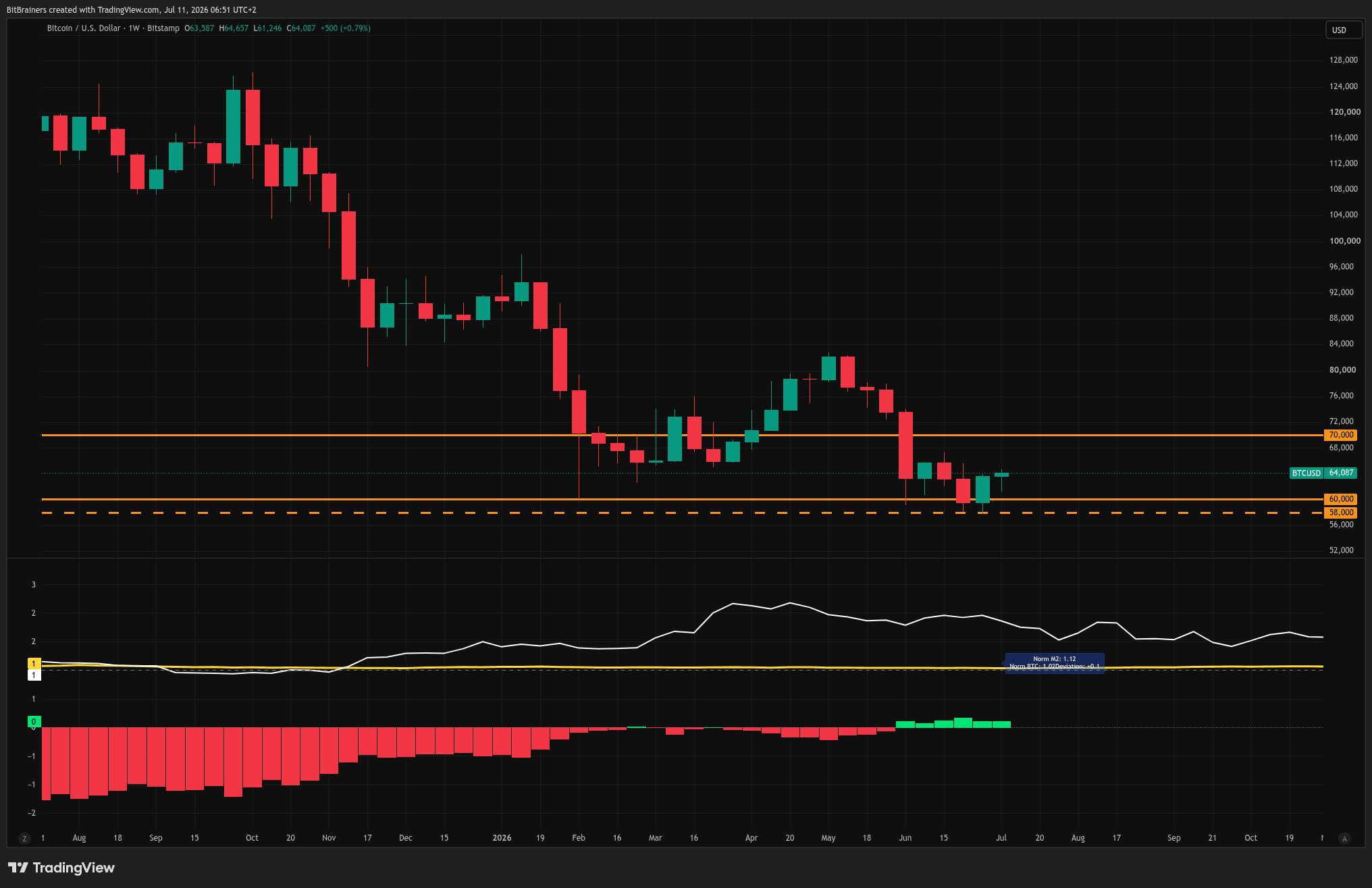
That grind leaves a mark on the chain. Glassnode's cost-basis data shows roughly 6% of the entire circulating supply last changed hands between $58,000 and $64,000, the largest cluster of cost-basis levels in Bitcoin's history. Six percent of all Bitcoin now has its break-even point directly underneath the current price.

That cluster cuts both ways. It acts as support while holders defend their entry, and it becomes a wall of sellers eager to exit at break-even if price dips below it and later recovers. Worth saying plainly: the cluster's existence is also the bull case in miniature. Six percent of supply changing hands here means someone spent ten months buying everything that was sold, and that absorption is demand, not just risk.

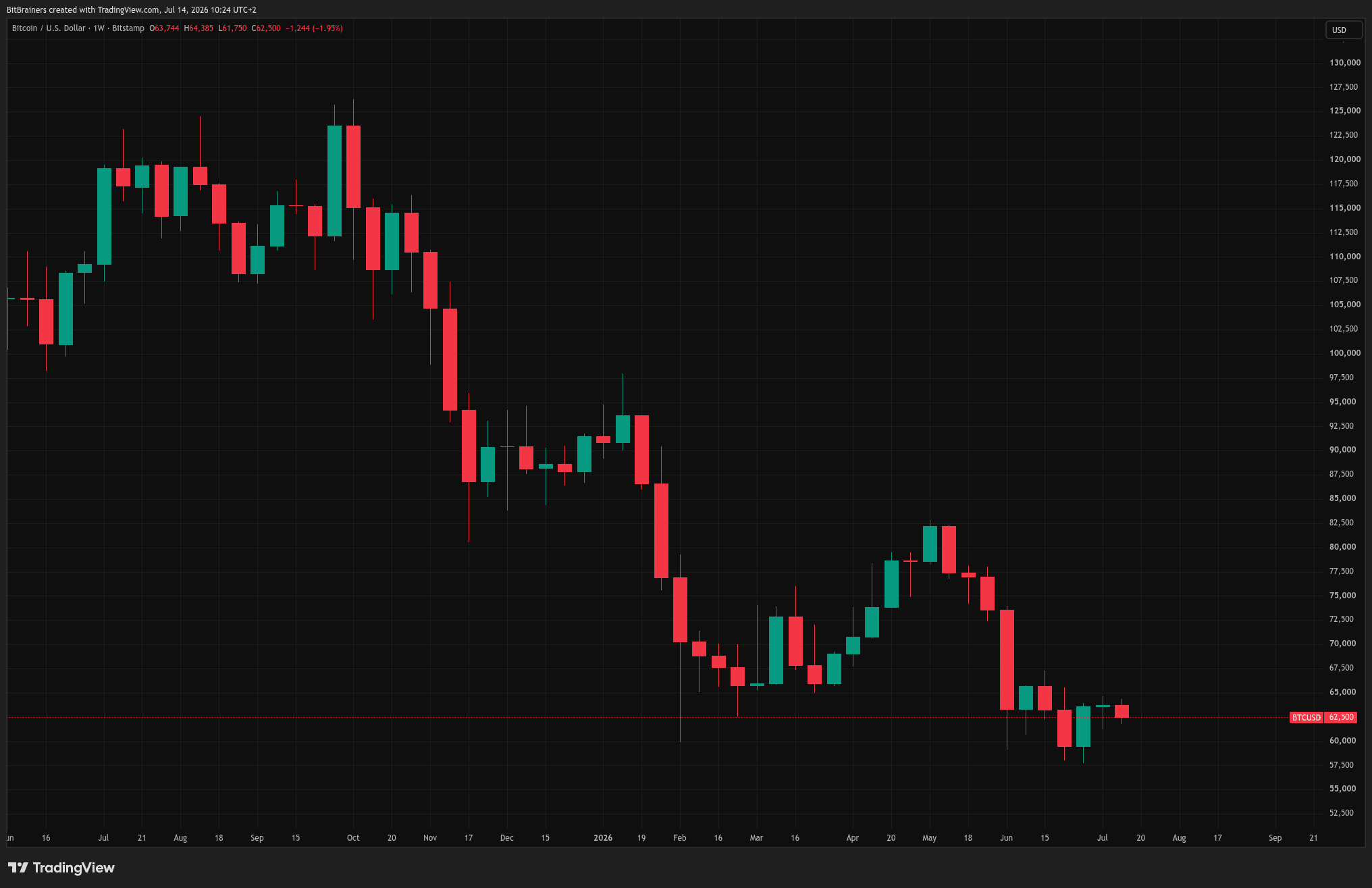
BTCUSD weekly chart with the 60-70K band and 58K cost-basis floor marked

The Line Running Through the Middle

The 200-week moving average sits near $62,873, almost exactly mid-range. Every major Bitcoin bear market has eventually found its floor around this line, and the few times price broke below it, the stay was brief.

So the range isn't random. Price keeps returning to and oscillating around the single most historically reliable long-term support in the asset's history, while half the market calls it a crash and the other half calls it a bottom.

Why This Range Isn't Quite Like the Other Two

There's a structural difference the record-chasing coverage skips. The 2018 and 2022 consolidations both formed after drawdowns of roughly 80% from the prior peak, at levels where nearly everyone who wanted out was already gone.

This range sits only about 50% below the October 2025 high of $126,198. The 2018 and 2022 ranges were exhaustion. This one is happening with far more of the market still holding positions from higher prices, which means far more potential supply overhead if price starts moving up.

CryptoQuant's Ki Young Ju put a related number on it this week: in 2011, $2.7 billion of inflows moved Bitcoin over 55,000%. Each cycle since has needed vastly more money for smaller gains. A $1.28 trillion asset doesn't get pushed out of a range by enthusiasm. It gets pushed out by flows, which is why the ETF numbers matter more than the pattern.

The most familiar range in Bitcoin. One email when it breaks.

We track the levels that matter, not the noise between them.

Subscribe

What the Market Is Actually Pricing

Prediction markets put numbers on the boredom. Polymarket traders give an 83% chance Bitcoin touches $65,000 at some point in July, but only 27% for $70,000, and a 46% chance of sliding back to $60,000 first.

Translated: the market expects the range to hold. High odds of tagging the nearby level, low odds of actually escaping the band, and nearly a coin flip on revisiting the bottom of it. The Fear & Greed index at 27 says sentiment agrees.

ETF flows tell the same undecided story. Thursday's $221.7 million inflow snapped a ten-day outflow streak, then Friday's $95 million outflow snapped the snap. Institutional money is doing exactly what price is doing: nothing, loudly.

The Part the Record Doesn't Tell You

Here is the honest limit of this statistic. The two longer consolidations resolved upward into new bull markets, which makes the pattern tempting to extrapolate. But two prior cases is not a base rate, it's a pair of anecdotes.

One honest note on the statistic itself: most coverage is reporting the 307 days as one continuous trap, and a glance at a weekly chart shows that's wrong, since price was above $100K as recently as November. It's cumulative time across visits. We made the broader argument about patterns and their marketing yesterday in Three Models Walk Into 2026, and it applies to this range too. History says long ranges near the 200-week average have resolved up. History also had a sample size that fits on one hand.

What has a mechanism rather than a pattern is liquidity. Our M2 deviation indicator flipped positive in June and has held there since, meaning global money supply is running ahead of Bitcoin's price while the range grinds on. If that deviation persists and the range still refuses to break upward by autumn, that tells you something real about how much the liquidity relationship has weakened.


The Levels That End This

Ranges this heavily traded don't resolve quietly. Below, the cost-basis cluster starts at $58,000, and losing it puts 6% of supply underwater at once. Above, $67,250 is the June high inside the band, and $70,000 is the ceiling that has held for ten months.

Until one of those gives way, every rally is a trade inside a box, and every dip is too. The cumulative count keeps climbing every week price stays here, and at this pace the band takes the number two spot from 2022 before the year is out. Whether that ends up being a bottom statistic or just a long pause depends entirely on which wall breaks first.

Sources:
CoinDesk: Bitcoin's $60,000-$70,000 range becomes third most traded range in history
TipRanks: Bitcoin's Price Is Trapped Right Now as One of History's Longest 307-Day Slumps Continues
Benzinga (via Yahoo Finance): Bitcoin Has Not Left the $60,000-$70,000 Range in 307 Days: What Is Happening?

This is market commentary, not financial advice. BitBrainers holds Bitcoin and other digital assets. Nothing here is a recommendation to buy or sell any asset. Do your own research.
Every Time the Fed Moved, Bitcoin Felt It.

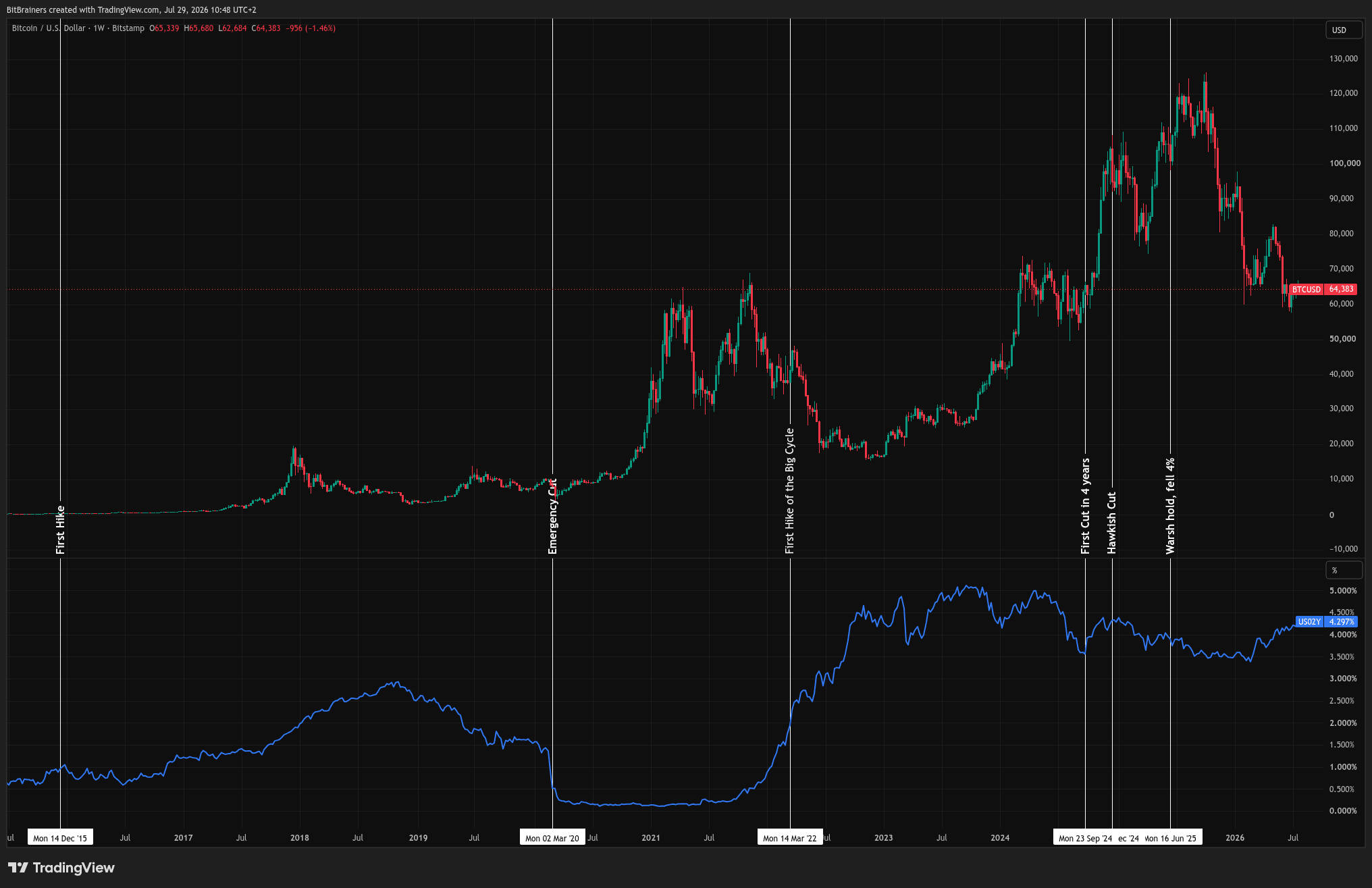
BTCUSD weekly, log scale, with US 2-Year Treasury Yield (lower pane) and FOMC decision dates marked. Source: TradingView / Bitstamp. By...

Every Time the Fed Moved, Bitcoin Felt It.