₿ BTC Loading... via Binance

Thursday, May 21, 2026

Capital Rotation From Asia to Crypto: Is It Already Happening

BitBrainers - Capital Rotation From Asia to Crypto: Is It Already Happening analysis and insights

Something quiet is happening in financial markets right now. Not in the price charts. Not in the headlines. In the plumbing underneath the system, specifically the movement of capital out of Asia and into hard, borderless, portable assets like Bitcoin.

This is not a prediction. The signals are already live.

Asian Investors Have Been Burned by Their Own Markets Before

Japan, South Korea, and Taiwan are three of the most financially sophisticated retail investor bases in the world. They have also watched their domestic markets eat them alive through currency devaluation, geopolitical tension, and central bank policy that punishes savers. Japanese investors in particular have lived through decades of yield suppression from the Bank of Japan, a policy framework that makes holding yen a guaranteed slow bleed.

When domestic assets fail to preserve purchasing power, capital moves. It moved into US equities for years. It moved into real estate. Now, with BTC sitting at $77,792 as of May 22, 2026, and global macro uncertainty at elevated levels, the question is whether it is moving into crypto in a meaningful way.

The answer appears to be yes, and the evidence is in the order flow, not the news.

South Korea Runs One of the Most Active Retail Crypto Markets on Earth

South Korea is not a small player here. Seoul has hosted some of the highest Bitcoin trading volume relative to GDP of any country in the world, a fact that has been documented consistently since at least 2017. The so-called Kimchi Premium, where BTC trades at a higher price on Korean exchanges than global benchmarks, has historically appeared when domestic Korean retail demand surges.

That premium has been observed again in recent weeks. It does not always appear for benign reasons. Sometimes it signals panic buying. Sometimes it signals capital flight dressed up as speculation. Either way, the direction of flow tells you something real about how Korean retail investors currently feel about holding Korean won-denominated assets.

Upbit and Bithumb, the two dominant Korean exchanges, continue to process trading volumes that rival several tier-one global platforms. That is not a coincidence. That is infrastructure built for a population that treats crypto as a serious capital allocation tool, not a curiosity.

The Yen Is the Canary in the Coal Mine for Bitcoin Demand

Japan's monetary situation is one of the most important macro signals for crypto traders globally, and almost no one outside of macro desks talks about it seriously. The Bank of Japan has been walking a tightrope between decades of ultra-loose policy and the pressure to normalize rates as inflation finally showed up in the Japanese economy.

When the yen weakens, Japanese investors holding yen-denominated assets watch their real purchasing power erode in real time. That creates a strong behavioral incentive to diversify into assets outside the yen system. Gold has historically captured some of this flow. Bitcoin, increasingly, is capturing more of it.

Japanese retail investors are not naive. They have watched the yen depreciate substantially over the past several years. They also live in a country where the government formally recognized Bitcoin as legal tender for exchange purposes back in 2017, making it one of the earliest regulated crypto environments globally. The infrastructure for Japanese capital to enter Bitcoin is mature, legal, and well-understood.

Most People Do Not Know This About Chinese Capital and Crypto

Here is something most crypto blogs miss entirely. China banned crypto trading domestically. But Chinese capital does not stop moving because of a government ban. It reroutes.

Hong Kong has been positioning itself as a regulated crypto hub since at least 2023, explicitly creating a legal framework to attract institutional and retail crypto activity. This matters because Hong Kong functions as a pressure valve for mainland Chinese capital. Wealthy mainland Chinese nationals have used Hong Kong as a routing mechanism for capital movement for decades. The new crypto licensing regime in Hong Kong did not happen by accident. It happened because demand exists and the city made a strategic choice to capture it.

Over-the-counter Bitcoin desks in Hong Kong continue to operate at scale. Stablecoin volumes in Asia remain enormous, and stablecoin inflows into exchanges often precede Bitcoin buying. That pipeline from mainland China through Hong Kong and into crypto assets is active. It is not visible on a standard price chart but it shows up in OTC order flow and stablecoin issuance data.

The Taiwan Strait Creates a Structural Demand for Portable Wealth

Taiwan deserves its own section and almost never gets one in crypto analysis. Taiwan sits in one of the most geopolitically exposed positions of any advanced economy. The ongoing tension around the Taiwan Strait has not resolved. It has simply become background noise that markets price in inconsistently.

Taiwanese businesspeople and high-net-worth individuals understand this risk in a way that Western traders do not. When you live under genuine geopolitical uncertainty, portable, borderless, seizure-resistant assets have real utility beyond speculation. Bitcoin at $77,792 is not just a risk-on trade for a Taiwanese investor thinking about capital preservation. It is potentially a survival asset.

This is the contrarian insight: most Western traders frame Asian capital rotation into crypto as a macro trade driven by yield differentials and currency weakness. Some of it is. But a meaningful portion of it is driven by genuine political risk assessment. These are investors who have thought seriously about scenarios where traditional financial infrastructure becomes unreliable or inaccessible. Bitcoin solves a specific problem for them that no US equity ETF can solve.

The Current Market Is Reflecting This Flow in Subtle Ways

In the past 7 days, BTC has held support above $76,000 multiple times despite macro headwinds from the US dollar and bond market volatility. That kind of demand-side resilience at these levels does not come from one type of buyer. It suggests multiple buyer pools absorbing selling pressure from different time zones and motivations.

Asian market hours, roughly 1:00 AM to 8:00 AM UTC, have shown notable bid support during periods when US-based traders are offline. This is not guaranteed confirmation of Asian capital rotation. But it is consistent with it.

The Grayscale Bitcoin Trust and spot Bitcoin ETF flows have been dominated by US institutional demand. What is harder to measure is the direct exchange flow from Korean, Japanese, and Hong Kong-based platforms directly into on-chain Bitcoin wallets. That flow bypasses the ETF wrapper entirely and does not show up in the institutional allocation data that US finance media focuses on.

Holding Your Own Keys Matters More When Capital Is Moving Across Borders

If you are watching this rotation and positioning accordingly, the security question becomes critical. Cross-border capital movement into crypto means assets that need to be held securely and privately. Exchange-held assets are one risk vector. Self-custody removes it.

A hardware wallet like the Trezor is not a nice-to-have in this environment. It is the difference between actually owning your Bitcoin and having a claim on someone else's ledger entry. For capital that has rotated out of a national financial system for specific reasons, the last thing you want is counterparty risk with a centralized exchange.

For actual trading and liquidity, Kraken is one of the longer-running platforms with a track record that dates back to when most crypto projects did not exist yet. Liquidity matters when you are trying to execute at meaningful size.

The Assumption You Brought Into This Post Is Probably Wrong

Most traders reading this assumed that if Asian capital rotation were happening at scale, Bitcoin would be trading significantly higher. The logic seems clean. More buyers equals higher price. But capital rotation does not work like a light switch. It works like a tide.

The capital moving from Asia into Bitcoin right now may be exactly what is holding BTC at $77,792 rather than $60,000. It may not be the catalyst for the next leg up. It may be the structural floor that everyone will only recognize in retrospect. Rotation provides support before it provides moonshots. The people who understand that hold through the quiet accumulation phase instead of waiting for the obvious signal that arrives after the move is already done.

Watch the Kimchi Premium on Korean exchanges and the stablecoin issuance data out of Hong Kong. When both start running together, the quiet rotation becomes loud. That is your real signal to pay attention to, not the next US CPI print.


Disclosure: This post contains affiliate links to Trezor and Kraken. BitBrainers may earn a commission at no extra cost to you. This is not financial advice.


BitBrainers. Follow the data, not the noise.

When Your Employer Pays You in Tokenized Assets Not Dollars

BitBrainers - When Your Employer Pays You in Tokenized Assets Not Dollars analysis and insights

MoonPay just launched a platform specifically designed to let banks distribute tokenized assets and connect into DeFi markets. That happened this week. Most people read that headline and thought it was about crypto trading. It is not. It is about payroll.

The rails for paying workers in tokenized real-world assets are not theoretical. They are being assembled right now, piece by piece, and most employees have no idea what is coming at them.

The Payroll System Has a Design Flaw That Tokenization Directly Solves

Traditional payroll runs on ACH rails built in the 1970s. Transfers take one to three business days, settlement is opaque, and cross-border payments lose value to FX fees at every step. For a global workforce in 2026, this is not a minor inconvenience. It is a structural failure.

Tokenized assets solve the settlement problem at the root level. When a paycheck is issued as a tokenized asset on a blockchain, settlement happens in seconds, not days. The employer does not need a bank correspondent network to pay a contractor in Manila or Lagos.

Bitcoin proved this was possible. BTC moves across borders in under ten minutes, 24 hours a day, 365 days a year, with no intermediary deciding whether the transfer is approved.

MoonPay Just Handed Banks the Keys to Token-Based Compensation

On May 21, 2026, MoonPay announced a new platform explicitly targeting banks and their ability to distribute tokenized assets and access DeFi markets. This is not a consumer crypto product. This is B2B infrastructure aimed at institutions that currently hold the relationship with your employer.

When banks can issue and distribute tokenized assets at the institutional level, the next logical step is compensation. A company treasury holding tokenized U.S. Treasuries or tokenized equity can route those assets directly to an employee wallet without converting to fiat first.

This collapses three steps into one. The employer saves on FX conversion, the bank earns custody and distribution fees, and the employee receives an asset that may appreciate rather than inflate away.

Bitcoin Sits at the Top of This Stack Whether Institutions Admit It or Not

Tokenized assets and Bitcoin are not competing ideas. They occupy different layers of the same emerging system. Tokenized real-world assets like Treasury bills or real estate fractions are productivity tools. Bitcoin is the reserve asset underneath them.

An employee paid in tokenized T-bills is receiving yield-bearing dollar-denominated exposure. An employee who converts a portion of that compensation into BTC at current prices of $77,271 is making a monetary decision about long-term purchasing power preservation. Both behaviors will become routine within the next decade.

The critical point is that Bitcoin does not need employers to adopt it directly. It only needs the tokenization rails to exist, and those are being built right now by institutions like MoonPay and the banks they serve.

Most People Do Not Know This: The Legal Framework Already Exists in Several Jurisdictions

Here is the insider detail most crypto blogs skip entirely. In Switzerland, El Salvador, and several U.S. states, employers can already legally compensate workers with digital assets as part of a broader compensation package. The legal barrier is not as high as most HR departments assume.

Wyoming passed a series of blockchain-friendly statutes that give digital assets legal property status. Switzerland has had a permissive digital asset compensation framework for years. El Salvador made it explicit at the national level. This is not future legislation. These laws are active today.

The real blocker right now is not law. It is accounting software. QuickBooks and SAP were not built to handle tokenized payroll. But that is a tooling problem, not a legal problem, and tooling problems get solved fast when there is money involved.

The Contrarian Take: Stable Employment Is the Biggest Risk Factor Here, Not Volatility

Every mainstream concern about crypto payroll focuses on price volatility. That is the wrong thing to worry about. The real risk is that workers with stable fiat salaries are sitting in a currency that loses real purchasing power every year, measured against goods, housing, and energy costs.

An employee paid in tokenized assets linked to Bitcoin or even tokenized hard assets has more transparent exposure to real value than someone holding depreciating fiat in a checking account earning near-zero interest. Volatility cuts both ways. Inflation only cuts one way.

The assumption most readers arrive with is that crypto payroll is riskier than dollar payroll. That assumption deserves a hard look in a world where the dollar's purchasing power declines predictably and structurally.

DeFi Integration Means Your Compensation Package Could Earn While It Sits

The MoonPay platform specifically targets DeFi market access for banks. That detail matters enormously for the future of compensation. A tokenized salary that sits in a DeFi-compatible wallet can be deployed into yield-generating protocols without the employee touching it manually.

This is not a savings account at 0.01% annual yield. DeFi lending markets have historically offered meaningfully higher yields on dollar-denominated stablecoins than traditional bank products. When your employer can directly deposit tokenized assets into a wallet you control, you gain the ability to put that compensation to work immediately and automatically.

This fundamentally changes the relationship between income and wealth-building. Right now those are two separate steps. Tokenized payroll collapses them into one.

The Wallet Question Is the One Nobody Is Asking Loudly Enough

If your compensation arrives as a tokenized asset, the custodianship question becomes urgent. When your paycheck is a dollar amount in a bank account, the bank holds custody and provides FDIC insurance up to $250,000. When your paycheck is a tokenized asset in a wallet, you are responsible for what happens to it.

This is where self-custody hardware becomes a professional necessity, not a hobbyist choice. A device like a Trezor hardware wallet moves your assets off exchange servers and into cold storage that only you control. You can explore Trezor's lineup at Trezor's site if you are thinking seriously about what self-custody looks like for an asset-based compensation future.

Exchanges will also matter more in a tokenized payroll world. When you need to convert between tokenized assets, or move BTC into fiat for living expenses, you want an exchange with deep liquidity and a multi-year track record. Kraken fits that profile. You can set up an account through this link and have the infrastructure ready before your employer does.

Employers Will Use Tokenized Payroll to Retain Talent Before Governments Regulate It

Corporate adoption of tokenized compensation will move faster than regulatory clarity, not because companies are reckless, but because the competitive pressure to retain global talent is immediate. A tech company with remote employees in 40 countries has a real incentive to offer low-friction, low-fee tokenized payroll before the IRS or Treasury finishes writing the rules.

We saw this same pattern with equity compensation in the 1990s. Options and restricted stock units spread across Silicon Valley well before the tax treatment was fully standardized. The tooling followed the behavior. Expect the same dynamic with tokenized compensation.

The first industries to move will be crypto-native firms, followed quickly by tech companies with international payroll complexity. Traditional industries will follow within five to seven years once the tooling infrastructure matures.

What You Should Do Today to Be Ready for This Shift

Stop treating crypto infrastructure as something you set up after you need it. The time to understand self-custody, on-chain wallets, and exchange accounts is before your employer asks you to fill out a new direct deposit form that requires a wallet address.

Get a hardware wallet now and learn how it works with zero pressure. Trezor's interface is straightforward enough to practice with small amounts before anything high-stakes depends on it. Visit Trezor here and start the setup process this week.

Open a Kraken account and understand how to convert between tokenized assets and local fiat. Kraken's platform supports a wide range of assets and jurisdictions, which matters when tokenized payroll is inherently cross-border. The readers who understand these tools before tokenized payroll becomes mainstream will have a significant structural advantage over those scrambling to learn them under time pressure.

The assumption that your employer controls what your paycheck looks like is about to become a negotiating point, not a fixed constraint. That shift is closer than most employees think, and the infrastructure being built right now is what makes it possible.


Disclosure: This post contains affiliate links to Trezor and Kraken. BitBrainers may earn a commission at no extra cost to you. This is not financial advice.

Sources
CoinDesk. MoonPay expands into tokenized assets and DeFi markets with new platform for banks

BitBrainers. We check the facts so you don't have to.

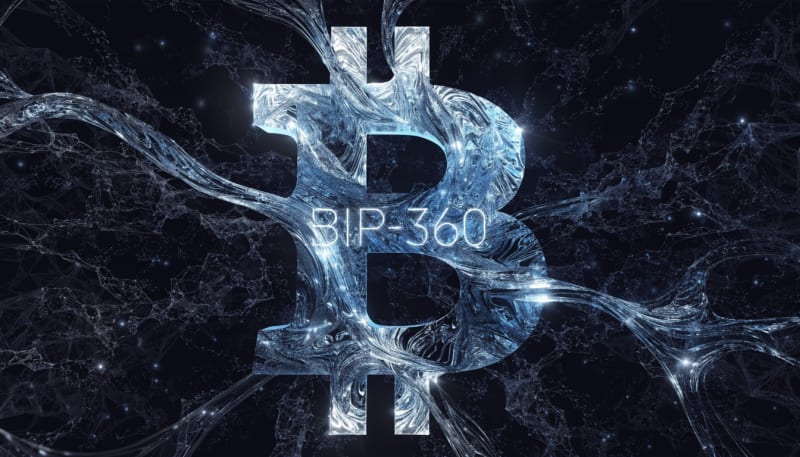
32% of All Bitcoin Is Vulnerable. BIP-360 Is What Developers Built to Fix It.

BitBrainers - 32% of All Bitcoin Is Vulnerable. BIP-360 Is What Developers Built to Fix It.

Most people in crypto are watching price charts and ETF flows. A small group of Bitcoin developers is working on something that will matter far more in the long run: making sure Bitcoin still exists and still works when quantum computers become powerful enough to break the encryption that currently protects every wallet on the network.

That work has now moved from theory to testnet.

The Threat Is Real, Even If the Timeline Is Uncertain

Bitcoin's current security relies on two signature schemes: ECDSA and Schnorr. Both are vulnerable to Shor's algorithm, a mathematical method that a sufficiently powerful quantum computer could use to reverse-engineer a private key from a public key. Once a public key is exposed on-chain, which happens every time you spend from an address, the clock starts ticking.

Most researchers believe a quantum computer capable of breaking Bitcoin's encryption is still years to decades away. But the US government is not waiting. Federal agencies faced an April 2026 deadline to submit post-quantum cryptography transition plans under National Security Memorandum 10. The European Union has set a 2030 target for quantum resistance across critical infrastructure. Canada implemented new procurement requirements aligned with post-quantum cryptography in April 2026.

Governments are treating this as an operational deadline. Bitcoin developers are responding.

The Number That Frames the Urgency

Approximately 6.51 million BTC, roughly 32.7% of all circulating supply, currently sit in addresses with exposed public keys. These are addresses that have already been spent from at least once, meaning the public key is visible on-chain. That is the population of coins that would be vulnerable first if a quantum computer capable of running Shor's algorithm emerged tomorrow.

BlackRock flagged quantum computing as a material threat to Bitcoin in its ETF filings. Coinbase analyst David Duong identified the same 6.51 million BTC figure as the core vulnerability. This is not fringe concern. It is showing up in institutional risk assessments.

What BIP-360 Actually Proposes

BIP-360 was formally proposed in September 2024, merged into Bitcoin's official BIP repository on February 11, 2026, and entered live testnet implementation in March 2026. The proposal introduces a new output type called Pay-to-Merkle-Root, or P2MR.

The design mirrors Bitcoin's existing Taproot upgrade (P2TR) with one critical difference: it eliminates the key-path spend mechanism. In current Taproot transactions, a single public key sits directly on the blockchain during the key-path spend. That exposed public key is the attack surface. P2MR removes it entirely, hiding all spending conditions inside a Merkle tree of scripts and only revealing the branch being used at spend time.

In practice, P2MR transactions would use Dilithium signatures instead of ECDSA or Schnorr. Dilithium, now standardized by the US National Institute of Standards and Technology as ML-DSA, is a lattice-based signature scheme that quantum computers cannot break using known algorithms. New addresses using bc1z encoding would be quantum-resistant from the moment of creation.

The Testnet Is Already Running

BTQ Technologies deployed Bitcoin Quantum testnet v0.3.0 on March 19, 2026. As of that date, the network had run more than 50 miners and processed over 100,000 blocks. People are creating and spending P2MR transactions on a live network right now. This is not a whitepaper anymore.

The testnet implementation includes five Dilithium post-quantum signature opcodes enabled in P2MR tapscript context. Compatibility with existing Bitcoin infrastructure, including the Lightning Network, was preserved in the design, which suggests the developers are prioritizing practical adoption over theoretical purity.

The Migration Problem Is the Hard Part

BIP-360 solves the forward-looking problem. New addresses created with the upgrade would be quantum-resistant from day one. The harder problem is the existing 6.51 million BTC sitting in vulnerable addresses right now.

BIP-361, co-authored by Casa CTO Jameson Lopp, addresses this directly. The proposal would give Bitcoin holders approximately five years to migrate their coins to quantum-resistant addresses after activation. Coins that fail to migrate within that window would become permanently unspendable on the network.

That is a significant proposal. Permanently freezing coins that belong to people who simply lost their keys, died, or failed to act in time is not something the Bitcoin community will adopt without extensive debate. BIP-361 is currently in informational status and requires no immediate action. But it frames the stakes clearly: the migration problem will eventually need a solution, and every year without one is another year of accumulated risk.

What Comes Next

BIP-360 is still a draft proposal. It has not been reviewed or endorsed by Bitcoin Core developers as a whole. The Bitcoin upgrade process is deliberately slow, requiring extensive peer review, security audits, and community consensus before anything touches mainnet. The testnet deployment is a proof of concept, not a deployment timeline.

But the direction of travel is clear. Governments are on post-quantum timelines. Institutions are flagging quantum risk in formal filings. Developers have moved BIP-360 from concept to live testnet in under six months. The upgrade cycle on Bitcoin mainnet could take several years from here. That means the work needs to start now.

The people who understand Bitcoin's long-term security posture are already treating this as an active engineering problem, not a distant theoretical one. The rest of the market will catch up eventually.

What Individual Holders Should Do Right Now

BIP-360 has not activated on mainnet. Quantum computers capable of breaking Bitcoin's encryption do not exist today at the required scale. The threat is real but not immediate. That does not mean individual holders have nothing to do.

The practical step that matters now is address hygiene. If you have Bitcoin sitting in an address that has already been spent from, your public key is exposed on-chain. That is the population of coins most vulnerable in any quantum scenario. The fix is simple: move those coins to a fresh address that has never been spent from, preferably a Taproot address using a hardware wallet.

A Trezor generates fresh addresses automatically for each transaction and supports Taproot natively. Moving your coins does not require waiting for BIP-360. It just requires generating a new receive address, sending your BTC there, and never reusing the old address again.

The window for easy migration is open now, before any urgency exists. The people who will scramble are the ones who wait until a quantum threat is imminent and then try to move coins under time pressure. The people who act now have nothing to worry about. Moving to a fresh address costs one transaction fee and takes ten minutes. There is no reason to wait.


Disclosure: This post contains affiliate links to Trezor and Kraken. BitBrainers may earn a commission at no extra cost to you. This is not financial advice.

Sources
Nasdaq / BTQ Technologies. BTQ Technologies Announces First Deployment of BIP 360 on Bitcoin Quantum Testnet v0.3.0

CryptoTimes. Bitcoin's Quantum-Resistant Future Gets Real as BIP-360 Goes Live on Testnet

Bitcoin.com. Bitcoin Developers Propose Freezing Coins That Skip Quantum-Safe Migration Under BIP-361

CoinGenius. Bitcoin BIP-360 Quantum-Resistant Upgrade Goes Live On Testnet

BitBrainers. We check the facts so you don't have to.

Why Bitcoin Keeps Rejecting at Round Numbers and What Comes After

BitBrainers - Why Bitcoin Keeps Rejecting at Round Numbers and What Comes After analysis and insights

$80,000. Bitcoin has touched it, flirted with it, and bounced off it like a wall. Right now, with BTC sitting at $78,022, the same tired drama is playing out again. Most traders are staring at the chart asking why. The real question is how the mechanism actually works, because once you understand it, you stop trading against it.

Round Number Rejection Is a Market Structure Problem, Not a Psychology Problem

Everyone says round numbers are "psychological resistance." That framing is lazy. It reduces a complex mechanical process to vibes and feelings. The reality is more specific and more useful to you as a trader.

At every major round number, you have a convergence of three separate forces hitting at the same time. Options market makers hedging delta exposure. Large institutions placing limit sells at clean levels for order management. Retail momentum traders setting profit targets at the obvious number. These three groups do not coordinate. They just all show up at $80,000 on the same day, and the math does the rest.

Options Market Makers Are the Part Nobody Talks About

Here is the insight most crypto blogs miss entirely. At major round numbers, the concentration of open interest in options contracts is enormous. Market makers who sold those options are short gamma near those strikes. When price approaches $80,000, they are forced to sell spot Bitcoin to hedge their exposure. They are not bearish. They are not making a prediction. They are running risk management software that tells them to sell.

This is not unique to crypto. It happens in equities, forex, and commodities wherever options markets are liquid. But in Bitcoin, because the market is relatively thin compared to traditional assets, the impact of that hedging pressure is outsized. You are not fighting traders at $80,000. You are fighting a mathematical obligation.

$20,000 Was the First Major Teaching Moment

The $20,000 level was the clearest early example of how this dynamic plays out. BTC approached that level multiple times, rejected hard each time, and then eventually broke through and accelerated violently to the upside. The rejection was not a ceiling. It was a compression zone. When the options market finally repriced and the hedging flow dried up, there was no natural supply left to stop the move.

The same pattern repeated at $50,000, at $60,000, and most famously at $69,000. Each of these levels had months of failed attempts followed by either a decisive break or a brutal reversal. The chart pattern looks like indecision. The underlying mechanic is actually a battle between directional buyers and forced hedgers.

The $100,000 Break Tells You Everything About What Comes After

When Bitcoin finally broke $100,000, the move above it was violent and fast. That is exactly what you would expect if the rejection mechanism is primarily mechanical rather than fundamental. Once the gamma exposure at a strike cluster is cleared, the forced selling stops. If organic demand still exists, price fills the vacuum quickly.

The implication for $80,000 right now is direct. Either Bitcoin grinds through it and accelerates, or it loses $80,000 and we see a flush toward the next significant level where buyers are sitting. There is no slow drift in either direction. These breaks or rejections at round numbers tend to resolve with conviction once the compression period ends.

Macro Noise Amplifies Every Rejection

This week, news broke that Trump's Bitcoin ETF plans likely collapsed before getting off the ground. That kind of headline lands differently when BTC is already stalling at a round number. It does not create the resistance. But it feeds the narrative that gives hesitant sellers a reason to act, and hesitant buyers a reason to wait.

Institutional positioning is sensitive to headline risk in a way retail positioning is not. A fund manager who was planning to add at $79,000 sees that headline and decides to wait for clarity. That marginal demand disappearing at exactly the wrong level is how sentiment amplifies a mechanical dynamic into a longer consolidation. The story becomes the justification for something that was already happening in the order book.

What the Flush Looks Like When It Comes

When Bitcoin breaks convincingly below a contested round number, the move is almost always faster than traders expect. The reason is that most stop losses cluster just below the round number. When those triggers trip, they create market sell orders that accelerate the move downward. What looks like a minor breach of $80,000 can turn into a $5,000 to $7,000 drop within hours as those stops chain together.

This is not a prediction about where BTC goes from $78,022 today. It is a description of the mechanical anatomy of what a failed round number looks like after the fact. Knowing the shape of the move in advance is more useful than guessing direction.

Consolidation Around Round Numbers Has a Specific Time Pattern

Most significant round number consolidations in Bitcoin history have lasted between 2 and 8 weeks before resolving. After 8 weeks of price compression near a major level, the structure typically breaks one way or the other with significant follow-through. If you are watching a chart that has been grinding around the same number for over a month, you are close to a resolution.

What traders miss is that the length of compression correlates with the size of the move that follows. A 6-week consolidation at $80,000 stores more energy than a 2-week one. The longer the market structure builds, the more stop clusters accumulate on both sides, and the more violent the eventual break becomes.

The Contrarian Read on Round Number Fear

Here is the part most traders get completely wrong. They treat round number rejection as bearish signal. They see BTC hit $80,000, pull back, and assume the market is telling them something negative about underlying demand.

The opposite framing is more accurate. The fact that Bitcoin is close enough to $80,000 to trigger the gamma hedging mechanism means buyers have been strong enough to push price into that zone. The mechanical selling you see at the round number is not evidence of weak demand. It is evidence of price being in the range where demand is strong enough to compress against forced supply. Every test of a major round number is actually a stress test of the buy-side. Multiple failed tests do not necessarily mean the buyers are losing. They mean the buyers are absorbing.

Here Is What You Need to Actually Watch Right Now

Stop watching the candle at $80,000. Watch the depth of pull-backs when BTC rejects. Shallow pull-backs after rejection, where price only drops a few hundred dollars before buyers step in, indicate that the buying pressure is still intact. Deep pull-backs, where price drops multiple thousands of dollars on low volume before finding support, indicate the buy-side is thinning out.

If you are holding BTC through this compression, you already know the security setup matters as much as the trading setup. A hardware wallet like Trezor keeps your stack offline and out of reach during the kind of volatile swings that round number rejections produce. And if you are actively trading this structure, Kraken gives you the order types and liquidity depth to actually execute around these levels without getting wrecked by slippage.

The Assumption You Walked In With Is Probably Wrong

You probably came into this post believing that breaking above a round number is the hard part. That once Bitcoin clears $80,000 or $100,000 or whatever the current target is, the work is done. The data says the opposite. The break above a round number is often the easy part. The retest after the break is where most traders give back their gains, because they assume the level is now support when it is still a high-density option strike zone. The mechanics do not flip instantly just because price closed above a number. The real confirmation comes when BTC retraces to a former round number, consolidates above it for at least 2 full weeks, and then resumes the uptrend. That is the signal. Not the initial break.


Disclosure: This post contains affiliate links to Trezor and Kraken. BitBrainers may earn a commission at no extra cost to you. This is not financial advice.

Sources
CoinDesk. Why Trump's bitcoin ETF plans likely collapsed before getting off the ground

BitBrainers. Follow the data, not the noise.
Wednesday, May 20, 2026

Smart Money Is Loading Bitcoin While You Are Panic Selling

BitBrainers -  Smart Money Is Loading Bitcoin While You Are Panic Selling

Bitcoin has dropped for five consecutive days. It is down 13% this year. Retail sentiment is in the gutter. And yet, on Bitfinex, one of the oldest and most closely watched crypto exchanges in the world, leveraged traders are doing the opposite of panicking.

They are buying more.

The Number That Matters

Margin long positions on Bitfinex have climbed to 80,636 BTC, their highest level since December 2023. That is a two-and-a-half year high, reached during one of the weakest stretches of price action Bitcoin has seen all year.

To understand why this is significant, you need to understand what a margin long actually represents. These are not spot purchases. These are leveraged bets, positions opened with borrowed funds, placed by traders who are confident enough in Bitcoin's upside to take on amplified risk at exactly the moment when most people are reducing exposure.

The traders doing this on Bitfinex are not retail. The exchange has historically attracted sophisticated, high-capital participants. When margin longs on Bitfinex spike during a downturn, the market pays attention.

This Has Happened Before

The pattern is not new. Bitfinex margin longs have a documented history of expanding during periods of maximum fear and contracting near local market tops. It happened during the FTX collapse in November 2022. It happened during the August 2024 carry-trade unwind. It happened again during the tariff-driven selloff in April 2025.

In each of those cases, the buildup of leveraged longs on Bitfinex preceded a significant price recovery.

That does not guarantee the same outcome this time. But it is a pattern worth understanding before you decide whether to sell.

Where Bitcoin Actually Stands

The current price weakness has pushed Bitcoin into a technically important zone. The asset is now testing two critical levels simultaneously: the True Market Mean, which represents the aggregate cost basis across all Bitcoin holders, and the short-term holder realized price, which tracks the average acquisition price of anyone who bought Bitcoin in the last 155 days. Both sit near $78,000, just above current spot prices.

Above that, the 200-day moving average sits at roughly $81,000. That is three levels of resistance stacked within a $4,000 range. Getting through all three cleanly would signal a meaningful shift in momentum. Failing to do so would put further downside pressure on the price.

The Bitfinex whales are betting on the former.

The Caveat You Need to Know

Here is where it gets more nuanced. Not all Bitfinex margin longs are pure directional bets on Bitcoin going up. Some of these positions are part of cash-and-carry strategies, where traders buy spot Bitcoin on margin while simultaneously shorting BTC futures to capture the spread between the two. The net effect on price is essentially neutral.

This matters because it means the 80,636 BTC figure is not a clean bullish signal. It is a signal that sophisticated traders see value in the current price range, whether through outright accumulation or through arbitrage. Both interpretations suggest the same thing: this is not a market where the smart money is running for the exit.

What the Rest of the Data Says

The Bitfinex longs do not exist in isolation. Other indicators are pointing in the same direction. Glassnode's RHODL ratio, which measures the relative holdings of long-term versus short-term Bitcoin holders, recently hit its third-highest reading in Bitcoin's history. The only comparable prior readings occurred at the 2015 cycle bottom and the 2022 cycle bottom.

April spot ETF inflows reached $2.44 billion, the strongest institutional month since October 2025. Whale wallets holding more than 1,000 BTC have grown by 142 addresses over the past six months. Exchange reserves continue to fall, meaning less Bitcoin is sitting where it can be sold quickly.

Every one of those metrics points in the same direction. Accumulation, not distribution.

What This Means for You

None of this tells you where Bitcoin is going next week. The short-term picture is messy. Geopolitical noise from Trump's Iran warnings continues to rattle risk assets. The 200-day moving average is still overhead. Five consecutive red days leave momentum traders cautious.

But the medium-term signal is clear. The people with the most capital, the most data, and the most experience are not treating $77,000 Bitcoin as a crisis. They are treating it as an opportunity.

Whether you agree with them is your call. But you should at least know what they are doing.

What On-Chain Data Is Telling You That Price Is Not

The Bitfinex margin long data is one signal. It becomes significantly more meaningful when it aligns with other on-chain indicators pointing in the same direction.

Long-term holder supply is the most reliable of those indicators. Long-term holders are defined as wallets that have not moved their Bitcoin in at least 155 days. These are conviction holders who have lived through multiple cycles and have demonstrated by their inaction that they do not panic sell during drawdowns. When long-term holder supply is increasing during a price decline, coins are transferring from short-term holders who are selling out of fear to long-term holders who are accumulating at lower prices. That transfer is the on-chain definition of a healthy correction.

Exchange reserve data tells the complementary story. When Bitcoin moves off exchanges into cold storage wallets, it is leaving the immediately sellable supply. Declining exchange reserves during a correction means that despite the negative price action, holders are choosing to remove coins from trading platforms rather than positioning to sell. That behavior is inconsistent with the distribution pattern you would expect at a genuine market top.

Funding rates on perpetual futures give you the leverage positioning context. When funding rates are negative, shorts are paying longs to hold their positions. Negative funding during a price decline means the market is heavily short, which creates the conditions for a short squeeze when buying pressure returns. When funding is positive and rising, the market is increasingly leveraged long, which creates the conditions for a liquidation cascade when price drops.

The Bitfinex margin long spike, combined with declining exchange reserves and neutral-to-negative funding rates, is the combination that has historically preceded recoveries from fear-driven corrections. No combination of on-chain signals is a guarantee. But this one has a better track record than any single price-based indicator.

The Practical Application

Watching smart money behavior on-chain is not useful if you have no plan for what to do when you see it.

The traders who benefit from these signals have defined their entry criteria in advance during calm conditions, not in the middle of a downturn when emotions are running high. They know before the correction starts what combination of signals would make them comfortable adding to a position. When those signals appear, they execute the plan they already built rather than making an emotional decision in real time.

For most Bitcoin holders the right response to a correction with strong on-chain accumulation signals is simple: do nothing if you are already positioned, and consider adding to your position through Kraken if you have dry powder and the signals align. Move anything you add directly to a Trezor and treat it as long-term cold storage from the moment you buy it.

The smart money is loading. Whether you load alongside them or sell into their bids is the decision that separates the two groups every cycle.

BitBrainers. We check the facts so you don't have to.

Sources: CoinDesk, CoinDesk


Strategy Says Its Bitcoin Covers The Dividend For 32 Years. The Real Number Is Different.

Photo: Gage Skidmore , CC BY-SA 2.0 By BitBrainers Editorial Strategy says its Bitcoin reserve covers STRC's dividend for 32 years. ...

Strategy Says Its Bitcoin Covers The Dividend For 32 Years. The Real Number Is Different.