
₿ BTC Loading... via Binance

Monday, July 6, 2026

Bitcoin Has a 21 Million Cap. The Claims Against It Don't.

BitBrainers - Bitcoin paper claims explainer

By BitBrainers Editorial

Bitcoin has a hard cap of 21 million coins. That number is enforced by consensus, secured by energy and cryptography, and cannot be changed without the agreement of the entire network. Satoshi built this constraint into the protocol in 2009 and it has held ever since.

What Satoshi did not build is a constraint on the number of claims that can be created against those 21 million coins. That problem belongs to the financial system, not the protocol. And the financial system is already working on it.

What FTX Actually Proved

In November 2022, FTX collapsed and roughly one million users discovered that the Bitcoin in their accounts did not exist. FTX had lent customer funds to its sister trading firm Alameda Research, which had lost them. The accounts showed balances. The coins were gone.

The popular read was "crypto is risky." The more precise read was: an exchange created claims against Bitcoin it did not hold, nobody audited those claims in real time, and users had no way to know the difference between an IOU and an actual coin.

That is the paper Bitcoin problem in its most extreme form. FTX was not an anomaly. It was a demonstration of what happens when the mechanism is left unchecked.

Every Exchange Balance Is an IOU

When you buy Bitcoin on an exchange and leave it in your account, you do not own Bitcoin. You own a contractual claim against the exchange for Bitcoin. The distinction matters enormously.

If the exchange is solvent and honest, the claim is worth exactly one Bitcoin. If the exchange is insolvent, over-leveraged, hacked, or operating fraudulently, the claim is worth whatever a bankruptcy court decides. That is not the same as holding a private key.

Most exchanges hold actual Bitcoin in reserve to back their customer balances. Most is not all. And reserve levels are not publicly verified on a real-time basis for most platforms. You are trusting an audit that may be months old, conducted by a firm with limited access.

ETFs Are Closer to Bitcoin. They Are Still Not Bitcoin.

The spot Bitcoin ETFs that launched in January 2024 are a genuine improvement over exchange IOUs. For several of the largest US funds, the custodian is Coinbase Custody, holding actual Bitcoin on-chain segregated from other assets.

But the custody chain introduces counterparty risk that does not exist with self-custody. The ETF share is a financial instrument, not a coin. The fund can be lent to authorized participants during the creation and redemption process. The holder has no ability to convert shares into actual Bitcoin or verify that the underlying coins are intact without trusting the custodian and the auditor.

For most institutional investors that tradeoff is acceptable. It is worth knowing it exists.

The protocol is sound. The system around it is not automatically.

We cover what the headlines skip. Every Monday, free.

Subscribe Free

Rehypothecation: The Same Bitcoin in Two Places

Bitcoin-backed lending is growing. Institutions borrow against Bitcoin collateral, just as they borrow against securities or real estate. The problem is rehypothecation: using the same collateral to secure multiple obligations simultaneously.

In traditional finance, securities rehypothecation is legal and common. A stock pledged as collateral at a prime broker can be lent out to a short seller, who delivers it to a buyer, who pledges it somewhere else. The original owner still "has" their shares. So does everyone in the chain. More claims than assets.

Bitcoin rehypothecation is less transparent than traditional finance because it is not subject to the same reporting requirements. There is no central registry of which Bitcoin has been pledged where. The protocol itself is sound, as we covered in our white paper breakdown, but that soundness does not prevent financial layer opacity.

Derivatives: Bitcoin Price Exposure With No Bitcoin

CME Bitcoin futures are cash-settled. When a contract expires, the counterparties exchange dollars based on the settlement price. No Bitcoin changes hands. The price is influenced by instruments that have zero connection to actual coin supply.

This is not unique to Bitcoin. Oil futures, gold futures, and stock index futures are all traded in volumes that dwarf the underlying physical market. But it means a significant portion of Bitcoin "demand" expressed in price discovery is demand for financial exposure, not demand for actual coins.

As derivatives markets deepen, this gap widens. Price can be set by participants who hold no Bitcoin and have no intention of ever holding any.

How Big Is Paper Bitcoin? Nobody Knows.

This is the honest answer. There is no public aggregate figure for total Bitcoin claims versus actual circulating coins. Glassnode estimates roughly 3 to 4 million BTC are permanently lost to forgotten keys. Circulating supply is approximately 19.8 million. Claims through exchanges, ETFs, lending desks, and derivatives are not audited in aggregate anywhere.

What we do know: exchange reserves have been falling for years and now sit at a seven-year low of 2.21 million BTC. That means less Bitcoin is sitting on exchanges than at any point since 2017. Whether that reflects genuine self-custody adoption or simply migration to different custodial structures is not clear from on-chain data alone.

What This Means in Practice

Bitcoin's protocol is not broken. The 21 million cap is real and mathematically enforced. Saylor is right on this. But the financial system building around Bitcoin is creating leverage, opacity, and periodic credit risk that the protocol was never designed to prevent.

Gold went through the same process. Banks created paper gold through fractional reserve systems for centuries before the gold standard was formally abandoned. The underlying commodity remained scarce. The claims against it did not.

Saylor's own view is more optimistic than this reads. He sees the financial layers forming around Bitcoin as ultimately strengthening it, the same way gold became more useful when banks and credit markets developed around it. The risk section of his manifesto is a warning about how those layers can go wrong, not an argument against them existing. This post is that warning in plain language.

The practical implication is straightforward. The closer your Bitcoin is to the base layer, meaning a private key you control with coins verified on-chain, the more actual Bitcoin exposure you have. The further you get from that, the more you are holding a financial instrument whose value depends on counterparty solvency, not protocol integrity.

Not every holder needs to self-custody. But every holder should understand what they actually own.


Sources

Michael Saylor / Strategy: Bitcoin Evolves by Not Changing — on paper Bitcoin risk
CoinDesk: FTX bankruptcy filing and customer fund misuse — November 2022
Glassnode: Exchange reserve data and on-chain supply metrics
CME Group: Bitcoin futures contract specifications — cash settlement

Disclosure: This article is for informational purposes only and is not financial advice. We may earn commissions from affiliate links. Always do your own research before making investment decisions.

Bitcoin Weekly Brief: July 6 — The President Made $1.2 Billion From Crypto. The Senate Noticed.

By BitBrainers Editorial

Good Monday morning. Bitcoin is trading near $63,252, up about 1.5% on the day, with the Fear and Greed Index at 22. The Senate is still on recess, the Fed does not meet for another three weeks, and the biggest crypto story of the week came from a 927-page ethics filing rather than a chart.

That filing is going to follow the market into July. Here is why.

Where Bitcoin Sits This Morning

Bitcoin spent last week clawing back from a 21-month low under $58,000 and is now pressing the low $63,000s. The bounce came on two things: a weak June jobs report that showed just 57,000 new payrolls, and the first green ETF day in two weeks.

The level that matters is still $63,800. Multiple analysts have flagged it as the point where the downtrend structure breaks — specifically, where Bitcoin clears the lower high from the June decline and changes the technical picture from a series of lower highs to something more constructive. Price is roughly $550 below it as of this morning, close enough that one decent catalyst closes the gap.

Context matters here. Late June gave us the first weekly close below the 200-week moving average since 2023, a line Bitcoin has only lived under during the worst stretches of past bear markets. A recovery from that kind of technical damage needs follow-through, not one good week.

The 927 Pages Hanging Over the CLARITY Act

On Tuesday the Office of Government Ethics released President Trump's annual financial disclosure. It runs 927 pages, one of the longest ever filed by a sitting US president, and it reports more than $1.2 billion in crypto-related income for 2025.

The breakdown: $635 million in royalties from a group called "Celebration Coins" tied to his memecoin business, and over $526 million from sales of cryptocurrency tokens tied to World Liberty Financial, the crypto firm co-founded by members of his family. The White House says there are no conflicts of interest. Senate Democrats spent Wednesday saying otherwise, loudly.

Why this matters for price: the CLARITY Act, the market structure bill the entire US crypto industry has been waiting on, is stuck in the Senate on exactly one unresolved dispute. The ethics provision covering government officials holding personal crypto. The president just filed a public document showing he earned more from crypto last year than most exchanges did.

The Senate returns from recess on July 13 with roughly three working weeks before the August break. The disclosure hands Democrats fresh ammunition for the ethics fight at the worst possible moment for the bill's timeline. If CLARITY does not advance before recess, it slides toward 2027, and the market knows it.

The Flow Test: One Green Day Is Not a Trend

Thursday's session brought $221.7 million into US spot Bitcoin ETFs, the largest daily inflow in two months. It ended a ten-day streak that drained $2.73 billion from the complex and capped the worst ETF month on record, with June outflows north of $4 billion.

Look inside the number before celebrating. Fidelity's FBTC took in $166 million and ARKB added $92 million, but BlackRock's IBIT, the largest fund in the group, still bled $40 million on its eleventh straight red day. When the biggest holder base keeps de-risking while smaller funds turn green, that is reallocation, not fresh conviction.

Year-to-date net outflows still sit at $5.4 billion. Research this year estimates ETF flows now explain close to half of weekly Bitcoin price moves, so this ledger is not a sentiment indicator. It is a structural input. The test this week is simple: does Thursday get a second and third green day, and does IBIT stop bleeding.

The disclosure everyone skimmed. The flows everyone missed.

We read the boring documents so your Monday starts sharp. Free, every week.

Subscribe Free

Key Levels This Week

$63,800 Flip line. Clearing this breaks the lower high structure from the June decline. Next resistance sits at $66,600 to $67,600.
~$63,252 Current price. Roughly $550 below the flip line. The 20-day moving average near $62,500 needs to hold as support.
$56,200 Support. A break here opens the $50,000 to $53,000 zone.
$53,000 Realized price floor. Aggregate cost basis of all circulating supply. A sustained break puts the average holder underwater and removes the structural argument for the bull case.

The Calendar From Here

July 13, Senate returns. The CLARITY window reopens with the ethics clause now radioactive after the disclosure. Three working weeks to the August recess. Watch whether Republican leadership even schedules floor time.

July 14, June CPI. This is the number that sets the FOMC table. The weak jobs print already cooled rate-hike talk. A soft CPI reading reinforces that and gives Warsh room to soften language. A hot one swings hike odds back up and likely reverses last week's ETF momentum on the spot.

July 28 and 29, FOMC. The Fed decides into a market where positioning is stretched and every basis point of expectation is already traded. Whichever way CPI leans two weeks earlier, this meeting is where it gets priced for real.

This week itself is quieter. No Senate, no Fed, no major data until CPI. That leaves the daily ETF flow prints as the single most direct signal for whether last week's bounce has real sponsorship behind it. We covered the full on-chain backdrop, LTH accumulation, funding rates, and the $53,000 floor in detail in our indicators breakdown from last week.

Our Read Going Into the Week

We are in the setup phase, not the move. The base case is continued chop between $56,000 and $63,800 until the Senate returns and CPI lands.

The on-chain picture has not changed: long-term holders back in accumulation, exchange reserves at multi-year lows, leverage washed out. The fuel is there.

What has changed is the politics. A market structure bill blocked on an ethics clause just collided with the largest presidential crypto disclosure in history. The disclosure does not move price today. But it moves the odds on the biggest regulatory catalyst of the year, and those odds moved in the wrong direction over the weekend. If CLARITY slips past August recess, the market loses its most credible near-term fundamental catalyst and the macro headwinds carry more weight.

Watch the flows Monday through Wednesday. That is the short-term answer. The Senate and the CPI are the medium-term one. Everything else is waiting.


Sources

CNBC: Trump says outside funds run his money after disclosure shows billions in 2025 revenue
CNN: Trump made more than a billion dollars from cryptocurrency ventures in first year back in office
NBC News: Trump's financial disclosure lists $1.4 billion in crypto earnings, powered largely by meme coins
CoinDesk: Bitcoin ETFs see $221 million inflow, ending 10-day outflow streak
24/7 Wall St.: Bitcoin price prediction for July 2026

Disclosure: This article is for informational purposes only and is not financial advice. We may earn commissions from affiliate links. Always do your own research before making investment decisions.
Sunday, July 5, 2026

Most People Have Read the Bitcoin White Paper. Almost Nobody Understood Section 11.

BitBrainers - Bitcoin white paper Section 11 math explained

By BitBrainers Editorial

The Bitcoin white paper is nine pages. Most people who claim to have read it understood eight of them. Section 11 is where Nakamoto stops arguing and starts proving. It is also where most readers quietly stopped following the math and decided to trust the conclusion instead.

This is an honest walkthrough of what Section 11 actually says, what problem it solves, and why the answer to that problem is the reason you wait for six confirmations before treating a Bitcoin transaction as final.

What the First Ten Sections Actually Do

Sections one through ten build the argument. Nakamoto describes the problem with double-spending, introduces the concept of a chain of proof-of-work, explains how nodes reach consensus without a central authority, and walks through the incentive structure that keeps miners honest.

It is a compelling design document. Every piece fits logically. But by Section 10, Nakamoto has only argued that the system should work. Section 11 is where he proves it cannot be broken, mathematically, given a specific assumption about the attacker's share of hash power.

The Problem Section 11 Is Solving

Imagine you receive a Bitcoin payment. The sender broadcasts the transaction, it gets included in a block, and the block gets added to the chain. You ship the goods. Then the sender quietly mines an alternative version of the chain that does not include your transaction, catches up to the honest chain, and broadcasts it. Your payment disappears. The sender has their Bitcoin back.

This is the double-spend attack. It is the fundamental threat Nakamoto needed to make practically impossible for the system to work.

The question Section 11 answers is precise: if an attacker controls q percent of the network's total hash power and the honest chain is already z blocks ahead, what is the probability the attacker ever catches up?

The Gambler's Ruin Problem

Nakamoto frames this as a version of the gambler's ruin problem. A gambler with finite resources plays against a casino with infinite resources. Even if the gambler has a near-even chance of winning each hand, the casino will eventually bankrupt them because the casino can absorb losses and the gambler cannot.

In Bitcoin, the honest chain is the casino. It has more hash power than the attacker by assumption, so it mines blocks faster on average. The attacker is the gambler, trying to close the gap against a chain that keeps moving forward.

Nakamoto models the number of blocks the attacker mines using a Poisson distribution. The Poisson distribution is the right tool here because it models the number of times a random event occurs in a fixed interval when that event has a known average rate. Mining a block is exactly that kind of event.

The attacker mines blocks at rate q. The honest chain mines blocks at rate p, where p plus q equals 1 and p is greater than q. For each block the honest chain adds, Nakamoto calculates the probability the attacker closes the gap entirely and overtakes the chain.

What the Formula Produces

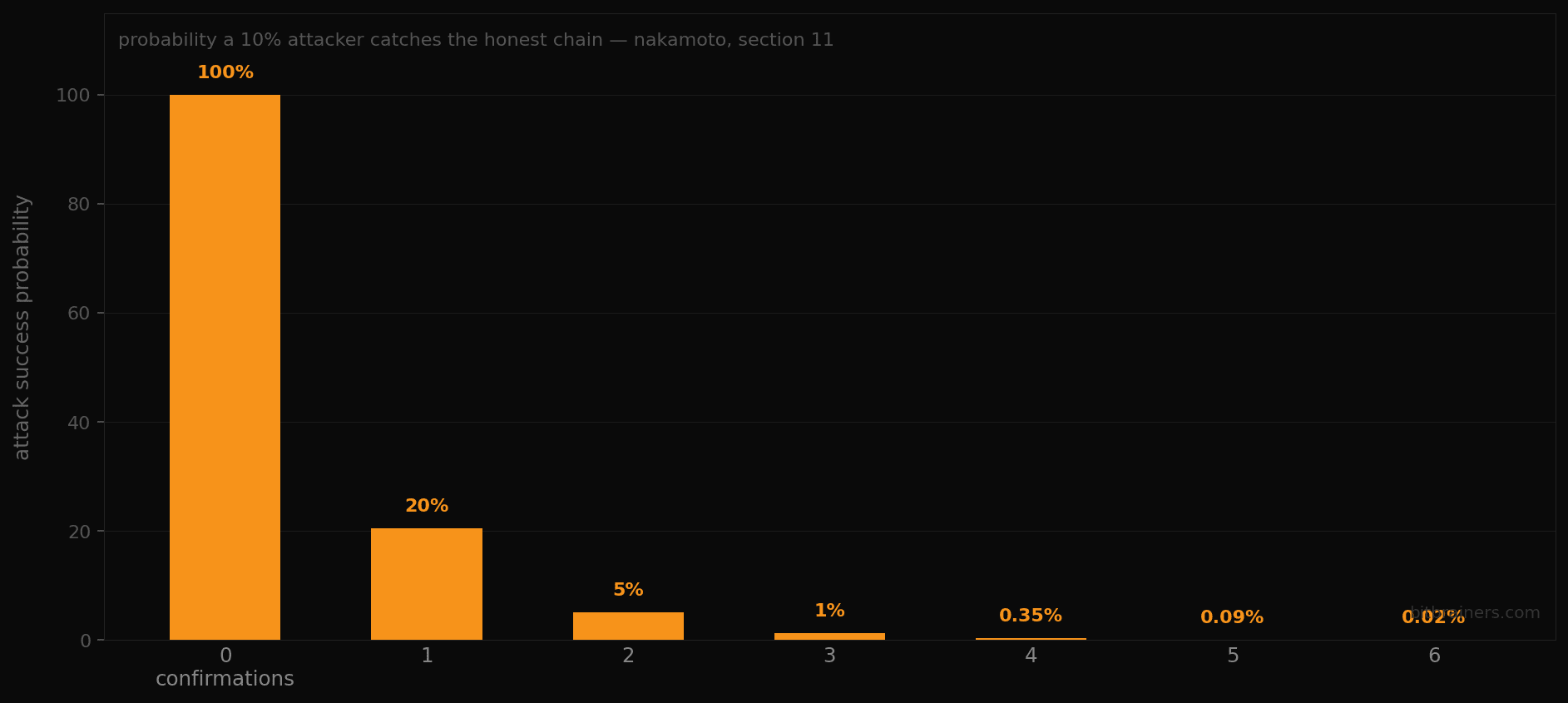
BitBrainers - Nakamoto Section 11 attack probability by confirmation

The result is this: the probability the attacker ever catches up from z blocks behind drops exponentially as z increases. Not linearly. Exponentially. Each additional confirmation multiplies the difficulty of a successful attack.

Nakamoto runs the numbers in Section 11 for a specific scenario. If the attacker controls 10 percent of hash power and the recipient waits for 0 confirmations, the attacker succeeds roughly 45 percent of the time. Wait for 1 confirmation and that drops to around 20 percent. At 6 confirmations with a 10 percent attacker, the probability of a successful double-spend is approximately 0.024 percent — two hundredths of one percent.

At 30 percent attacker hash power, the same 6 confirmations holds the probability in the low double digits, around 10 to 12 percent. It is only when the attacker approaches or exceeds 50 percent that the math breaks down fundamentally, because at that point the expected value of the attack becomes positive.

Six confirmations is not an arbitrary convention. It is the point at which the attack probability becomes economically irrational for any attacker controlling a realistic share of hash power.

This also explains why different participants use different thresholds. A merchant accepting a small payment might accept one or two confirmations — the potential loss is too low to justify waiting. An exchange receiving a large transfer might wait for 20 or 30. Six became the industry default because it represents the rational threshold for a realistic attacker, not because Nakamoto mandated it.

Bitcoin basics without the hand-waving.

Every Monday we break down what actually matters in markets and on-chain. No hopium, no noise.

Subscribe Free

Why This Was a Genuine Intellectual Achievement

Nakamoto did not invent the Poisson distribution or the gambler's ruin problem. Both are classical probability theory. What he did was recognize that these tools mapped precisely onto the double-spend problem and apply them correctly in nine pages.

The insight is that you do not need to prevent attacks from being attempted. You only need to make them unprofitable. The math in Section 11 proves that with honest majority hash power, the cost of a successful double-spend attack grows faster than the potential gain as confirmations increase.

That is the security model. Not cryptography alone. Not decentralization alone. A probability calculation that makes cheating economically self-defeating.

What It Means Today

The model holds as long as no single entity controls more than 50 percent of hash power. That assumption has been under pressure as mining has concentrated in large pools. Two or three major pools coordinating would theoretically cross the threshold.

In practice, the economics still work in Bitcoin's favor. A successful 51 percent attack would destroy the value of the asset the attacker spent resources to mine. The incentive to attack is undermined by the attack's own success. Nakamoto noted this too, in Section 6.

But the honest read is that the security guarantee in Section 11 is a probabilistic one, not an absolute one. Six confirmations makes attack economically irrational under normal conditions. It does not make attack physically impossible.

That distinction is what most white paper summaries quietly omit. Nakamoto did not omit it. He put the exact numbers in a table and let the math speak.

The One Line Worth Remembering

Section 11 closes with this: "We can see that the probability drops off exponentially with z."

That sentence is the entire security argument in eleven words. Every six-confirmation standard, every exchange policy, every custody procedure in the industry is downstream of that one observation. Most people who have "read" the white paper read around it.

Now you have not.


Sources

Satoshi Nakamoto: Bitcoin: A Peer-to-Peer Electronic Cash System (2008)
Bitcoin Wiki: Confirmation — security model and confirmation thresholds
Bitcoin Wiki: Double-spending — attack mechanics and historical context

Disclosure: This article is for informational purposes only and is not financial advice. We may earn commissions from affiliate links. Always do your own research before making investment decisions.
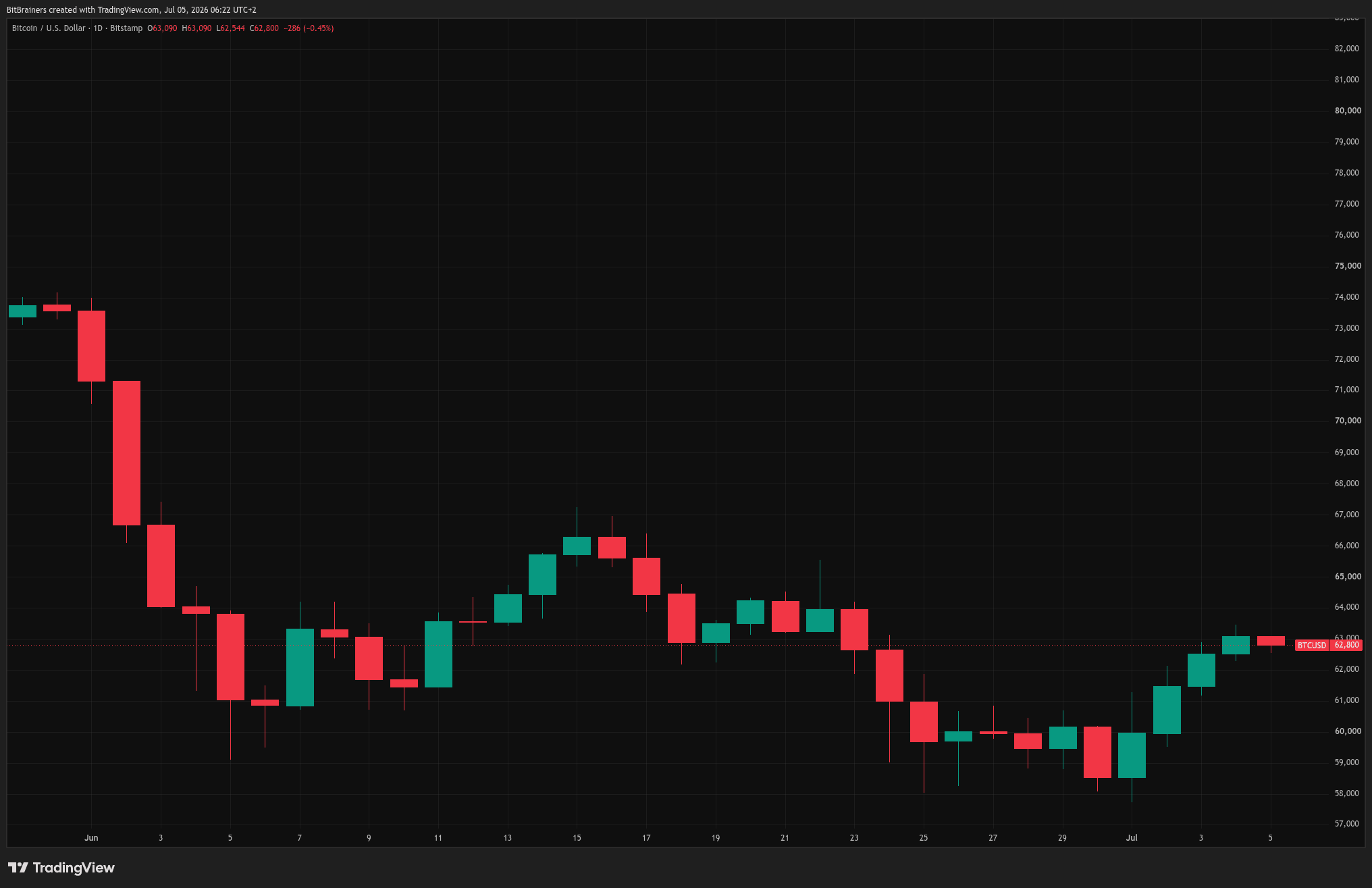
Fear and Greed Says Buy. MVRV Says Not Yet. Long-Term Holders Aren't Waiting.

BitBrainers - Bitcoin indicators analysis July 2026

By BitBrainers Editorial

Bitcoin is trading at $62,544 with the Fear and Greed Index at 19. Extreme Fear. In every previous cycle, that reading was one of the cleanest buy signals the market produced. This time, three other indicators are pointing somewhere different. Not down. Not up. Just not yet.

The data is not contradicting itself randomly. Each signal measures a different thing. Working through the disagreement produces a clearer picture than any single number alone.

What Fear and Greed Is Actually Measuring

Extreme Fear at 19 measures sentiment, not structure. It tells you how people feel, not what they own or what price they paid.

In 2022 and 2023, Extreme Fear readings corresponded to retail capitulation. Emotional sellers drove the price down, and the recovery came from the same retail base buying back in at lower levels.

This cycle is structurally different. A significant portion of the selling is coming from ETF redemptions. That is a mechanical process, not an emotional one. When an ETF investor redeems, the fund sells Bitcoin to meet that redemption regardless of how fearful or confident anyone feels.

The Fear and Greed signal assumes a seller who might change their mind. ETF redemptions do not reverse on sentiment alone. That is why the index is at 19 while the outflow streak ran for ten consecutive days before finally breaking this week.

Why MVRV Says the Bottom Is Not Confirmed

The MVRV Z-Score sits at 0.20 as of July 1. Bitcoin is trading near its aggregate realized value. That sounds neutral, and it roughly is.

The issue is that previous confirmed cycle bottoms did not stop at neutral. The Z-Score went negative in November 2022 and briefly negative again in early 2023. Negative MVRV means the average market participant is underwater. That is the level where forced sellers exhaust themselves.

At 0.20, that level has not been reached. The NUPL reading at 0.12 confirms the same picture from a different angle: the network holds minimal unrealized profit, but it has not flipped to aggregate loss.

Neither reading is screaming danger. Neither is screaming bottom.

The Number That Matters More Than $60K

The aggregate realized price, the average acquisition cost of all circulating Bitcoin supply, sits around $53,000. That is roughly 15% below current spot.

As long as Bitcoin trades above $53,000, the network in aggregate is in profit. Drop through that level and the entire post-2020 Bitcoin market goes underwater. That is the structural capitulation line. Not $58,000. Not $60,000. $53,000.

Bitfinex described the realized price hold as "the strongest structural argument the bull case has," adding it is "support only till the mechanical sellers allow it to be." Bitcoin is currently 15% above it. That is margin, not safety.

One clarification worth making: briefly dipping below $53,000 and recovering is not automatically a death sentence. Previous cycles have seen the realized price tested and then held as a launchpad. What would confirm a deeper problem is a sustained break with continued ETF outflows and no LTH response. A wick below followed by a bounce is a different story than a weekly close through it.

We covered the ETF mechanics in more detail in our breakdown of the jobs data bounce and the first ETF inflow of the week.

The signals are splitting. We track what they mean.

One macro read every Monday, the key levels, the data that matters. Zero filter.

Subscribe Free

What Long-Term Holders Are Actually Doing

Here is where the picture gets genuinely interesting. Long-term holders, defined as wallets holding Bitcoin for at least 155 days, flipped from net distribution back to net accumulation in late June, according to Glassnode's Week 26 on-chain report.

LTH supply hit a record 16.3 million BTC. Exchange reserves dropped to a seven-year low of 2.21 million BTC. Coins are leaving exchanges and moving into longer-term storage while the market panics.

The cohorts leading the buying are smaller and mid-sized wallets, 100 to 1,000 BTC, not the largest whale addresses. Glassnode described this as "accumulation beneath the surface," and was careful to note it is too early to call a full accumulation regime. Early accumulation signals have failed before when macro conditions deteriorated faster than on-chain data could capture. That caveat is real. But the directional shift is on-chain, not a survey or a sentiment reading, and that distinction matters.

The Short Squeeze Nobody Is Talking About

Funding rates on perpetual futures hit their most negative reading in three years this week. Negative funding means leveraged traders are paying a premium to maintain short positions. They are betting against Bitcoin at a record rate, and this has persisted for weeks without the price break they are positioned for.

LTH accumulation plus record short positioning is a classic setup for a squeeze. The question is what provides the catalyst. Two candidates sit directly ahead: the Senate returns July 13 to resume CLARITY Act negotiations, and the FOMC meets July 28 and 29. Either event, if it lands on the soft side, hits a market where the short book is extremely crowded.

That is not a price prediction. It is a description of the fuel and the potential ignition points.

What Decides This

On Thursday July 3, Bitcoin ETFs pulled in $221.7 million, their largest single-day inflow in two months, ending the ten-day outflow streak. Fidelity's FBTC led with nearly $166 million. Year-to-date net outflows still sit around $5.4 billion, so one day does not reverse the picture. But the streak ending is not nothing.

The indicators are not disagreeing about Bitcoin's long-term thesis. They are disagreeing about timing. Long-term holders are buying now. MVRV says the structural reset is not complete. The realized price at $53,000 gives the bull case a concrete floor to defend. The short book is loaded for a squeeze that needs a spark.

If ETF inflows stabilize and the Senate produces visible progress on CLARITY before the August recess, the setup changes fast. If Warsh delivers another hawkish surprise at the July 28 FOMC and outflows resume, $53,000 stops being a margin and starts being the number on everyone's screen.

The most honest synthesis across all four signals is this: the data looks more like a mid-cycle correction than a full bear market bottom. Bear market bottoms require MVRV to go deeply negative, widespread LTH distribution, and exchange reserves rising as holders give up. None of those are present. What is present is a sentiment washout, mechanical ETF selling, and conviction buyers stepping in quietly underneath.

Mid-cycle corrections end. They just rarely end on a schedule. Right now Bitcoin has the right ingredients for both outcomes. That is what four indicators in disagreement actually looks like.


Sources

CoinDesk: Bitcoin long-term holders have returned to accumulation, Glassnode says
CoinDesk: $221 million flow into Bitcoin ETFs ending a painful 10-day outflow streak
The Block: Accumulation beneath the surface: Bitcoin rebounds above $61,000
AhaSignals: Bitcoin MVRV Z-Score and NUPL readings, July 1, 2026
24/7 Wall St.: Bitcoin Price Prediction for July 2026
FXStreet: Bitcoin long-term holders resume accumulation as ETF outflows keep institutional sentiment subdued

Disclosure: This article is for informational purposes only and is not financial advice. We may earn commissions from affiliate links. Always do your own research before making investment decisions.
Saturday, July 4, 2026

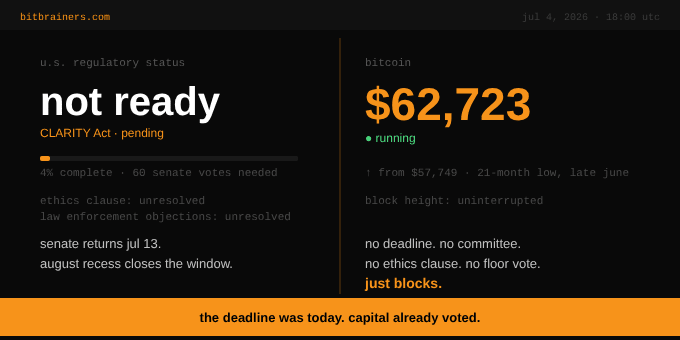
Washington Promised Crypto a July 4 Signing. Bitcoin Is Still Waiting at $62K.

BitBrainers - CLARITY Act missed July 4 deadline

In early May, the White House's top digital assets adviser stood on stage at Consensus Miami and named a date. July 4. The CLARITY Act signed into law as, in his words, a birthday present for America's 250th.

Today is July 4. There is no bill on the president's desk. There is no scheduled floor vote. The Senate is not even in session, and it does not return until July 13.

Bitcoin is trading around $62,700. That number and this missed deadline are more connected than they look.

What Actually Happened to the Deadline

The bill made real progress. The Senate Banking Committee passed it 15 to 9 on May 14, with two Democrats joining every Republican. On June 1 it was placed on the Senate Legislative Calendar, formally eligible for a floor vote.

Then the process hit the wall it was always going to hit. Bipartisan negotiations over ethics provisions broke down in June. The sticking point is a rule barring government officials from holding personal stakes in the crypto industry.

Senate Democrats treat that provision as non-negotiable. The White House has said it will accept rules that apply to everyone but will reject anything targeting one officeholder. Read between those two positions and the problem is obvious. The ethics clause is about the president's own crypto interests, and neither side can say so plainly and still cut a deal.

A second dispute over law enforcement objections to the bill's blockchain developer protections opened a parallel front. Two unresolved fights, one shrinking calendar.

What the CLARITY Act would actually deliver is straightforward. The CFTC gets clear jurisdiction over digital commodity spot markets, the SEC stays focused on securities and investment contracts, and for the first time there is a written framework for DeFi platforms and developer liability. That is the framework that removes the enforcement ambiguity keeping traditional finance cautious about sizing up crypto exposure.

The Math That Decides It

The bill needs 60 votes on the Senate floor. Republicans hold 53. That means at least seven Democrats have to cross over, and the two who voted yes in committee both said their floor votes are not guaranteed.

The calendar is the other constraint. The Senate returns July 13 and breaks for August recess a few weeks later. Policy analysts at Stifel put it bluntly: if the bill does not clear the Senate before that recess, its prospects deteriorate materially.

After August, every senator's attention shifts to the November midterms. The bill also still has to be reconciled with a separate Senate Agriculture Committee version and then merged with the House text that passed back in July 2025. None of that is fast.

Deadlines slip. Our Monday Brief doesn't.

One macro read every Monday, the levels that matter, zero hopium.

Subscribe Free

What the Vacuum Costs, in Numbers

This is where the missed deadline stops being a Washington story and becomes a price story.

Citi cut its 12-month Bitcoin target to $82,000 from $112,000, citing slow progress on US crypto legislation alongside ETF outflows and weak investor interest. That is a $30,000 haircut on a major bank's target, with regulatory delay written explicitly into the rationale.

The ETF picture makes the same point from the flow side. US spot Bitcoin ETFs posted roughly $4.5 billion in net outflows in June, their worst month on record. Institutions that were supposed to be the patient money spent six consecutive weeks heading for the exit.

Part of that is macro. The Fed held rates in June and dropped its easing language, and that repricing hit everything risky. We covered the flow mechanics in our breakdown of this week's bounce on weak jobs data and the first real ETF inflow.

But part of it is exactly what the CLARITY Act was supposed to fix. Institutional allocators do not size up positions in an asset class whose basic regulatory boundaries are still being negotiated. Every month the bill slips, that capital stays parked.

Where That Leaves the Chart

Bitcoin printed a 21-month low near $57,750 in late June and has since clawed back to the $62,000 to $63,000 area. The bounce is real but thin. It arrived on soft jobs data and one day of ETF inflows, not on any structural change.

The structural change was supposed to be today. It did not come.

That leaves two dates carrying the weight for July. The Senate's return on July 13, which starts the three-week window where the CLARITY Act either moves or effectively dies for the year. And the Fed meeting on July 28 and 29, where the market finds out whether the June hawkish turn was a one-off or the new baseline.

The Honest Read

The CLARITY Act is not dead. Senator Hagerty's base case still has a floor vote landing after July 13. A passage before the August recess would be a real catalyst, one the market is currently pricing at close to zero.

But we watch what capital does, not what politicians promise. A deadline the White House set publicly, with five months of runway, just passed with the Senate out of town. Citi did not wait to find out how the ethics fight resolves before cutting its target. The ETF money did not wait either.

If the bill slips past August, expect the analyst downgrades to continue and expect regulatory clarity to become a 2027 story. At $62,700 with no framework, that risk premium stays embedded in the price.

The next two to three weeks after July 13 will matter more than July 4 ever did. Capital is already voting with its feet.


Sources

CoinDesk: White House targets July 4 for Clarity Act passage, says crypto adviser Patrick Witt
CNBC: Crypto industry scores win as Clarity Act regulation bill clears Senate hurdle
The Crypto Times: Bitcoin Price Prediction July 2026: Will BTC Go Up or Crash?
CCN / Yahoo Finance: Senate's Last-Ditch CLARITY Act Talks Could Decide Crypto's Fate for the Rest of the Decade
24/7 Wall St.: Bitcoin Price Prediction for July 2026

Disclosure: This article is for informational purposes only and is not financial advice. We may earn commissions from affiliate links. Always do your own research before making investment decisions.
Bitcoin Bounce on Weak Jobs + ETF Inflow: Real Reversal or Relief Rally?

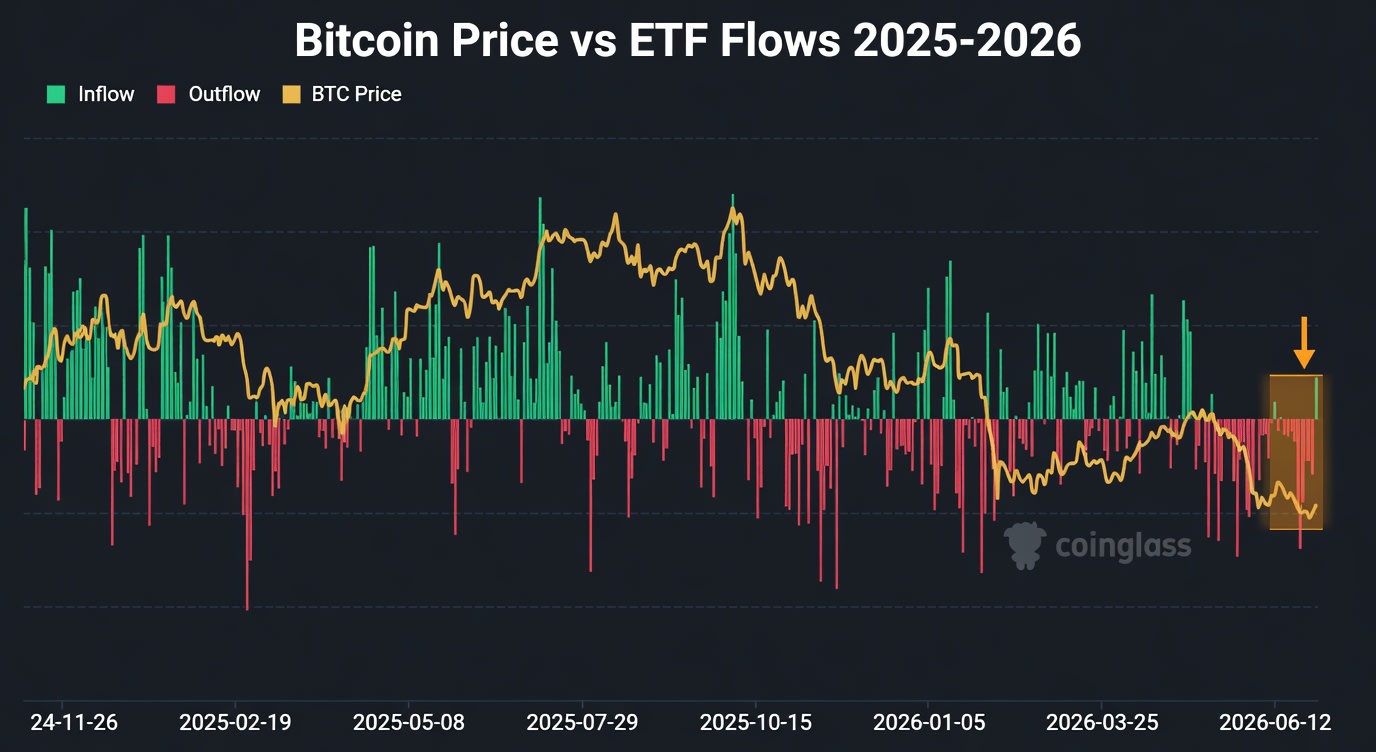
BitBrainers - Bitcoin Price vs ETF Flows June-July 2026

By BitBrainers Editorial

Bitcoin printed a 21-month low near $57,735 on July 1. Three days later it trades above $62,000, a bounce of roughly 8.5 percent, and the timeline has already decided it was the bottom. Two genuinely new data points arrived this week, and both are real. Whether they add up to a reversal is a different question, and the gap between those two things is where most traders lose money.

What the Jobs Report Actually Said

Nonfarm payrolls rose just 57,000 in June, well below the roughly 110,000 to 115,000 consensus. The miss did not land on a strong trend either.

May was revised down to 129,000 and April to 148,000, removing 74,000 jobs from the prior two months combined. Three months ago this labor market was printing upside surprises. It is now decelerating, with revisions pointing the same direction.

The headline unemployment rate fell to 4.2 percent, and that number is doing a lot of misleading work in the coverage. The rate fell because labor force participation dropped 0.3 points to 61.5 percent, its lowest level since March 2021.

The household survey counted 507,000 fewer people employed in June. Unemployment did not fall because more people found work. It fell because people stopped being counted.

Markets read the report as dovish anyway, and for rate expectations that reading is correct. A labor market this soft gives the Fed no case for a hike. But dovish-because-weak is not the same fuel as dovish-because-healthy, and the difference matters for how far any risk rally can run.

One Green Day in the ETF Data

The second catalyst came from the flow side. US spot Bitcoin ETFs recorded a net inflow of roughly $221 million on July 3, the first positive day after ten straight sessions of outflows.

The context makes it notable. June closed as the worst month in the products' history, with net outflows of roughly $4.0 to $4.5 billion depending on the data provider, surpassing the previous record of $3.56 billion set in February 2025. Outflows hit on 19 of 22 trading days.

Against that backdrop, one green day is a crack in the story, and cracks are how reversals start. They are also how relief rallies start, which is why the mechanics of the bounce deserve a look.

As price reclaimed $62,000, roughly $130 million in short positions were liquidated in a single 24-hour window against about $50 million in longs. A meaningful share of this move is forced covering, shorts buying because they had to, not fresh demand buying because it wanted to.

That does not invalidate the bounce. It does mean some of the fuel burns once and does not reload.

Numbers checked. Narratives questioned.

The Macro brief that reads the data before the hype.

Subscribe Free

On paper, the combination looks compelling: a dovish jobs surprise, the first crack of green in ETF flows after record outflows, forced short covering, and upcoming regulatory and central bank events. That narrative deserves scrutiny. The alignment is partial and conditional, not definitive.

The Spread Is the Information

The honest takeaway is the width of the plausible range. Near-term relief is reasonable.

A sustained reversal needs sustained ETF inflows, labor data that does not deteriorate further, constructive regulatory signaling, and a non-disruptive FOMC. That multi-thousand-dollar uncertainty band is not analytical failure. It is a direct measurement of how little decisive structure exists right now.

Two Dates Decide Whether This Was a Bottom

The confirmation test is mechanical, not emotional. Flow-following desks typically want three to five consecutive positive ETF flow days, at volumes above the recent outflow average, before treating a bounce as a regime change.

One green day after ten red ones does not clear that bar. Neither does a rally where short liquidations outran long liquidations by better than two to one.

The calendar does the rest. On July 17 the House Financial Services Committee takes up the CLARITY Act, the first regulatory catalyst with a date attached since the June selloff began.

Then the FOMC meets July 28 and 29. Warsh has dropped the old habit of telegraphing moves in advance, and there is no fresh projection material until September, so markets walk into that meeting with less guidance than at any point in his tenure. A hold likely extends the relief. A hawkish surprise tests the July 1 low.

Until then, the discipline is the same one that applies in every low-structure environment. Confirmation before conviction, mechanism before narrative, and the same suspicion for data that agrees with your position as for data that contradicts it. We covered the flow side of this setup in our July 1 breakdown of why the ETF data matters more than the price.

Sources: U.S. Bureau of Labor Statistics Employment Situation, June 2026, Farside Investors Bitcoin ETF Flow Data, SoSoValue ETF Dashboard, CoinGlass ETF and Liquidation Data, House Financial Services Committee schedule.

Disclosure: This is analysis, not financial advice. We hold BTC. Do your own research before making investment decisions.
Friday, July 3, 2026

Five AIs, One Bitcoin Chart, Ten Thousand Dollars of Disagreement

BitBrainers - Five AIs, One Bitcoin Chart, Ten Thousand Dollars of Disagreement

By BitBrainers Editorial

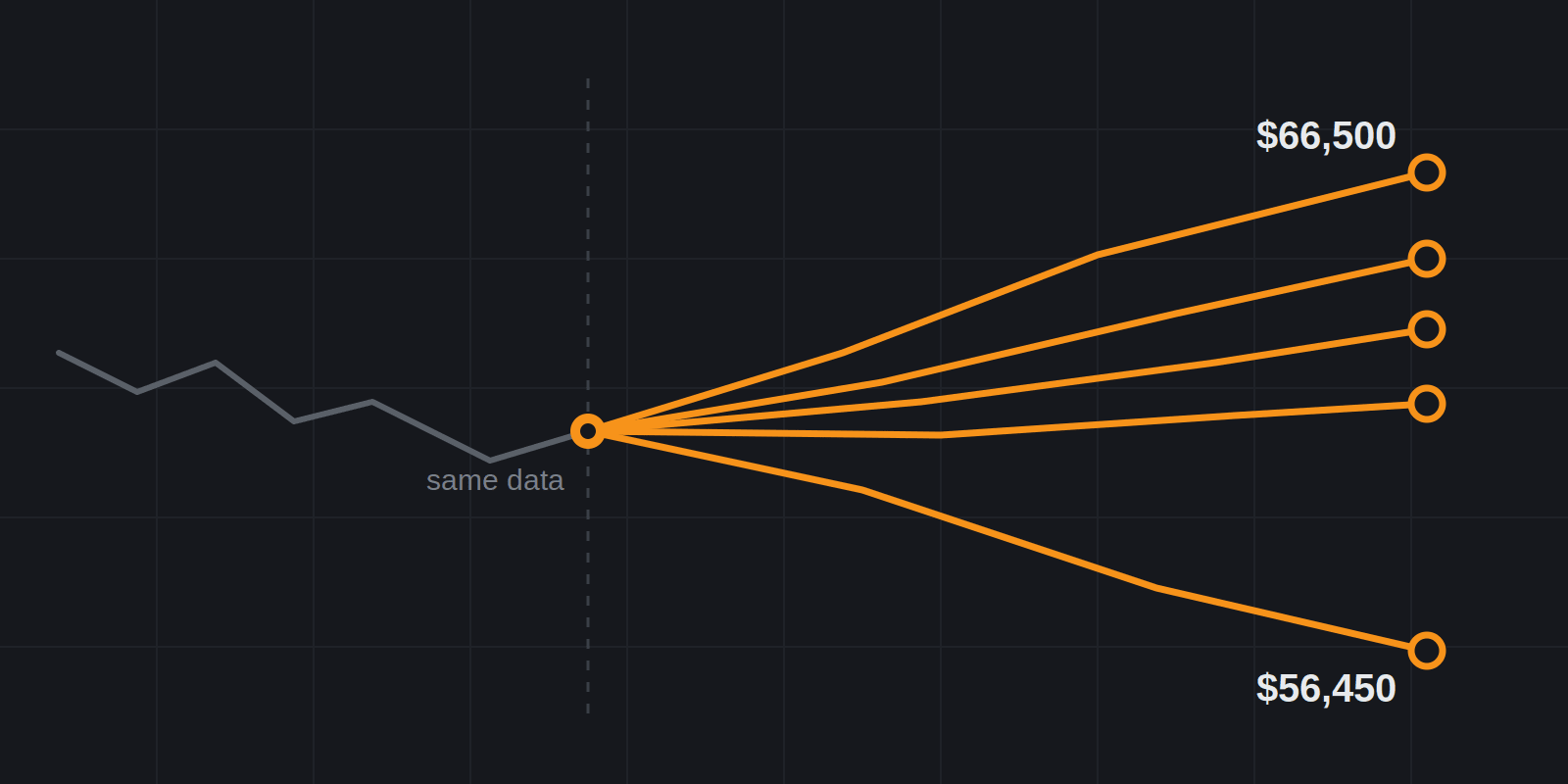
Five of the most advanced AI models on the planet were handed the same Bitcoin chart this week and asked where the price lands on July 31. Their answers span more than ten thousand dollars. Before you screenshot whichever forecast agrees with your position, it is worth understanding what that spread actually measures, because it is not Bitcoin.

The Numbers, Side by Side

Finbold ran the test with Bitcoin trading around $61,200. Anthropic's Claude came in most bullish, projecting an 8.67 percent climb to $66,500 by month end. OpenAI's ChatGPT-5.2 called a 5.4 percent rally to $64,500. Grok 4.1 landed at $63,501, a 3.77 percent gain. DeepSeek saw an essentially flat month, up 1.31 percent to $62,000. And Gemini 3 Flash broke from the pack entirely, forecasting a 7.76 percent drop to $56,450.

Same price data. Same technical indicators. Same date. One model says Bitcoin gains eight and a half percent, another says it loses nearly eight.

To be fair about the baseline: human analysts produce at least this much dispersion on Bitcoin targets, often more. Citi just cut its 12-month target to $82,000 in the same week other desks are defending six figures. Dispersion is not the AI-specific failure here. The difference is in the delivery. A human strategist wraps the number in scenarios, probabilities, and an implicit admission that this is an educated guess. The models deliver theirs with uniform, unhedged confidence, because sounding authoritative is what they are optimized for. The spread is normal. The false certainty attached to every point in it is the new problem.

A separate and larger experiment last week makes the point harder to dismiss. Bitcoin.com News put the same stripped-down question to 14 AI chatbots, deliberately removing the supporting context so each model had to produce an unbiased forecast across 30-day, 90-day, and year-end horizons. The answers came back as ranges wide enough to be unfalsifiable. One flagship model offered a year-end window of $50,000 to $75,000. Another gave $55,000 to $75,000. A forecast that spans a 50 percent move in either direction is not a forecast. It is a refusal to be wrong dressed up as analysis.


When They Agree, It Gets Worse

The counterintuitive part: model agreement is not more trustworthy than model disagreement. In June, ChatGPT and Claude were separately asked where Bitcoin bottoms by Q4 2026, and their answers landed within $2,500 of each other, $54,500 and $52,000 respectively. That looks like signal. Two independent systems converging on the same zone.

Except they are not independent. Both models were trained on overlapping snapshots of the same internet, both were fed the same public market data, and both leaned on the same widely published frameworks, realized price for one, miner production cost for the other, both of which have been standard crypto-analyst furniture for years. Even the outlet reporting the convergence flagged the open question of whether it reflects genuine signal or simply shared training data and identical inputs. When two students copy from the same textbook, matching answers tell you about the textbook, not about the exam.

Numbers checked. Narratives questioned.

The Macro brief that reads the data before the hype.

Subscribe Free

We Ran Our Own Version of This Test

Back in June we tested this mechanism directly rather than taking anyone's word for it. We asked several leading models for a Bitcoin allocation recommendation and got the same answer from all of them: a cautious 2 to 15 percent position, dollar-cost averaged in, medium risk. That uniformity is not five systems independently reasoning their way to the same conclusion. It is the answer a compliance-minded advisor is trained to give, the one that never gets anyone sued, reproduced across every model because they were all trained on the same body of careful, liability-aware financial writing.

Then we corrected one model's stale price data and watched its recommended allocation triple, from a 1 to 5 percent range up to 5 to 15 percent, off a single number changing in its context. Nobody managing real money triples position size over one price correction. Whatever produced that jump, it was not conviction. The model latched onto whatever drawdown figure it believed it was looking at and rebuilt its entire answer around it, with full confidence both times.

That is the mechanism under this week's ten thousand dollar spread. These systems do not hold a thesis about Bitcoin that survives from one question to the next. Each answer is generated fresh, shaped by whatever is loudest in the prompt, and delivered with the same fluent certainty whether the underlying reasoning is sturdy or nonexistent. Fluency and correctness are not connected, and price forecasting is where that disconnect is most expensive to ignore.

The Spread Is the Information

None of this means the models are useless. It means the test itself measures the worst way to use them. Short-term crypto moves are driven by things a single chart rarely captures: macro liquidity, ETF flows, whale wallet movements, regulatory headlines, leverage cascades, corporate treasury actions. Pure visual technical analysis is a weak signal in the best of times, so handing a model a chart and asking for a price is asking it to be confident about insufficient input. It will oblige, because a system trained to sound authoritative papers over the gap rather than admitting it.

The stronger configurations exist and almost nobody publishing these forecast pieces uses them: feed the model on-chain data, filings, and news flow together instead of a chart in isolation, give it code execution to build custom indicators rather than eyeballing MACD, or run multiple models against each other in structured debate and study where they break ranks. Used that way, a model is a research multiplier. Used as a chart oracle, it is a random number generator with excellent grammar.

Read properly, this week's forecasts do carry one honest piece of information: the spread itself. Five frontier systems given identical data disagree by more than 16 percent of Bitcoin's price. That is a direct measurement of how little predictive structure exists in the chart right now, published accidentally by the companies most motivated to hide it. The disagreement is the finding.

Meanwhile the thing that actually moved markets this week was not in any model's forecast. It was a mechanical trigger, Strategy's valuation crossing below the value of its own Bitcoin, that had been sitting in an SEC filing since last August. We covered it here: The Premium Died First. The Framework Was Already Written. No chatbot flagged it in advance. It was findable the whole time by anyone reading filings instead of asking for price targets.

How to Read the Next Forecast

Practical rules for the next time an AI price prediction crosses your feed.

  • Check the spread before the number. If the same test produced targets ten thousand dollars apart, any single model's target is noise wearing a suit
  • Treat convergence with the same suspicion as divergence. Models trained on the same data agreeing is expected, not informative
  • Watch what happens when inputs change. An answer that swings hard on one corrected number was never analysis
  • Judge the input before the output. A forecast built on a chart alone was starved of the things that actually move price. Rich input, filings plus flows plus on-chain data, deserves more attention than any chart-only oracle
  • Use the models for what they are built for: reading filings, compressing data, arguing against your position. The July 31 forecasts will be graded in four weeks, and we will check the scores

Sources: Finbold AI predicts Bitcoin price for July 31, 2026, Bitcoin.com News 14 AI Models Including Claude, ChatGPT and Grok Predict Bitcoin's Price Outlook, CCN via Yahoo Finance Can AI Call the Bitcoin Bottom?

Disclosure: This is analysis, not financial advice. We hold BTC. Do your own research before making investment decisions.

The Premium Died First. The Framework Was Already Written.

BitBrainers - The Premium Died First. The Framework Was Already Written.

By BitBrainers Editorial

On June 27, a number on Strategy's own website crossed a line it had never crossed before, and two days later the company that spent four years promising never to sell Bitcoin published a board-approved plan to sell up to $1.25 billion of it. The stock went up on the news, JPMorgan published a warning three days after that, and almost nobody in the coverage connected the two dates, even though Strategy itself filed the script for this exact moment with the SEC back in August 2025.

The Number That Forced It

The metric is enterprise mNAV. It compares Strategy's total enterprise value, meaning market cap plus debt plus preferred stock, against the market value of the 847,363 BTC on its balance sheet. For years that ratio was the whole bull case. At the November 2024 peak it hit 4x, meaning investors paid four dollars for every dollar of Bitcoin the company held, because MSTR was the leveraged BTC vehicle everyone wanted. The premium powered a flywheel: issue stock above the value of the Bitcoin backing it, use the proceeds to buy more Bitcoin, and let the growing stack justify the next issuance.

On June 27, 2026, that ratio closed below 1 for the first time. The market briefly valued the entire company, the software business, the brand, the financial engineering, at less than the coins in the vault. The ratio has since recovered above parity as MSTR rebounded roughly 20 percent after the framework announcement, but the crossing itself did its damage, because below 1 the funding model stops working. Issuing shares below NAV to buy Bitcoin dilutes existing shareholders instead of enriching them, so the accumulation engine that bought $13.7 billion of BTC this year alone could no longer fund itself the old way. Meanwhile the obligations stacked on top of that engine kept running regardless. The company owes roughly $1.7 billion a year in preferred dividends and interest, anchored by its STRC preferred stock, whose rate just went up to 12 percent.


A Script Filed Last August

Here is the part the coverage keeps missing: Strategy told everyone this would happen. An 8-K exhibit filed with the SEC in August 2025 laid out a public playbook tied to mNAV levels. Above 4x, issue stock aggressively to buy Bitcoin. Between 2.5x and 4x, issue opportunistically. Below 1x, consider issuing credit to repurchase MSTR instead. CEO Phong Le went further late last year, saying the company might consider selling Bitcoin if the ratio dropped below 1. And the first crack in the never-sell brand had already appeared in May, when Strategy quietly sold 32 BTC for about $2.5 million to cover dividend obligations, its first sale since 2022.

So when the ratio crossed on a Friday and the framework arrived the following Monday, it was less a reversal than a pre-announced contingency going live.

The June 29 filing, branded the Digital Credit Capital Framework, has five parts: a $2.55 billion dollar reserve dedicated to dividends and interest, a hard floor of 12 months of coverage, the STRC dividend increase to 12 percent, two separate $1 billion buyback authorizations for preferred securities and common stock, and the piece that made headlines, a Bitcoin Monetization Program authorizing sales of up to $1.25 billion. Worth being precise here: this is an authorization, not a sale. The ceiling represents under 2.5 percent of the stack, and as of the filing date no additional Bitcoin had been sold under it.

MSTR jumped 6 to 7 percent in pre-market trading on the news, which sounds backwards until you look at the alternative. With the treasury underwater by roughly $14 billion at the time of the filing against a $75,651 average cost, and a $1.7 billion annual dividend bill, a formal funded mechanism for meeting those obligations beats improvised distress selling from every angle an investor cares about. The rally was relief that the company had a plan, not enthusiasm for the selling.

The market moves fast. We keep the receipts.

One macro brief every Monday. No hopium, no noise.

Subscribe Free

Then JPMorgan Picked Its Target

Three days after the framework, on July 2, JPMorgan analysts led by Nikolaos Panigirtzoglou published a report warning that Strategy's sell authorization introduces avoidable two-way flow risk into the Bitcoin market. Their argument: Strategy bought roughly 70 percent of all net digital asset inflows this year and holds around 4 percent of total BTC supply, so a buyer that size gaining formal authority to sell adds a new source of uncertainty. Their prescription: hold 24 to 36 months of dividend coverage instead of the current 17.4, even if it means issuing equity at a discount.

The concentration point has real substance. A holder of 4 percent of supply gaining sell authority genuinely changes market signaling, whoever the holder is. But the aim is selective, and the numbers show it.

In June, US spot Bitcoin ETFs posted their worst month ever, $4.06 billion in net outflows. BlackRock's IBIT alone accounted for roughly $3.3 billion of it, and the ETF complex mechanically sold an estimated 51,726 BTC over 30 days to meet redemptions. That is realized selling, more than two and a half times Strategy's entire authorized ceiling, executed in a single month. JPMorgan wrote no report about two-way flow risk from the ETF wrapper. The warning went to the Bitcoin-native company with the loud founder rather than to the asset manager whose product did the actual selling.

Context on the messenger matters too. Jamie Dimon called Bitcoin a fraud in 2017, a pet rock in 2024, and told a Senate hearing in 2023 that if he were the government he would close it down. None of that makes his analysts wrong about Strategy's balance sheet, and the balance sheet criticism deserves engagement on its merits. It does mean the framing deserves the same scrutiny the balance sheet gets.


Where We Actually Land

We have watched enough leverage from the desk side to separate two things the coverage keeps merging. The accumulation was never the problem. Building an 847,363 BTC position, 4 percent of everything that will ever exist, is the boldest corporate conviction bet on record, and if you believe Bitcoin survives the decade, that stack is the whole point of the company. We still back that idea, including this week.

The machinery bolted on top is a different animal. Twelve percent perpetual dividends, layered preferred securities, and a funding model that only works while the equity trades at a premium amount to a structure that borrowed against the premium as if it were permanent, and premiums are cyclical by nature. The framework is not Saylor abandoning the thesis. It is the balance sheet adapting to a bear market that refused to honor the financing terms, with enough reserve and flexibility built in that distress is a scenario, not a schedule.

The honest read: the conviction survives, the engineering is on probation, and the largest realized Bitcoin seller last month was the ETF wrapper Wall Street built, not the company Wall Street warned about.

Read also: Bitcoin Doesn't Have a Crypto Problem. It Has an AI Problem.

What Happens Next

The open questions this framework does not answer yet.

  • Does mNAV hold above 1, or was the rebound a bounce? Every week below parity is a week the accumulation engine stays mathematically stalled, no matter what Saylor tweets
  • Does Strategy actually sell, or does the $1.25 billion authorization sit untouched as a confidence prop? The first real sale under the program, whatever its size, will move the market more than the announcement did
  • STRC trades near $87.50 against $100 par. Until it recovers par, Strategy cannot issue new preferred at a profit to fund purchases, which leaves the reserve and the sell authorization as the main funding tools
  • July ETF flows. IBIT redeemed roughly $3.3 billion in June. If that pace holds, the ETF wrapper stays a bigger BTC seller than Strategy is even authorized to become
  • The FOMC meets July 28 and 29. A hawkish Warsh keeps pressure on everything above, a softer tone changes the whole equation
  • The CLARITY Act clock in the Senate, which JPMorgan itself names as the other condition for a stronger second half

Sources: SEC / Strategy Inc. Form 8-K, June 29, 2026, CoinDesk Strategy's valuation has fallen below the value of its bitcoin holdings, CoinDesk JPMorgan says Strategy's bitcoin sales policy adds two-way risk, Bloomberg JPMorgan Says Saylor's Strategy Adds New Risk to Bitcoin Market, The Block Strategy loses its bitcoin premium as enterprise mNAV dips below 1

Disclosure: This is analysis, not financial advice. We hold BTC. Do your own research before making investment decisions.

Thursday, July 2, 2026

The Fed Just Lost Its Reason to Hike

BitBrainers - The Fed Just Lost Its Reason to Hike

By BitBrainers Editorial

The US economy added 57,000 jobs in June. The forecast was 114,000. That is not a soft print, that is half of one, and it landed on a market that spent the last two weeks pricing in the opposite problem. On top of the miss, May's figure was revised down by 43,000 to 129,000, ending a three-month streak of payrolls beating expectations. Within hours, Bitcoin went from drifting below $60,000 to briefly trading above $62,000. The move was fast, but the repricing underneath it is the actual story.

One Report, Two Repricings

Remember where the market stood on Wednesday. The June FOMC dots projected at least one more rate hike before year end, several officials penciled in more than one, and Polymarket had the odds of another 2026 hike at 54 percent. The debate was not hikes versus cuts. It was hikes versus holding.

One jobs report moved both dials. Polymarket's hike probability dropped from 54 to 47 percent in a day. CME FedWatch now shows roughly 80 percent odds the Fed leaves rates unchanged at the July 28-29 meeting, up from about 72 percent before the print. Traders also priced out a September move entirely, pushing residual hike risk into October.

The setup helped. A day earlier at the ECB Forum, Fed Chair Kevin Warsh said inflation risks were easing. He gave no path, he never does, but paired with a payrolls number at half the forecast, the market did the math for him. Hiking into a labor market that just printed 57,000 is a hard sell, even for a Chair who spent his first meeting sounding hawkish. We covered that first meeting and what it did to Bitcoin in The Fed Chair Who Loved Bitcoin. Today was the first data point that pushed back.

The macro read, once a week, no hopium

Join the BitBrainers Weekly Brief. The week's real signal in one email.

Subscribe Free

The Bounce Comes With an Asterisk

Bitcoin rallied about 4 percent on the release and briefly reclaimed $62,000 before settling near $61,700. After the worst month since June 2022 and a roughly 30 percent decline across the first half of the year, any green candle gets attention. This one deserves some, and also deserves its asterisk.

The level that matters is $62,500. That is the halfway retracement of the recent leg down, and desks are treating it as the line between a relief rally and an actual recovery. Below it, today's move is short covering plus a macro sigh of relief. Above it, with follow-through, the conversation changes.

The heavier problem has not moved. US spot Bitcoin ETFs bled roughly 4 billion dollars in June, the largest monthly redemption since launch. A jobs report can reprice the Fed in an afternoon. It cannot reverse institutional flows. Until those stabilize, rallies in this tape are guilty until proven innocent.


The Part Nobody Wants to Price

Here is the uncomfortable read. The US economy needs roughly 100,000 new jobs a month just to keep the unemployment rate steady. June printed 57,000, and May was revised lower. One month below breakeven is noise. Two starts a trend, and a trend below breakeven stops being a Fed story and starts being a growth story.

Weak labor data helps risk assets exactly as long as it reads as "the Fed can relax" and not "the economy is stalling." That line is invisible until it is crossed, and markets historically cross it in one session. In 2019 and again in 2024, jobs misses were bought right up until a print landed that made cuts look like a rescue instead of a gift.

So the honest framing of today: Bitcoin got a real macro tailwind, the first one this summer. The hike case took genuine damage and the July meeting is now close to a formality. But 47 percent is still nearly a coin flip on the year, the ETF door is still swinging outward, and the same data that killed the hike will kill the rally if it repeats in August. Enjoy the bounce. Respect the asterisk.


On The Radar This Week

The FOMC meets July 28-29, and the market has effectively pre-decided a hold. The more interesting release is the next CPI print, because an inflation surprise is now the only thing that could put the hike back on the table. On the chart, $62,500 is the confirmation level above and $57,900 is the late-June low that has to hold below. And the quiet third dial is ETF flows: this bounce only becomes a trend if the redemption streak breaks. Watch for the first string of consecutive net inflow days since May. Until then, between those numbers, everything is noise.

Sources

US Bureau of Labor Statistics: The Employment Situation, June 2026
crypto.news: Bitcoin surges past $62K as U.S. payroll miss dents Fed rate hike odds
Investing.com: Bitcoin jumps to $62,000 as weak US jobs data eases rate-hike fears

Disclosure: This content is for informational purposes only and does not constitute financial advice. We may earn a commission through affiliate links at no extra cost to you. Always do your own research.

The FBI Director Bought Bitcoin Stock. He Just Forgot to Mention It for Six Months.

Kash Patel speaking with attendees at FreedomFest 2024

Photo: Gage Skidmore, CC BY-SA 2.0

By BitBrainers Editorial

The FBI director bought six figures of Bitcoin-adjacent stock, sat on the disclosure for six months, and the Justice Department's own ethics office says there's nothing to see here. The company he bought into does millions of dollars in business with his own agency. This is the kind of story that gets buried in a Wednesday news cycle, and it deserves better than that.

What Actually Happened

FBI Director Kash Patel purchased between $100,001 and $250,000 in Strategy stock, the company formerly known as MicroStrategy, on November 21. Strategy is the largest publicly listed corporate holder of Bitcoin in the world, built around aggressively accumulating BTC as its primary treasury asset. Patel did not disclose the trade to federal regulators until May 26, six months after the purchase and well past the 45-day window required under the STOCK Act.

His explanation, delivered in a letter to the Office of Government Ethics that same day, was that the trade had been "inadvertently omitted" from an earlier disclosure. Two days later, a Deputy Assistant Attorney General wrote to the same office stating the omission was caused by an unspecified "miscommunication." An FBI official told reporters the late filing was "not realized and unintentional."


Why The Company Matters As Much As The Delay

A late disclosure alone is a paperwork problem. What makes this one worth reading past the headline is who Patel bought stock in. Strategy has done millions of dollars in business with the Department of Justice over the past decade, and the FBI is part of the Department of Justice. Patel now personally holds a six-figure position in a company his own agency writes checks to.

The Deputy Assistant Attorney General who reviewed the case concluded there was no conflict of interest. Government watchdogs disagree with the framing entirely. Dylan Hedtler-Gaudette of the Project on Government Oversight put it in blunt terms: "That's violating the law, no other way to put it." He's referring specifically to the disclosure timeline, not the ethics question, but the two are hard to fully separate here. Late disclosure and financial entanglement with an agency contractor are not the same problem, but they compound each other.

Worth being fair about the baseline here. Senior officials holding stock in companies their agency interacts with is not automatically a scandal, Pentagon officials often hold defense contractor stock, HHS officials hold pharma stock. Passive investment in a publicly traded company isn't prohibited on its own, that's exactly why ethics offices exist to make case-by-case calls rather than ban the practice outright. No evidence has surfaced that Patel steered any DOJ contract toward Strategy, traded on non-public information, or received anything in return for the purchase. The documented complaint is narrower than "corruption": a six-figure trade, a company with agency ties, and a disclosure filed roughly 186 days late. That's still a real problem. It's just a specific one, not a vague one.

This also isn't Patel's first time drawing scrutiny for personal stock trades in office. He purchased shares in Krispy Kreme and ON Semiconductor in 2025, trades that already prompted questions from members of Congress before this latest disclosure issue surfaced. A pattern of individual stock trading while running a federal law enforcement agency is its own separate conversation from any single trade's merits.


The Rules Everyone Ignores

The STOCK Act exists for exactly this reason: to make sure senior officials disclose trades fast enough that the public can see potential conflicts before they compound. The threshold is low, any trade over $1,000, and the window is short, 45 days. Patel's trade sat undisclosed for roughly six times that window.

He is not alone. NOTUS, the outlet that first reported this story, has identified more than 30 members of Congress who filed STOCK Act disclosures late over the past year. The customary penalty for a first violation is a $200 fine, a number small enough that it functions less as a deterrent and more as a rounding error against a quarter-million-dollar trade. Patel has not been fined as of this writing, and multiple watchdog groups doubt he will be.

This is the kind of read you get weekly.

No hype. No "this coin will 100x." Just honest macro on Bitcoin, gold, and the market.

What This Says About Bitcoin's Position In Washington

Set aside the ethics question for a moment and look at what this story confirms about where things actually stand. A sitting FBI director felt comfortable putting a six-figure personal position into a Bitcoin treasury company, one connected to his own agency's contractor relationships, and the mistake that got him in trouble wasn't the trade itself, it was the paperwork. Nobody in this story is arguing Patel shouldn't have bought Strategy stock. The argument is entirely about timing.

That's a meaningful signal on its own. Bitcoin exposure has moved deep enough into Washington's bloodstream that a law enforcement official's personal stake in the largest corporate BTC holder barely registers as controversial, only the six-month delay in reporting it does. A few years ago this trade wouldn't have happened at all, or would have drawn scrutiny on the merits, not just the calendar.


Worth Watching Right Now

Strategy's stock itself remains under separate pressure. Canaccord cut its price target on the company this week even while maintaining a broadly bullish thesis on Bitcoin, part of a wider reassessment of Strategy's capital structure following its recently disclosed unrealized paper losses and new buyback authorization. Meanwhile Trump's own 2025 financial disclosure, released the same week, showed over $1.4 billion in crypto-related income, a separate and much larger story about the overlap between federal power and Bitcoin exposure that deserves its own treatment.

Sources

NOTUS. Kash Patel's Late Stock Disclosure Raises STOCK Act Questions

CoinDesk. FBI Director Kash Patel Caught Sleeping on Required Disclosure of Six-Figure MSTR Investment

Raw Story. Kash Patel Accused of 'Violating the Law' With Massive Undisclosed Stake in DOJ Contractor

BitBrainers. We check the facts so you don't have to.

Disclosure: This is market and policy commentary, not financial or legal advice. We hold Bitcoin. Always do your own research.

Wednesday, July 1, 2026

Why Your Exchange Wants You to Stay (And What Actually Fixes It)

BitBrainers - fractured Bitcoin coin with capital flowing toward AI infrastructure

By BitBrainers Editorial

Every exchange interface is built around one goal: keep your coins on their platform. Not because they're malicious by design, but because your balance sitting on their books is the entire business model. The friction to withdraw isn't an accident. It's revenue protection.

The Balance Sheet You Never See

When you deposit Bitcoin on an exchange, you don't hold Bitcoin anymore. You hold an IOU. The exchange holds the actual private keys, and your balance is just a number in their database. That number can be lent out, used as collateral, or in the worst case, gone before you ever try to withdraw it.

FTX proved this isn't theoretical. Sworn testimony and court filings later confirmed that Alameda Research, the trading firm founded by the same person who ran FTX, had been drawing on customer deposits for years before the collapse, using them as an open line of credit that reportedly ran into the tens of billions. The exchange marketed itself as the safest place to hold crypto while quietly reinvesting customer funds behind the scenes. When withdrawals spiked in November 2022, the gap between what customers thought they owned and what the exchange actually had on hand became impossible to hide. A U.S. court later ordered $12.7 billion in restitution and disgorgement, one of the largest judgments in the history of financial fraud enforcement. None of that money would have been at risk if it had never left customer wallets in the first place.

Three Ways They Profit While You Wait

Trading fees are the obvious one, but they're rarely the biggest. Spread markup on market orders quietly costs more than the stated fee on most retail trades. Interest on idle deposits is another: your uninvested cash or stablecoins often earn the exchange yield in the background while you earn nothing. And withdrawal friction, minimum amounts, network fee markups, occasional "verification delays," all nudge you toward leaving funds parked rather than moving them out.

None of this requires bad intent. It's just what happens when the platform's incentives and your incentives point in different directions. I watched this exact dynamic from the inside on a CFD brokerage desk. The house doesn't need you to lose. It just needs you to stay active and stay parked.

Worth saying plainly: not every exchange is FTX. Platforms like Kraken that publish proof-of-reserves and submit to third-party audits are a meaningfully different risk than one that hides its balance sheet entirely. Some withdrawal friction is also just regulation doing its job, KYC and AML checks exist to catch fraud and stolen funds, not only to slow you down. The incentive misalignment is still real. It's just not the whole story on every platform.

This is the kind of read you get weekly.

No hype. No "this coin will 100x." Just honest macro on Bitcoin, gold, and the market.

What Self-Custody Actually Fixes

Self-custody removes the middleman from the equation entirely. Your keys, your coins, no balance sheet risk, no lending desk, no "temporary" withdrawal freeze during a bank run. It doesn't eliminate risk, you take on the responsibility of not losing your own keys, but it converts counterparty risk into a risk you fully control.

A hardware wallet like a Trezor keeps your private keys offline, away from any exchange's balance sheet. Setup takes minutes. The habit of moving funds off-exchange after every trade takes longer to build, but it's the difference between owning Bitcoin and owning a promise.

Be honest with yourself about the tradeoff. More people lose crypto to their own mistakes, a lost seed phrase, a phishing link, a backup that was never written down, than to an exchange collapse. Self-custody removes one risk and hands you a different one. It's still the better trade for anything you're not actively using, but only if you take the seed phrase part seriously.

The Middle Ground

You don't need to self-custody every dollar you trade with. Keep active trading capital on the exchange, move everything else off. Treat the exchange like a checking account, not a savings account. That single mental shift changes how much risk you're actually carrying at any given time.

The Test That Actually Tells You Something

Forget reading the terms of service. There's a faster way to gauge how an exchange treats withdrawals: try one. Move a small, real amount off the platform and time it. A clean process, clear fees, and funds landing in your wallet within the stated window is a good sign. Repeated "verification required" prompts, minimums that conveniently sit above what you're trying to move, or support tickets that go nowhere are the same pattern that preceded past exchange failures, just earlier in the timeline. This costs you a few dollars in network fees. It's a cheap way to find out what a five-figure or six-figure withdrawal would actually look like before you need it to work.

Worth Watching Right Now

The EU's MiCA transitional licensing period expired today, July 1. Roughly 92 percent of the exchanges and crypto businesses that previously operated under older national licenses across Europe still lack full MiCA authorization, leaving them to either secure a license, wind down, or transfer clients to an already-licensed platform. Separately, Strategy authorized a new $2 billion buyback program alongside a mechanism that would let it sell bitcoin for liquidity if needed, a notable shift from its prior all-in accumulation stance. Bitcoin extended its slide below $58,500 this week, with roughly $320 million in leveraged positions liquidated in a single day.

Sources

CFTC, consent order and $12.7 billion judgment against FTX and Alameda Research, August 2024. Forbes, coverage of the FTX/Alameda restitution ruling, August 2024. Axios, FTX trial testimony on Alameda's use of customer funds, October 2023.

BitBrainers. We check the facts so you don't have to.

Disclosure: This post contains affiliate links. We may earn a commission at no extra cost to you.

The Fed Meets Tomorrow. Bitcoin Is Watching the Wrong Number.

By BitBrainers Editorial Tomorrow at 2pm ET, the Federal Reserve announces whether the fed funds rate holds at 3.50 to 3.75 percent o...

The Fed Meets Tomorrow. Bitcoin Is Watching the Wrong Number.