₿ BTC Loading... via Binance

Friday, August 14, 2026

Metaplanet Just Moved $322M in Bitcoin for Eight Dollars. That's Not the Story.

BitBrainers - Metaplanet Just Moved $322M in Bitcoin for Eight Dollars. That's Not the Story.

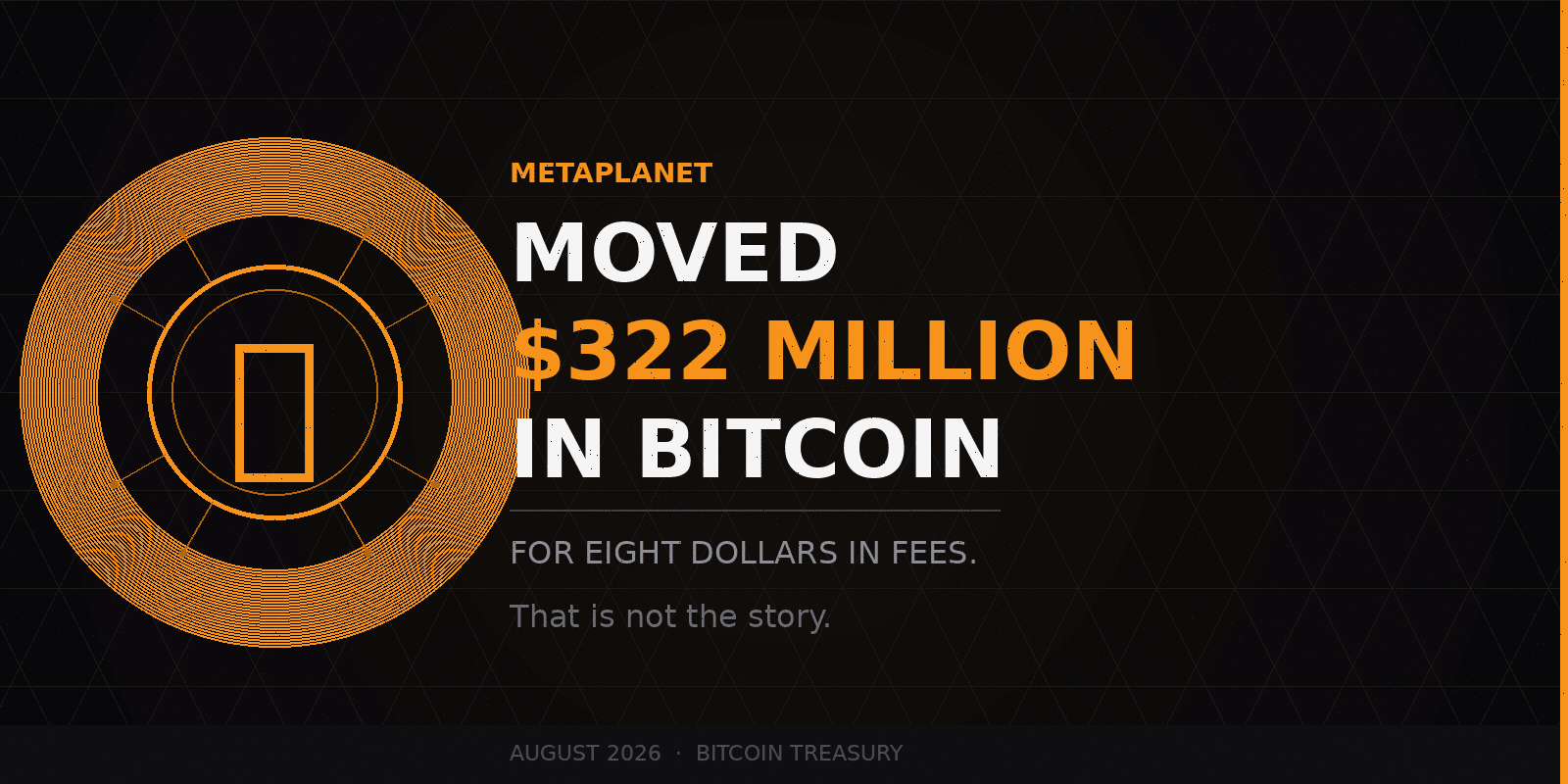
Metaplanet BTC transfer, August 2026. Source: Blockchain explorer, CryptoTimes.

By BitBrainers Editorial

Metaplanet's wallets lit up Tuesday. 5,014 BTC moved between addresses in real time, $322 million on the block explorer, $8 in fees. The crowd did what it always does: screenshot the transaction, assume the worst, type "they're selling" before finishing the sentence.

They were not selling.

CEO Simon Gerovich said it plainly: routine custody operation, no bitcoin sold, holdings still at 43,000 BTC. Believe him or not, moving cold storage around is not a crime. But that is not the interesting part of this week.

The interesting part is that Metaplanet spent 2026 building one of the more aggressive structured-finance operations in crypto, and few people have sat with the full picture.

Here is the count.

January: $137 million raised, partly to pay down debt. March: $255 million, equity plus warrants, including a mechanism that only exercises once the stock trades above 1.01x its modified net asset value. April: $50 million in zero-interest bonds. This week: BitBonds — four private bond series, roughly $1.3 million total, 4 to 4.3% interest, three-year maturity, sold through their own in-house securities arm and closed before most people knew the solicitation was open.

Four raises, one year, same company.

The Warrant Deal

The March warrant deal deserves a pause. EVO Fund, a Cayman Islands vehicle, received rights convertible into up to 100 million new shares, gated behind that 1.01x mNAV trigger. It is filed, it is dilution risk sitting on the balance sheet, and there is no public documentation framing it as personal enrichment for Gerovich. That is a leap the timeline does not support.

The Number That Matters

Skip past the wallet noise. Here is the number that actually matters: 43,000 BTC, bought at an average price around $96,191. Current price, roughly $63,600. That is about $1.4 billion underwater. Thirty-four percent down. On the whole stack.

They are still raising debt.

Not because they are desperate. Maybe it is discipline. Maybe the plan is working exactly as designed, four instruments deep, buying time until price catches back up to cost basis. Or maybe it is a company that bet enormous on a number going up on a schedule nobody promised, and is now financing the gap with whatever paper the market will still take. Both readings fit the same facts. That is the uncomfortable part.

The wallet transfer was not the risk. It never was. The risk is a treasury company sitting on a nine-figure unrealized loss that keeps finding new ways to raise money to keep buying more of the thing that is currently losing. Fine until it is not.


Get the Weekly Brief

One email. Monday morning. The stories that actually move your bitcoin's security, not just its price.

Subscribe

Sources

CryptoTimes Metaplanet Moves 5,014 BTC for $8 in Fees, CEO Says No Bitcoin Sold

CoinDesk Bitcoin Treasury Company Metaplanet Unveils BitBonds with $1.3 Million Private Debt Sale

CoinDesk Metaplanet Raises $255 Million to Accelerate Bitcoin Accumulation

TipRanks Metaplanet Taps EVO Fund With New Warrant Issue for Major Capital Raise

CoinDesk Metaplanet Raises Up to $137M to Expand Bitcoin Holdings and Reduce Debt

CoinDesk Bitcoin-Holder Metaplanet Raises $50 Million in Zero-Interest Bonds to Buy More BTC

Tools: Kraken for trading. Trezor for storage.

This is market commentary, not financial advice. Nothing here is a recommendation to buy or sell any asset. Do your own research.

Thursday, August 13, 2026

Trezor's Devices Are Fine. Your Mailing Address Is Not

BitBrainers - Trezor's Devices Are Fine. Your Mailing Address Is Not.

Trezor shipping breach scope, August 2026. Source: Trezor blog, ShipMonk disclosure.

By BitBrainers Editorial

Trezor's shipping provider got breached. Not Trezor's servers, not their firmware. A third-party fulfillment company called ShipMonk. Anyone who has tracked enough of these already knows the shape of it: the vendor holds the line, the vendor's vendor doesn't.

The Numbers

11,742 customers with full exposure — name, shipping address, phone number, email, all four together. Another 1,947 with partial exposure — name, city, email (sounds like less, until you remember that someone patient enough to fill in the rest doesn't need much more than that, and plenty of people have exactly that kind of patience for exactly this kind of target). Seven countries: US, UK, Sweden, Colombia, Brazil, Italy, Portugal. A ninety-day window running back from August 8th.

The Statement

Predictably, the statement leads with reassurance. Devices remain secure, systems remain secure. Technically accurate. Still not the point.

The Actual Risk

Somewhere there is now a list connecting real names to real home addresses to the specific fact that these people bought hardware built to hold bitcoin, and a list like that is worth more than a generic email dump from some SaaS tool nobody remembers signing up for, worth more than most of what gets filed under "breach" in a given month, worth enough that treating this as a routine notification email is the wrong instinct entirely.

Not exactly reassuring.

What Trezor Did Right

Trezor did limit the damage somewhat. Their ninety-day retention policy meant this wasn't years of order history sitting exposed, and they say they negotiated matching terms from their fulfillment partners. A real policy choice, not just a line in a statement. Credit where it's earned. ShipMonk, for what it's worth, handles fulfillment for a long list of consumer brands most people have ordered from this year without thinking twice. Back to Trezor specifically. They're the ones who actually have to answer for this.

The Gap Nobody Checked

Turns out the failure mode nobody built a checklist for is the one that just happened. Wallet security has entire industries built around it, firmware audits, entropy standards, open-source review, all of it pointed at the device itself. Nothing close to that discipline exists for what happens when a shipping partner's systems get compromised, and you already know which way that gap gets exploited first.

What To Do

If your name's on the list Trezor emailed, the advice doesn't really change from any other breach you've sat through by now. Expect sharper phishing attempts, ones that can reference your real address to sound legitimate. Never enter a seed phrase into anything with a screen you didn't set up yourself. Stop posting your hardware wallet setup anywhere a stranger could connect it to a delivery window.

Two hardware wallet companies, one stretch of two weeks, two completely different failure points, the same lesson underneath both of them for anyone paying attention to the pattern instead of just the headline.


Get the Weekly Brief

One email. Monday morning. The stories that actually move your bitcoin's security, not just its price.

Subscribe

Sources

Trezor Recent customer data exposed in shipping provider incident

Tools: Kraken for trading. Trezor for storage.

This is market commentary, not financial advice. Nothing here is a recommendation to buy or sell any asset. Do your own research.

Your Hardware Wallet's Security Now Depends on Who Has Better AI

BitBrainers - Your Hardware Wallet's Security Now Depends on Who Has Better AI

By BitBrainers Editorial

Two weeks. That is how long it has been since Coldcard, and here is what actually survived the panic cycle once the hot takes burned off.

The number kept moving and almost nobody watched it happen in real time. Day one, $38 million. By the time Galaxy Research finished tracing wallets, three confirmed waves, 1,596 BTC, roughly $100 million, plus a suspected fourth wave pushing the real total past 2,000 BTC. Call it $130 million and even that comes with an asterisk. Fifteen separate attackers, working independently, all finding the same open door within days of each other. One of them is still sitting on 1,159 BTC he has not moved, which either means patience or fear. There is no way to tell from the outside.

So drop the loss number. It was never the real story. The real story is the bug lived in the firmware for five years, shipped March 2021, survived whatever review process existed, and nobody caught it until it was already draining wallets. That is not a Coldcard problem specifically. That is every piece of custody hardware you own, running code nobody has actually broken yet, that you are calling "secure" because it has not failed publicly. Yet.

The Headline Everyone Printed Falls Apart

The story that ran everywhere said an attacker used AI to find the bug before Coinkite's own review did. Good headline. Clean narrative. Except Galaxy's own forensic work says Block's engineering team and Coinkite's internal investigation found the flaw independently, no attacker AI required. So the thing that made this story go viral probably was not even true, and almost nobody has gone back to fix it. Which tells you something about how these stories actually spread. It is not the correction that gets the retweets.

The AI angle is not dead. It just is not the one that ran. Somebody, still unnamed, ran an AI-assisted audit across other Bitcoin wallet firmware after Coldcard broke, and found 85 more critical bugs in the same family. Weak reseeding. Fallback bindings that quietly downgrade your randomness under specific build conditions. Most of those have not even been disclosed publicly yet. They are apparently rolling out on coordinated vendor timelines, one wallet at a time, whenever each company decides you are ready to hear it.

Eighty-five. Sit with that.

That means somewhere right now there is a wallet holding real money with a known critical flaw that has not been told to its owner yet. Not maliciously. Responsible disclosure is a real practice with real reasons behind it. But the effect on you is the same either way: you do not know, and you will not, until your wallet's turn comes up in whatever queue this is.

The Actual Shift

This is the actual shift, and it is the reason the title is not hyperbole. This is not about one hacker with one clever tool anymore. Finding a five-year-old logic flaw buried in firmware used to take a determined human years, or never happen at all. Now it takes an AI model pointed at the right codebase for an afternoon. Whoever points theirs first, the wallet maker running the audit or whoever is looking for a way in, decides whether you get a quiet patch or a headline with your balance in it.

Keep firmware current. Use dice-roll entropy where your device supports it, because it does not depend on the internal RNG being right. Stop treating "no known vulnerabilities" as a safety claim. It is a timestamp, nothing more. And accept that the industry is about to find a lot more of these, fast, because the tools for finding them just changed and the tools for patching five years of legacy firmware across a dozen vendors did not.


Get the Weekly Brief

One email. Monday morning. The stories that actually move your bitcoin's security, not just its price.

Subscribe

Sources

Galaxy Research Coldcard Wallets Hacked for $130m and Counting

TRM Labs The Largest Hardware Wallet Exploit of 2026

Block Bitcoin Engineering and Security Predictable RNG Fallback and 32-Bit Reseed Disclosure

Coinkite Coldcard Security Advisory (updated August 1, 2026)

CBC News What we know about ongoing Coldcard hack that's stolen over $100M worth of bitcoin

crypto.news Coldcard's RNG flaw is still draining wallets, and an AI audit just found 85 more critical bugs across the ecosystem

Tools: Kraken for trading. Trezor for storage.

This is market commentary, not financial advice. Nothing here is a recommendation to buy or sell any asset. Do your own research.

Wednesday, August 12, 2026

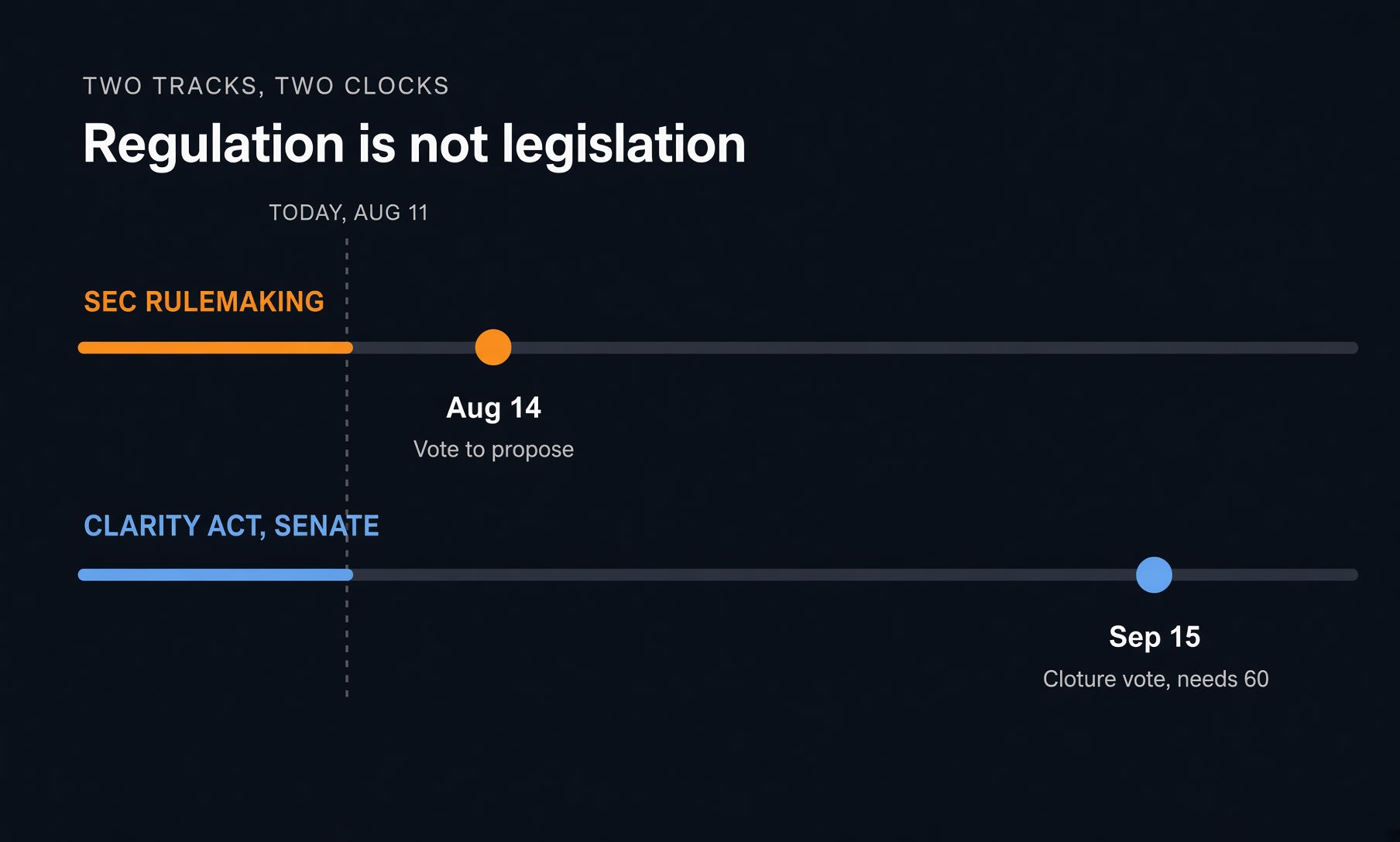
The SEC Votes Friday, the Senate Doesn't Vote Until September 15

BitBrainers - The SEC Did Not Wait for Congress

The SEC votes Friday on a crypto rule. The CLARITY Act is stuck in the Senate. Two branches, two timelines. BitBrainers, Aug 2026.

By BitBrainers Editorial

The SEC and the Senate are not the same thing. They don't have the same vote. They are completely different entities in this regulation story. On Friday the SEC votes on whether to propose a crypto rule. The Senate doesn't touch CLARITY until September 15. And that vote is only to start debating it, not pass it. Everyone's treating this week like regulation arrived. It didn't.

What Friday Actually Is

The Sunshine Act notice dropped Monday night. Open meeting. August 14, 10:00 a.m. ET. One item on the agenda.

A vote on whether to issue a release proposing new rules for certain investment contracts involving crypto assets.

That's it. Not law. Not even a proposed rule yet. Just a vote on whether to start the comment period.

Three commissioners, all Republicans. Paul Atkins has pushed Reg Crypto since he took the chair. A yes vote kicks off notice-and-comment. Major SEC rules usually need 12 to 18 months from proposal to final.

Think deeper. The SEC rules over stocks, commodities, crypto, what goes on the table, the prices, the derivatives. The Senate is the one that gets regulation to the top of the country. Two different jobs.


The Bill Is Separate

CLARITY is legislation. It has to pass the Senate, go back to the House, and get signed. Its job is drawing a statutory line: SEC keeps securities, CFTC gets digital commodity spot markets. The CFTC doesn't have that authority now. Congress has to grant it.

The SEC can't do that. No amount of rulemaking lets an agency hand its jurisdiction to someone else. Only a statute works.

What the SEC can do is operate inside the Securities Act of 1933. That's Friday. Using the power it already has, because Congress hasn't acted.

The permanence gap matters. A future commission can kill an SEC rule in one vote. A statute needs another act of Congress to repeal. One lasts. The other doesn't.


Where CLARITY Actually Stands

House passed it July 2025.

294-134.

Senate Banking Committee moved it 15-9 in May. Then it sat. June 1 it hit the full Senate calendar. Still there.

Thune filed cloture on the motion to proceed August 8. Vote is September 15, 2:15 p.m. ET. Five weeks away. Cloture needs 60. Republicans have 53. Seven Democrats or independents would need to flip just to open debate. The bill itself doesn't get negotiated until after that.

The same fights from the July hearing haven't moved: ethics and divestiture for federal officials, the stablecoin yield provision critics call the exchange loophole, and a developer safe harbor that illicit finance hawks want narrowed. Nothing changes while the Senate is out of session.

Polymarket has CLARITY passing in 2026 at 21%. Was 82% in February.

The July 17th hearing was just a hearing before it goes to the Senate. They didn't add anything meaningful. Another attempt to prolong the actual vote. Of course they claimed they were discussing the future of finance. What it actually is: the CLARITY Act. Think deeper. To protect their own. That's why the ethics clauses became the problem.

BITCOIN doesn't care about the CLARITY ACT.


Regulatory noise, sorted from signal

Weekly Bitcoin and macro analysis. Free. We track which agency actually did what.

Subscribe

Why the SEC Is Moving Now

TD Cowen's Jaret Seiberg called Friday's meeting the first of several rulemakings aimed at regulatory certainty. He tied it directly to the Senate failing to advance CLARITY before recess.

Grayscale's head of research said the same thing last week. US crypto markets can keep running even if CLARITY dies in 2026, partly because SEC rules can patch some gaps. That's what Friday is. A patch. Not a fix.

Everything the SEC has issued on crypto so far is staff guidance and policy statements. A new chairman can reverse those with a memo. A Federal Register rule is different. It survives an administration change unless someone runs the full repeal process.

The industry wants that kind of durability. A statute gives more of it than any rule. Friday is a step toward the weaker kind of stability. It doesn't replace the stronger one.


What to Actually Watch

Whether the SEC votes yes Friday. A no vote or a delay kills Reg Crypto before the comment period opens.

What the proposed text says once it's published. Coverage keeps citing a $75 million fundraising exemption Atkins mentioned in a March speech. That number isn't confirmed for Friday's agenda. Treat it as a placeholder.

Whether the September 15 cloture vote hits 60. The 21% Polymarket odds reflect real skepticism. Not just volatility.

Two branches of government are working the same problem on different timelines with different levels of permanence. Run them together in coverage and you get headlines saying regulatory clarity arrived this week. It hasn't. One agency started paperwork. The other is five weeks from its first procedural vote. Still not debating the actual bill.

Sources

U.S. Securities and Exchange Commission: Sunshine Act Notice, August 10, 2026

CoinDesk: U.S. SEC sets meeting to propose Reg Crypto to support certain digital assets offerings

Congress.gov: H.R. 3633, Digital Asset Market Clarity Act

CoinPedia: SEC Moves Toward Regulation Crypto as CLARITY Act Faces Delays

This is market commentary, not financial advice. Nothing here is a recommendation to buy or sell any asset. Do your own research.
Tuesday, August 11, 2026

The Inflation Hedge Argument for Bitcoin Has a 2022 Problem

BitBrainers - Is Bitcoin Actually an Inflation Hedge

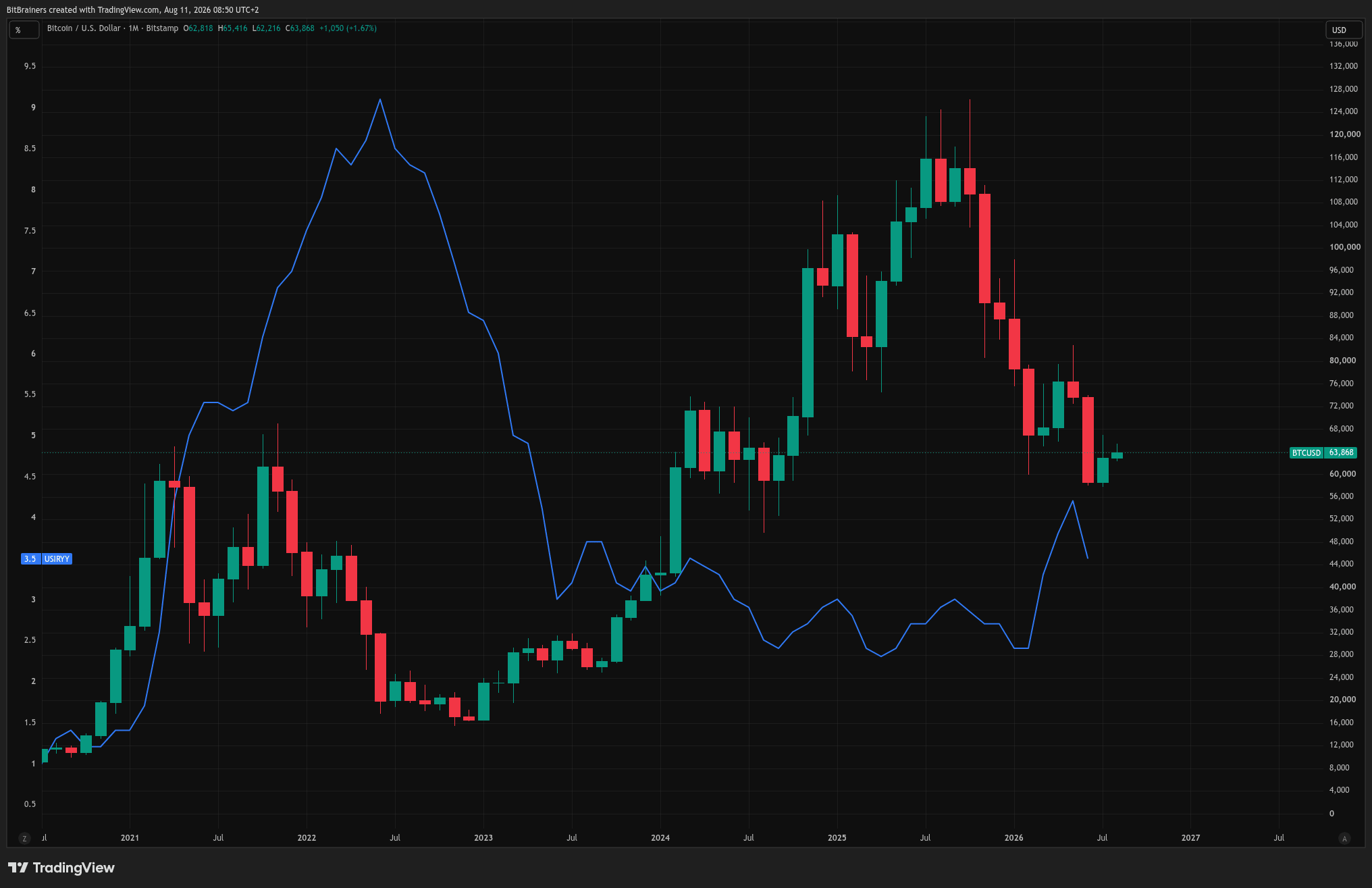
BTC/USD vs US CPI YoY (USIRYY), monthly. BitBrainers via TradingView, Aug 2026.

By BitBrainers Editorial

Every Bitcoin pitch eventually arrives at the same line: it's a hedge against inflation. Fixed supply, no central bank, 21 million cap. The argument borrows gold's playbook and assumes the same rules apply. The chart above is worth staring at before accepting that framing.

The Part of the Argument That Is Actually True

The structural case for Bitcoin as a long-run store of value is real. The 21 million cap is not a marketing claim. It is enforced at the protocol level, and no government decision changes it. Every major fiat currency in history has been expanded by whoever controls the printing mechanism. Bitcoin cannot be..

Investors who bought in 2017 and held through 2021 saw returns that made CPI irrelevant as a comparison. The scarcity argument held up over that window. The problem comes when the word "hedge" gets attached to it. A hedge implies a specific mechanical relationship: when the thing you're hedging against rises, the hedge rises with it.

Bitcoin has not reliably done that. It did the opposite in the one period where the test actually mattered.


What Happened in 2022

US CPI peaked at 9.1% in June 2022, the highest reading since 1981. Bitcoin that month was trading below $20,000, down roughly 70% from its November 2021 high. The blue line in the chart above rises steadily through 2022. The candles collapse.

Gold fell too during 2022, though far less dramatically, and it recovered faster. The assets that genuinely performed as inflation hedges in that environment were energy, agricultural commodities, and real assets with direct pricing power tied to what was actually causing the inflation. Bitcoin was not in that category.

It fell because it had been trading as a risk asset. During the 2022 rate hiking cycle, Bitcoin's 90-day rolling correlation with the S&P 500 consistently ran above 0.65, peaking above 0.75 in mid-2022 per Bloomberg data. Gold's equity correlation over the same period stayed near zero. That single data point dismantles the "digital gold" comparison at the mechanism level, not just the surface level.

I have watched the same retail client make the inflation hedge argument in 2021, size up at $60,000, and get liquidated at $16,000 in 2022. The narrative did not change. The price did.

When the Fed started hiking and liquidity tightened, Bitcoin dropped alongside Nasdaq growth stocks. Not alongside gold. Not in the direction an inflation hedge should move.

The pattern has not shifted meaningfully since. In May 2026, CPI printed 4.2% year-on-year, the highest reading since April 2023. Bitcoin dipped roughly 2% on the release, from $62,800 to $61,500, then recovered to flat within hours. That is not a hedge behavior, thats a risk asset behavior.


Why Liquidity Drives It, Not Inflation

The 2020-2021 period is worth acknowledging here, because the narrative looked convincing then. The Fed expanded its balance sheet, rates went to zero, and Bitcoin went from $10,000 to $69,000. Inflation was rising through 2021. Bitcoin was rising. The two moved together and the "hedge" framing felt validated.

It was not inflation driving Bitcoin. It was liquidity. The Fed flooded the system with capital, that capital chased risk assets, and Bitcoin was at the top of that trade. CPI happened to be rising at the same time. The correlation was coincidental, not causal.

When the Fed reversed in 2022, the distinction became obvious. Inflation kept rising for months after the hikes started. Bitcoin stopped rising the moment liquidity conditions tightened. It was responding to the Feds balance sheet, not to CPI.

This is why global M2 money supply tracks Bitcoin's price far better than CPI does. M2 measures liquidity availability directly. Bitcoin historically lags global M2 expansion by roughly 10 to 12 weeks, which means the signal is readable in advance if you know where to look. The full breakdown of that lag and how to use it is in Bitcoin Follows M2 With a Lag Nobody Talks About.


Macro reads without the pitch

Weekly Bitcoin and macro analysis. Free. No price targets dressed up as research.

Subscribe

So What Does the Long-Run Case Actually Rest On?

Pull the short-term correlation out of the argument and a more defensible version survives. Bitcoin may be a hedge against currency debasement over decade-long horizons. That is not the same claim as hedging CPI.

Currency debasement is the structural erosion of purchasing power through sustained monetary expansion across multiple cycles. CPI is a quarterly snapshot of a basket of goods. The two are related but they diverge constantly over months and years. A fixed-supply asset plausibly protects against the first. It has not reliably protected against the second.

Most investors making the "inflation hedge" argument are thinking in one to two year windows. On that timeframe, Bitcoin has failed the test repeatedly, Gold has not. Gold does not need favorable liquidity conditions to function as a store of value. At this stage in its maturity, Bitcoin still does.


Two Things That Would Have to Change

For Bitcoin to function as a short-to-medium term inflation hedge, two conditions would need to shift.

Its equity correlation would need to break down structurally, which would require a holder base dominated by sovereign and institutional allocators treating it as a reserve asset rather than a speculative position. Spot ETF flows are moving in that direction, but the correlation data has not changed materially yet.

Its market depth would need to reach a scale where a central bank could buy meaningful quantities during an inflationary crisis without moving the price by double digits in a week. That depth does not exist at the size that matters for national reserve management.

Neither condition is impossible. Both are a long way off. Spot ETFs help, but $56 billions in cumulative inflows has not yet moved the correlation needle. Sovereign buyers are not showing up in the data.


Where That Leaves It

Bitcoin is a bet on global liquidity expansion, institutional adoption, and a fixed-supply design that may matter more in twenty years than it does today. That is a defensible position. It might even be a good one.

It is not a shortrun inflation hedge. The 2022 data makes that clear, and the chart at the top of this post shows it without requiring any argument at all.

The 21 million cap is a real property of the protocol. The inflation hedge label is a sales narrative built on top of it. Telling the difference is the first step toward writing something useful instead of something that sells. Most of the inflation hedge content online is the second kind.

Sources

Federal Reserve Bank of St. Louis: US Consumer Price Index, All Urban Consumers

Bureau of Labour Statistics via TradingView: USIRYY, United States Inflation Rate YoY

CoinGecko: Bitcoin historical price data

World Gold Council: Relevance of Gold as a Strategic Asset

This is market commentary, not financial advice. Nothing here is a recommendation to buy or sell any asset. Do your own research.
Monday, August 10, 2026

Weekly Brief: The Number That Decides September

By BitBrainers Editorial

The July CPI report is scheduled for August 12 at 8:30 AM ET. It is the next input that moves September FOMC pricing. Bitcoin is at $65,212 with $65,800 as the weekly resistance. Whether that level breaks depends on what Wednesday says.

Why This CPI Print Is Different

June CPI came in at 3.5% year-on-year. The month-on-month reading fell 0.4%, mostly because energy prices dropped 5.7% in June. That tailwind is gone.

The Iran conflict pushed oil back up through July, and markets are expecting the month-on-month reading to turn positive again. Consensus sits around 3.5% year-on-year for headline, with core near 2.6%. The issue is not the number itself. It is the direction.

A positive month-on-month print, even a small one, shifts the narrative from cooling to reaccelerating. The Fed is watching that, not the headline. After July's jobs report missed badly, September hike odds fell. CME FedWatch now prices a hold at 60% and a hike at 40%. Wednesday resets that in one direction or the other.

CME Futures Positioning Flipped

Hedge funds have moved to net long on CME Bitcoin futures, according to the CFTC Commitments of Traders report. That is a structural shift. These are positions built over weeks, not sentiment readings that reverse overnight. One CPI print does not unwind that positioning. What it does is delay or accelerate the next move.

Leveraged funds also cut their net short Yen positions by 74,000 contracts in five weeks, per CFTC data reported by The Kobeissi Letter. The Kobeissi Letter described it as one of the sharpest reductions in short positioning since the 2008 Financial Crisis.

The last time Yen carry dynamics unwound at scale, August 2024, BTC dropped to $49,000 in days. The current unwind is slower. That is not the same as safe.


Jackson Hole Is the Next Real Signal

The September 16 FOMC is not the only event shaping the rate path. Fed Chair Kevin Warsh speaks at Jackson Hole on August 27-29. The symposium theme this year is "Financial Innovation: Implications for Payments and Policy." That theme is unusually relevant to crypto under a new Chair.

His speech will be the final pricing input before the September decision. Between now and then: July CPI on August 12, July PPI on August 13, and July PCE on August 26. Three inflation prints in 14 days, then Warsh.

Key Levels This Week

BTC at $65,212 entering August 10. Resistance at $65,800. Support at $62,000, then $58,000 as the macro floor.

10-year Treasury yield near 4.70%. A move above 4.80% post-CPI tightens financial conditions further. Fed September hike odds: 40% as of today.

For the macro setup behind the liquidity picture: Bitcoin Follows M2 With a Lag Nobody Talks About

The Week Ahead

Date Event Why It Matters
Wed Aug 12 July CPI, 8:30 AM ET Consensus 3.5% YoY. Month-on-month turning positive reaccelerates the hike narrative.
Thu Aug 13 July PPI Leading indicator for CPI. Shows how inflation moves through the supply chain before it hits consumers.
Mon Aug 26 July PCE Fed's preferred inflation gauge. Core PCE above 3% strengthens the September hike case.
Aug 27-29 Jackson Hole Symposium Warsh speaks. Final pricing input before the September 16 FOMC.
Sep 16 FOMC Decision Hold at 60%, hike at 40% as of today. Every print between now and then moves that needle.

For last week's setup: Weekly Brief: July Closed Green. August Has a Record to Defend


Monday Morning. Every Week.

The macro data and Bitcoin levels that matter this week, before the week starts.

Subscribe

Sources

CFTC Commitments of Traders Report, week ending August 4, 2026

The Kobeissi Letter Hedge Funds Cut Short Yen Positions By Half

CME Group FedWatch Tool, September FOMC Probabilities

US Bureau of Labor Statistics Consumer Price Index Release Schedule, July 2026

Federal Reserve Bank of Kansas City Jackson Hole Economic Policy Symposium 2026

CNBC Odds of Fed Rate Hike Tumble Following July Jobs Miss

Tools We Use

Kraken: Spot and futures on BTC, ETH, and 200+ assets.

Trezor: Cold storage. No internet connection required.

This is market commentary, not financial advice. Nothing here is a recommendation to buy or sell any asset. Do your own research.
Sunday, August 9, 2026

Saylor: The Man Who Wants His Fortune To Disappear

BitBrainers - The Man Who Wants His Fortune To Disappear

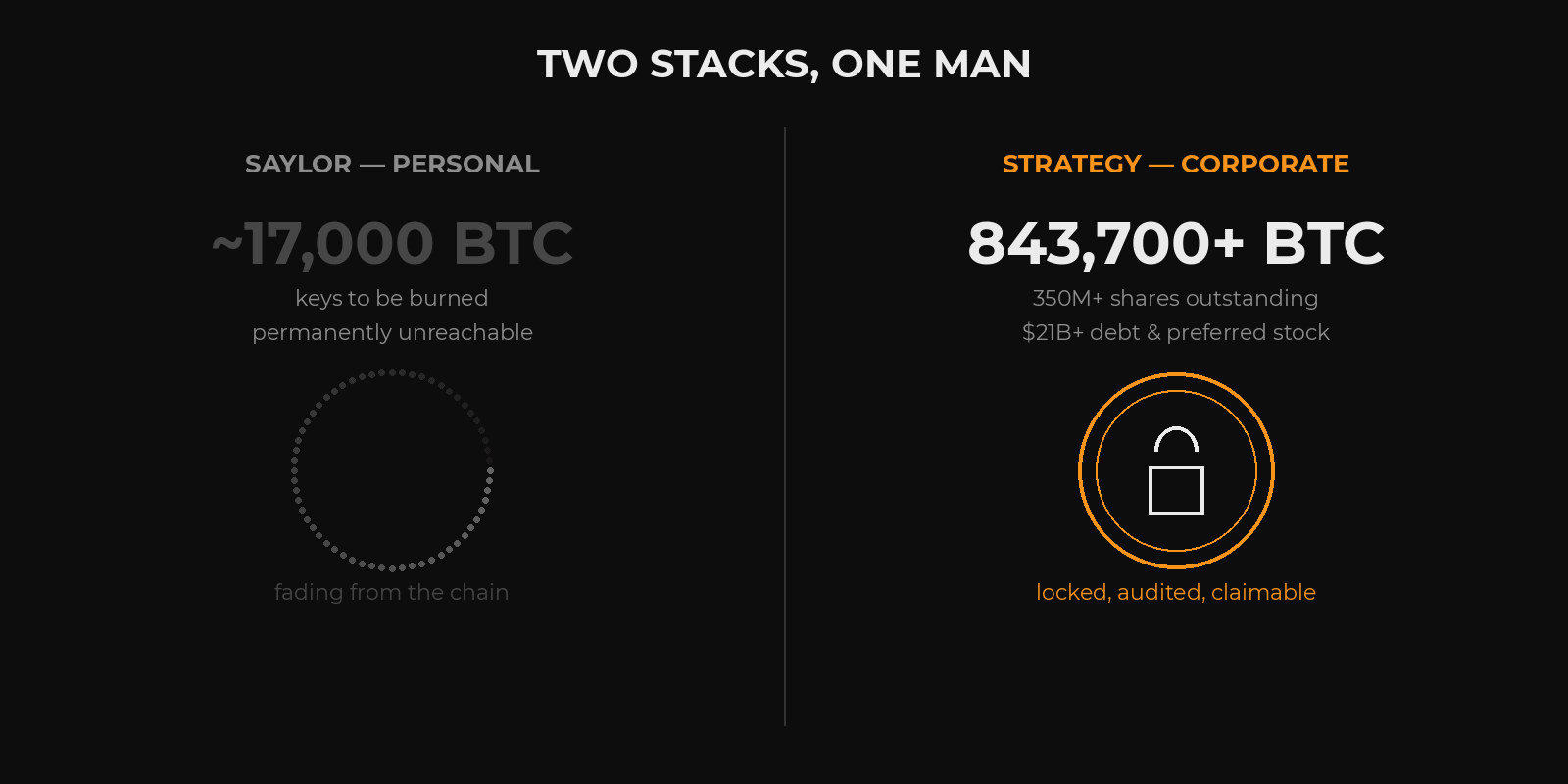
Strategy's Bitcoin holdings versus its share count and debt load, 2020 to 2026. Source: Strategy SEC filings.

By BitBrainers Editorial

In interviews since January 2025, Michael Saylor has described his intent to make sure his personal Bitcoin never goes to heirs. In 2024 he called it a gift to civilization. Since then the language has hardened into something more specific: burn the keys, make the coins permanently unreachable, let scarcity do the rest for everyone still holding.

Meanwhile the company he built raises billions in debt and issues hundreds of millions of new shares to buy Bitcoin it will never let anyone touch directly. Same man, same asset, two structures built to do opposite things with it.

Three Ways a Fortune Disappears

Money in a bank disappears slowly. Inflation runs 2 to 7 percent a year depending on the currency, and nobody signs up for that, it's just the default setting of the system. Saylor watched MicroStrategy's own cash reserves erode this way for years before he pivoted the company to Bitcoin in 2020.

Money on an exchange disappears suddenly. FTX, Celsius, and Mt. Gox all proved the same point: the coins are there until the platform isn't, and depositors never got a vote on the timing.

Money in self-custody disappears differently. It's not on any bank's ledger or exchange database, and that absence is a choice, not a failure. Because it's a choice, it can be reversed. A holder with their own keys can move coins to anyone, at any time, for any reason. Or to no one at all. Taken to its logical end, self-custody isn't just the power to hold wealth outside the system. It's the power to delete it.

A Plan That Got More Extreme

That third option is what Saylor described to the New Zealand Herald in October 2024. "I'm a single guy, I have no children, when I'm gone, I'm gone. Just like Satoshi left a million Bitcoin to the universe, so I'm leaving whatever I've got to the civilization." At a Bitcoin conference weeks earlier he'd framed it as a charitable structure: his shares and assets flowing into a public foundation dedicated to Bitcoin adoption.

By early 2025 the framing changed. In interviews since January, Saylor has described burning his own private keys outright rather than routing the coins through any foundation. He's specific about the number: roughly 17,000 BTC, the personal stack he disclosed back in 2020 before Strategy started buying. He calls burning it a "pro rata contribution," destroying access so every other holder's coins become proportionally scarcer. A charity can spend a donation. Nobody can spend a burned key. The plan didn't just continue, it hardened into something more extreme.

Both statements are real and both are his. What they share matters more than which one is current: whether given away or destroyed, the coins leave his control entirely, permanently, and by his own decision. Self-custody is what makes either version possible.


Get the Weekly Brief

One email. Monday morning. The macro events that move Bitcoin this week.

Subscribe

What Strategy Actually Sells

Strategy holds roughly 843,700 BTC as of its latest capital structure update. An investor who buys MSTR doesn't hold any of those coins. They hold shares in a company that holds the coins, which is a different asset with a different set of risks attached.

Those risks are visible in the filings. Shares outstanding have climbed from under 200 million in 2024 to somewhere near 350 million today, more than a 50 percent increase in a single year. Convertible debt stands at $6.7 billion. Preferred stock across four separate series adds well over $15 billion more in notional obligations, some paying dividends above 11 percent annually. None of that is hidden. It's disclosed every quarter. It's also the exact opposite of a structure built for release.

Coins in cold storage, audited, reported, financed against, are coins built to stay put. That's not a flaw. Institutions that can't legally custody Bitcoin directly need exactly this kind of wrapper, and it's why Strategy has become the largest corporate holder in the world. But it's a structure engineered for permanence, sitting downstream of a founder who has twice, in two different ways, said permanence is the last thing he wants for his own coins.

Put plainly: Saylor the individual wants his coins to be unspendable, gone from circulation, gone from reach. Strategy the company makes its coins, short of extreme legal or regulatory action, functionally impossible to render unspendable the same way. They're seizable by courts, claimable by shareholders, collateral for debt covenants. Regulators can see every one of them. Nobody is burning anything on a public company's balance sheet. MSTR is Bitcoin with the burn button disabled.

The split shows up in Strategy's own trading, not just in Saylor's stated plans. He spent years insisting the company would never sell. In 2026 it sold Bitcoin three separate times anyway, including 1,638 BTC in late July to help fund preferred-stock dividends. When asked about it, Saylor's answer was direct: "Strategy is not my wallet." That's not a contradiction he's trying to hide. It's the same line drawn twice, once for the keys he'll burn, once for the company he runs. His conviction and the company's obligations are two different things, and he's told people that himself, in public, more than once.

The Part That Actually Matters For Your Money

This isn't an argument that MSTR is a bad investment or that self-custody is morally superior. It's that they end differently, and the difference shows up exactly when it counts most. It also reframes what the MSTR premium actually prices in. Part of it is leverage, and that part gets discussed constantly. A less discussed part is that the premium buys Bitcoin exposure with the one feature Saylor personally values most stripped out: the ability to disappear on command. Investors are paying extra for permanence from the same person who's paying nothing, deliberately, to make his own stack vanish.

A self-custodied stack passes to whoever the holder names, with a seed phrase and, if they set it up that way, a time lock. It can be donated in one transaction. It can be destroyed in one transaction. The holder decides, right up until they don't need to decide anymore.

An MSTR position passes through probate as a security. It's subject to estate tax, brokerage restrictions, and whatever Strategy's balance sheet looks like the day the estate gets settled. It cannot be donated as Bitcoin, because it was never Bitcoin. It was always a claim on a company that owns Bitcoin, and a claim on a company carries every risk the company carries.

Saylor has been consistent about which structure he wants for himself, even as the specific plan evolved. The open question is whether everyone buying MSTR because they believe in his Bitcoin conviction understands they bought the one structure he's actively planning to avoid.


Sources

Decrypt Michael Saylor Says He'll Give Away His Bitcoin, Like Satoshi Nakamoto

SEC EDGAR Strategy Inc. Filings

Benzinga Michael Saylor's Unusual Bitcoin Plan For The Afterlife

Tools: Kraken for trading. Trezor for storage.

This is market commentary, not financial advice. Nothing here is a recommendation to buy or sell any asset. Do your own research.
BIP-110 Split From Bitcoin, Then Its Only Miner Quit

BitBrainers - BIP-110 chain split node comparison

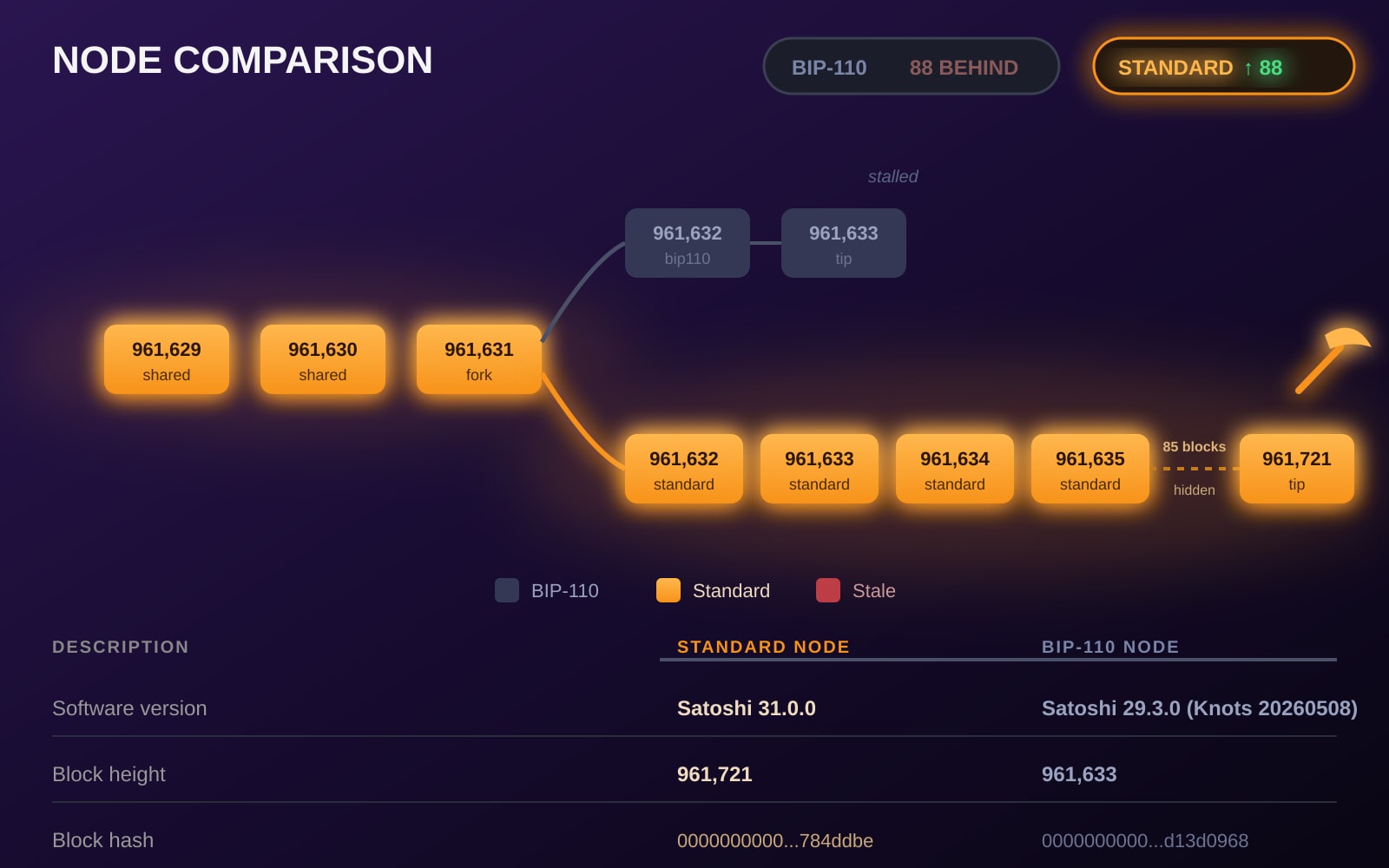
The BIP-110 chain split off from Bitcoin at block 961,632 and stalled at 961,633 after its only miner stopped. The main chain kept building normally, reaching 961,721 by publish. Data: mempool.space.

By BitBrainers Editorial

Bitcoin split into two chains over the weekend. This one was not a surprise. BIP-110 hit its mandatory signaling deadline at block 961,632 on Saturday, and the numbers behind it had been telling the same story since March.

How The Split Actually Happened

BIP-110 is a one-year restriction on storing non-financial data, mainly Ordinals inscriptions, inside Bitcoin transactions. Supporters wanted it locked in through voluntary miner signaling. When that never reached the 55% threshold, the proposal's own rules forced a mandatory signaling period instead.

That period started August 7 at block 961,632. Nodes running BIP-110 software began rejecting any block that didn't signal support. Every other node kept validating normally, which is how you end up with two chains sharing one history up to a single block.

Support going into the deadline was thin: 2.53% of blocks signaled in the final two-week window, and the average since May sat closer to 0.42%. Ocean Pool provided most of what little signaling existed. We flagged this exact gap back in July, when support was still parked near zero.

The split didn't need majority support to trigger, only to lock in cleanly. Miners who reject non-signaling blocks simply start building their own chain the moment the deadline passes. Bitcoin Knots is the software behind that decision.

At block 961,632, AntPool mined the version the main network followed. Roughnecks, mining through Ocean, produced the signaling alternative that BIP-110 nodes accepted instead.

Ocean's own hashrate didn't move as one bloc, though. Its DATUM system lets individual miners set their own block templates, including whether to flip the BIP-110 signal. Simple Mining, which routes through Ocean, mined the very next block on the main chain instead. Even inside BIP-110's biggest backer, support was split.

The gap kept opening. By early Sunday afternoon the main chain had reached block 961,721 while the BIP-110 chain sat frozen at 961,633, the last block Roughnecks mined before it stopped. Eighty-eight blocks is several days of normal production on one side and nothing on the other.

Bitcoin has done this before without a split. Taproot activated at block 709,632 in November 2021 after building broad miner support first, and it never produced a persistent minority chain. BIP-110 entered its mandatory phase with a fraction of that support behind it, so the outcome here was closer to a default than a surprise.

Chain Splits Don't Wait For You To Catch Up

Get the mechanism explained before the headlines catch up. Free, straight to your inbox.

Subscribe

What This Means For Your Coins

Exchanges and ETF holders are not exposed to any of this. The people who need to pay attention are self-custody users running full nodes, especially anyone who updated to Bitcoin Knots to signal support. Replay protection is not automatic between the two chains, so moving coins carelessly during the split window can expose funds on both sides at once.

If you hold your own keys through a hardware wallet like Trezor, the fix is simple. Don't move anything until your node software and wallet firmware agree on which chain you're actually on.

Who's Saying What

Reaction split along predictable lines. Blockstream's Adam Back, who'd argued for months that a breakaway chain was the likely endgame, called the outcome settled and urged BIP-110 supporters back into the main ecosystem.

Strategy's Michael Saylor brought the clearest numbers: about 99.85% of Bitcoin's hashpower on the main chain, the minority branch stuck at two blocks and already more than 80 behind, figures that line up closely with what's above.

He followed with the math that matters. At roughly 0.15% of network hashpower, the minority chain needs 2,015 more blocks to reach its first difficulty adjustment, which at the current pace works out to about 25 years. His framing was blunt: "Consensus is earned, not declared."

There's a wrinkle if you mine through Ocean specifically. The pool switched its default endpoint to signal for BIP-110 on July 15, so anyone pointed at Ocean who never opted into the non-signaling endpoint has been mining the minority chain without realizing it. Developer Peter Todd flagged this over the weekend, estimating roughly $43,000 a day in hashpower value going to blocks the main network will never recognize.

The question of whether the minority chain would keep going got answered fast. Roughnecks, the pool behind both of its blocks, posted early Sunday that it was stopping mining under its own name after an internal team meeting around 3:40am UTC.

The post called it an escalation rather than a retreat and told anyone still mining BIP-110 blocks to stand down for now. Either way, the chain that split off at 961,632 no longer has an active miner behind it.


What Actually Got Resolved Here

Not much, honestly. The mandatory signaling period settled a governance mechanism, not the underlying argument. Whether non-financial data belongs in Bitcoin blocks is the same fight it was in March, and Ordinals volume has already been falling on its own for unrelated reasons.

The other side of this fight didn't need a fork at all. Ordinals advocate Leonidas proposed a client called DOG Mode in July that changes nothing about consensus rules. It just raises the transaction size Bitcoin Core will relay and drops the dust limit to one satoshi, making Ordinals and Runes cheaper to broadcast. DOG Mode needs one willing miner, not 55% of the network, which is the exact asymmetry BIP-110 just ran headfirst into.

With Roughnecks gone, the minority chain isn't fading out gradually so much as it just stopped. A chain with zero active miners doesn't creep toward its next difficulty adjustment. It sits frozen at whatever block it last reached, waiting for someone to pick the work back up.

The real story is what BIP-110 proved about changing Bitcoin's rules going forward. Getting 55% of hashrate to agree on anything in 2026 is a different bar than it was during Taproot, and the next controversial proposal will be measured against this exact outcome.


Sources

CoinDesk: Controversial Bitcoin fork BIP-110 mines two blocks, then stops

The Block: Bitcoin's BIP-110 supporters split onto minority chain as main network pulls ahead

KuCoin: Bitcoin BIP-110 Fork Fails as Mainnet Outpaces Minority Chain by 26 Blocks

ForkLog: Bitcoin network splits over BIP-110 soft fork

Binance Square (via Odaily): Roughnecks Stops Mining Operations Under BIP-110 Protocol

This is market commentary, not financial advice. Nothing here is a recommendation to buy or sell any asset. Do your own research.
Friday, August 7, 2026

July Payrolls Fell. The September Hike Odds Went With Them

BitBrainers - Payrolls Break the Hike Case

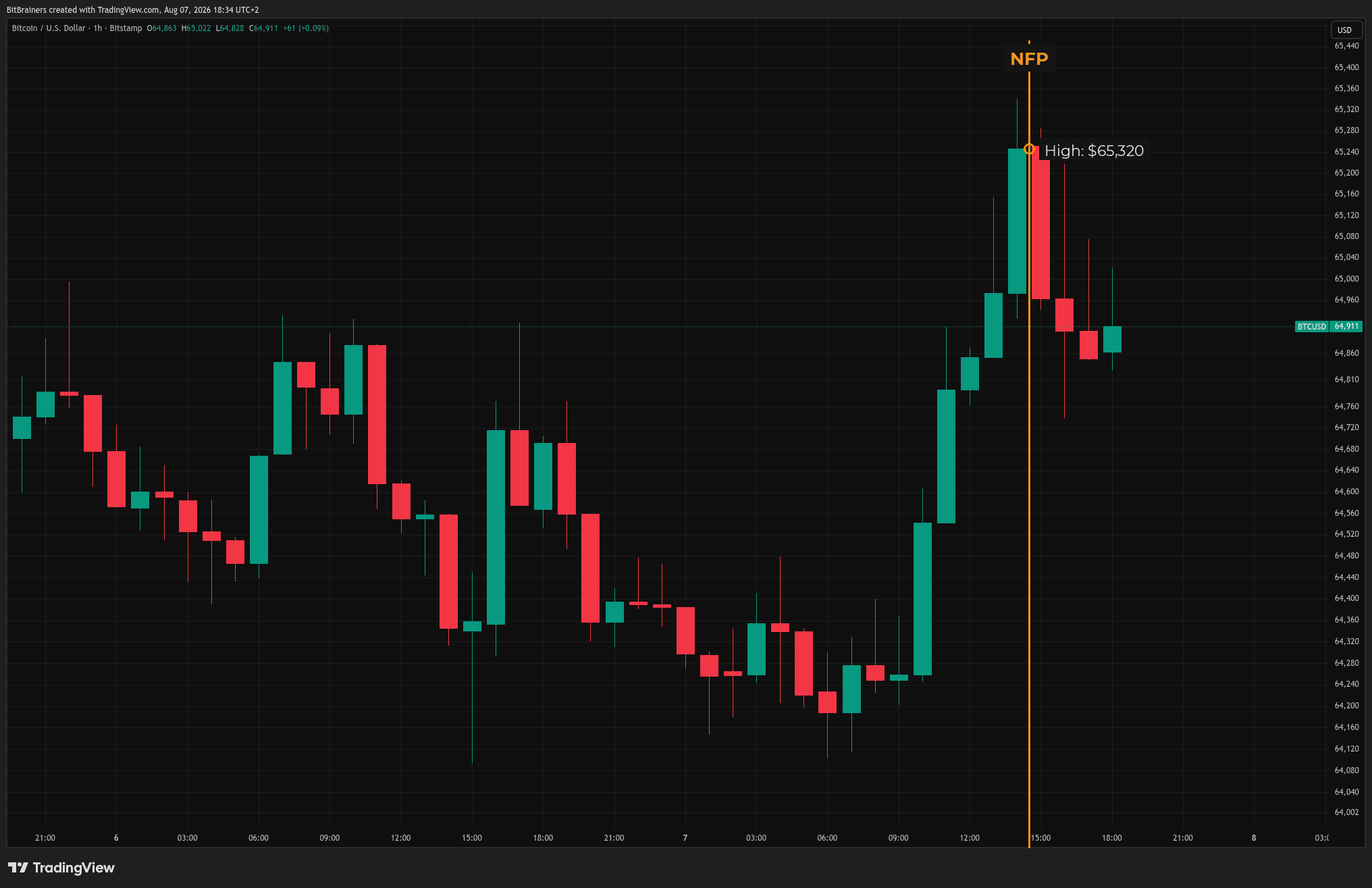
BTC/USD 1H reaction on August 7, 2026 following the July jobs report. Source: TradingView, Bitstamp.

By BitBrainers Editorial

July payrolls fell by 23,000. Consensus expected a gain near 80,000. June was revised down to 20,000 from the previously reported 57,000. September rate hike odds, which had climbed to 56.7% on Wednesday after Chair Warsh and Governor Cook both signaled openness to tightening, fell back to roughly 44% within hours of the print. Bitcoin spiked, then gave back most of the move, in the hours after the print.

The headline number is a contraction, not a miss. The economy shed jobs in July. Losses concentrated in local government education, down 50,000, and retail, down 19,000. Average hourly earnings rose just 0.1% on the month, 3.2% year over year, both soft.

The unemployment rate fell to 4.1% from 4.2%. That sounds like strength. It is not. The labor force participation rate dropped to 61.4%, the lowest level in more than five years. Fewer people looking for work pulls the unemployment rate down even when hiring is negative.

The Hike Case Just Lost Its Foundation

Wednesday's story was Warsh privately telling the Financial Times he would back a September hike if inflation data ran hot, with Governor Cook publicly saying the same. CME FedWatch odds jumped from 54.4% to 56.7% on that alone.

The hike case was never about jobs data hitting the mark. It rests entirely on the inflation prints still to come: CPI on August 12, PPI on August 13, and core PCE on August 26. But a labor market that is now shedding jobs, not just slowing, gives the doves on the committee real ammunition heading into those releases. Hammack, Kashkari, and Logan dissented for a hike on July 29 when the data still looked resilient. That argument gets harder to make in front of a negative payrolls print.

What the Market Did

Bitcoin spiked to $65,320 in the immediate reaction to the print, then faded back into the mid-$64,000s within hours. That is the print-below-100K, risk-recovers scenario from this morning's setup, not the sell-first pattern that shows up when weak data reads as recession fear instead of rate-cut relief. The fade is worth watching too: initial relief rallies that don't hold often mean the move was positioning unwinding, not fresh conviction.

It also lands on top of a genuine institutional bid. ETFs have taken in $763.6 million over four consecutive sessions heading into today. A soft jobs report that cools hike odds without reviving recession talk is close to the best case that streak could have asked for.

The reaction outside crypto confirms the read. Stock futures jumped and Treasury yields fell within minutes of the release, with the curve bull steepening as traders priced out the more aggressive tightening path Warsh had floated two days earlier. That is a market repricing toward easier policy, not one bracing for recession.


Get the Weekly Brief

One email. Monday morning. The macro events that move Bitcoin this week.

Subscribe

Why the Cut Path Still Isn't Guaranteed

A falling participation rate is not the same signal as a strong labor market, and traders reading today's unemployment tick as good news are reading half the report. One weak print plus heavy downward revisions is harder to wave off than a single soft month, but it is still one data point against three more scheduled releases before the Fed meets on September 15 and 16.

Hot inflation in any of those three reports puts the hike case back on the table fast. Warsh has not walked anything back. He has just lost his best piece of supporting evidence for now.

Watch whether Hammack, Kashkari, and Logan, the three dissenters who wanted a hike on July 29, say anything publicly before the next meeting. Their case was built on a labor market that was still adding jobs. A negative payrolls print with heavy revisions is the kind of data that makes a dissent harder to repeat, not easier.

Track the Next Signal Yourself

The same deviation-from-consensus logic that just moved hike odds by 12 points applies to every print between now and September 16. Markets do not react to whether a number is good or bad in isolation, they react to how far it lands from what was already priced in, which is exactly why a falling unemployment rate produced a rally instead of relief.

We built a one-page reference for reading each of the remaining releases: what a hot or cold surprise on CPI, PPI, and core PCE typically does to hike odds and to BTC, so you are not starting from scratch on August 12. Grab the free FOMC signal cheat sheet here.

For the full pre-print setup, including the ETF flow context behind today's rally: this morning's post


Sources

Reuters US nonfarm payrolls fall in July; unemployment rate eases to 4.1%

Bureau of Labor Statistics Employment Situation Summary

CME Group FedWatch Tool

Tools: Kraken for trading. Trezor for storage.

This is market commentary, not financial advice. Nothing here is a recommendation to buy or sell any asset. Do your own research.
$763.6 Million in Four Days, NFP Decides If the Streak Holds

BitBrainers - Bitcoin ETF Inflow Streak Faces NFP Test

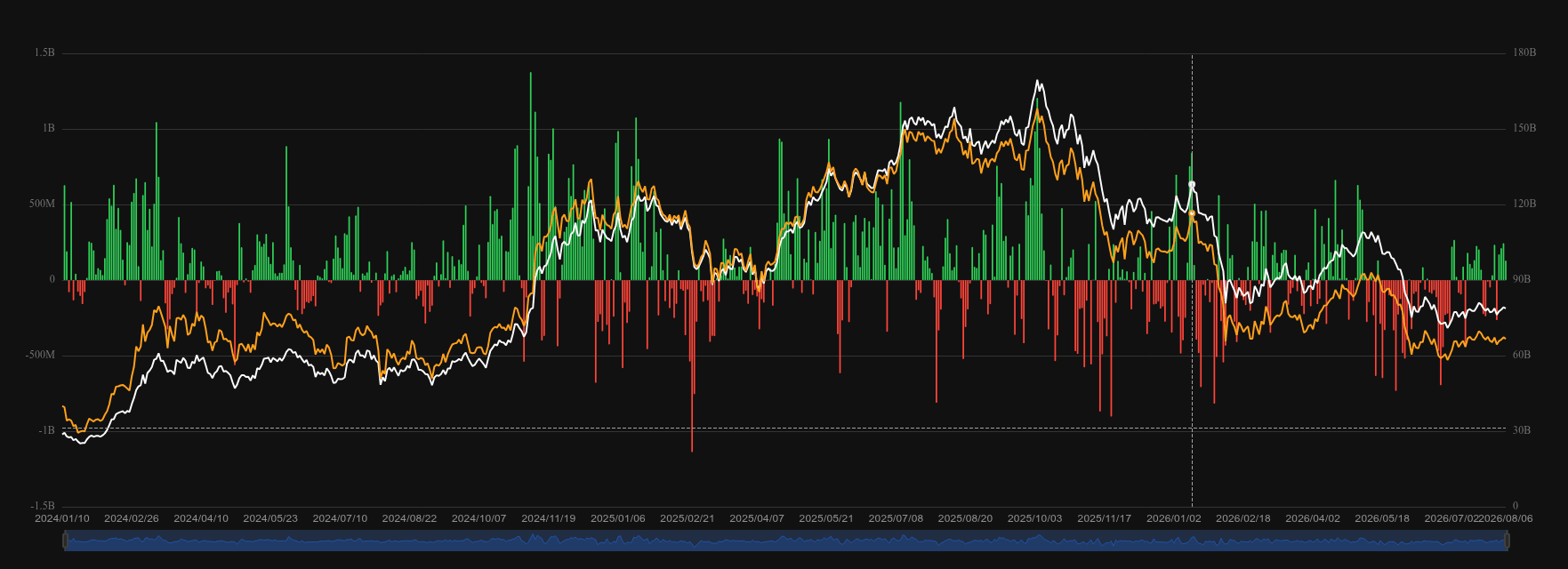
Spot Bitcoin ETF total net flows (green/red bars) and BTC price (orange line), January 2024 to August 2026. Source: SoSoValue.

By BitBrainers Editorial

Spot Bitcoin ETFs have recorded net inflows for four consecutive trading days in August 2026. The total stands at roughly $763.6 million. BlackRock's IBIT led every session. Franklin Templeton returned after 30 days of silence. The July nonfarm payrolls report lands at 8:30 AM ET. This is the first real test of whether the streak is conviction or reflex.

The numbers are straightforward. On August 3, the complex took in $170.1 million: IBIT led with $111.4 million, Fidelity's FBTC added $33.4 million, and Franklin Templeton's EZBC bought $9.2 million, its first purchase in more than 30 days. On August 4, IBIT added $170.3 million and the complex printed $211.5 million total.

On August 5, IBIT led again with $196.8 million and the daily total reached $244.4 million, the strongest single day of the run. On August 6, IBIT added $128.3 million and the complex printed $137.6 million total despite outflows from HODL and GBTC.

The cumulative August total is now roughly $763.6 million. Total net assets across the complex sit at approximately $79 billion. Cumulative net inflows since January 2024 are approximately $51.9 billion. The year-to-date deficit, which stood at $5.4 billion after June's carnage, has narrowed to roughly $4.5 billion.

The Context

June produced $4.5 billion in outflows, the worst month since the ETFs launched. July recovered only $172.4 million. August has already added roughly $763.6 million in four sessions. That is a reversal, not a recovery, and reversals in ETF flows have been short-lived in 2026.

The last sustained inflow streak ran seven sessions from July 14 to July 22, totaling roughly $981 million. It followed a ten-day outflow streak that pulled $2.73 billion from the complex. The streak before that, in April, brought $2.44 billion and nearly doubled March's $1.32 billion. Each streak has been followed by renewed selling. The question is whether August is different.

What makes this streak notable is the breadth. On August 3, every major fund printed green. IBIT, FBTC, BITB, ARKB, BTCO, and EZBC all bought. That level of coordinated participation has not happened since April. On August 5, even ARKB added $37.6 million, a fund that had been bleeding for most of July. The only red days in August came from HODL and GBTC, both legacy products with structural outflow trends.


What the Flows Actually Say

IBIT's flow profile tells the whole story. Over the past four trading days, IBIT has taken in roughly $607 million. Over one month, it has lost approximately $1.83 billion. Over three months, $3.91 billion has left. The four-day figure recovers roughly a third of one month's outflows. The streak matters, but it has real ground left to cover.

The year-to-date picture keeps the bulls honest. The complex would need roughly seven more weeks at the current pace simply to return to flat for 2026. One session in early 2026 recorded $753 million in a single day. The current streak averages roughly $189 million per day. The capacity for large creations exists. What has been absent is the sustained sequence that converts individual green days into a trend.

The structural improvement is durability. The complex has now been through an $8.2 billion drawdown, a $2.73 billion ten-day outflow streak, and a 21-month price low without any product closing, any issuer exiting, or any operational failure. The infrastructure held, which is not a price catalyst but the kind of datapoint institutional allocators underwrite before they size up.


The NFP Test

Consensus expects 83,000 to 100,000 jobs for July. The unemployment rate is expected to hold near 4.2%. The Fed held rates at 3.50% to 3.75% on July 29 with three dissenters voting for a hike. Chair Kevin Warsh said the Committee is positioned to wait for more data. That data arrives in hours.

A print below 100,000 with rising unemployment increases cut expectations. Risk assets typically sell first on recession fears before recovering on liquidity hopes. Bitcoin's $64,000 area, trading near $64,300 as of this morning, faces its first real test since February. If the ETF bid is conviction, it holds through the initial volatility. If it is reflex, the streak breaks today.

A print above 150,000 with steady unemployment validates the three dissenters. The dollar strengthens. The recent ETF inflows look premature. The streak breaks for a different reason.

The Goldilocks zone, 100,000 to 150,000, leaves the Fed holding in September and the market shrugging. The streak continues because the macro ambiguity that created it remains intact.


Get the Weekly Brief

One email. Monday morning. The macro events that move Bitcoin this week.

Subscribe

What to Watch

Watch the headline figure relative to 100,000. That is the threshold where recession pricing overtakes soft landing pricing.

Watch the unemployment rate. A tick to 4.3% or higher matches the highest level since late 2021.

Watch average hourly earnings. Sticky wages with weak jobs create the hardest outcome for the current policy framework.

And watch the ETF flow print for today. It will not be available until after the market close, around 4 PM ET. If the streak holds through an NFP miss, the institutional bid is real. If it breaks, the reflex trade is over.

For the full NFP preview and the Fed dissent context: yesterday's setup post


Sources

Farside Investors Bitcoin ETF Flow (US$m)

SoSoValue Bitcoin ETF Tracker

The Block Spot Bitcoin ETF Flows

Tools: Kraken for trading. Trezor for storage.

This is market commentary, not financial advice. Nothing here is a recommendation to buy or sell any asset. Do your own research.
Thursday, August 6, 2026

Tomorrow's NFP Is the Only Print That Matters Before Jackson Hole

BTC/USD daily with NFP line and $60K-$67K range

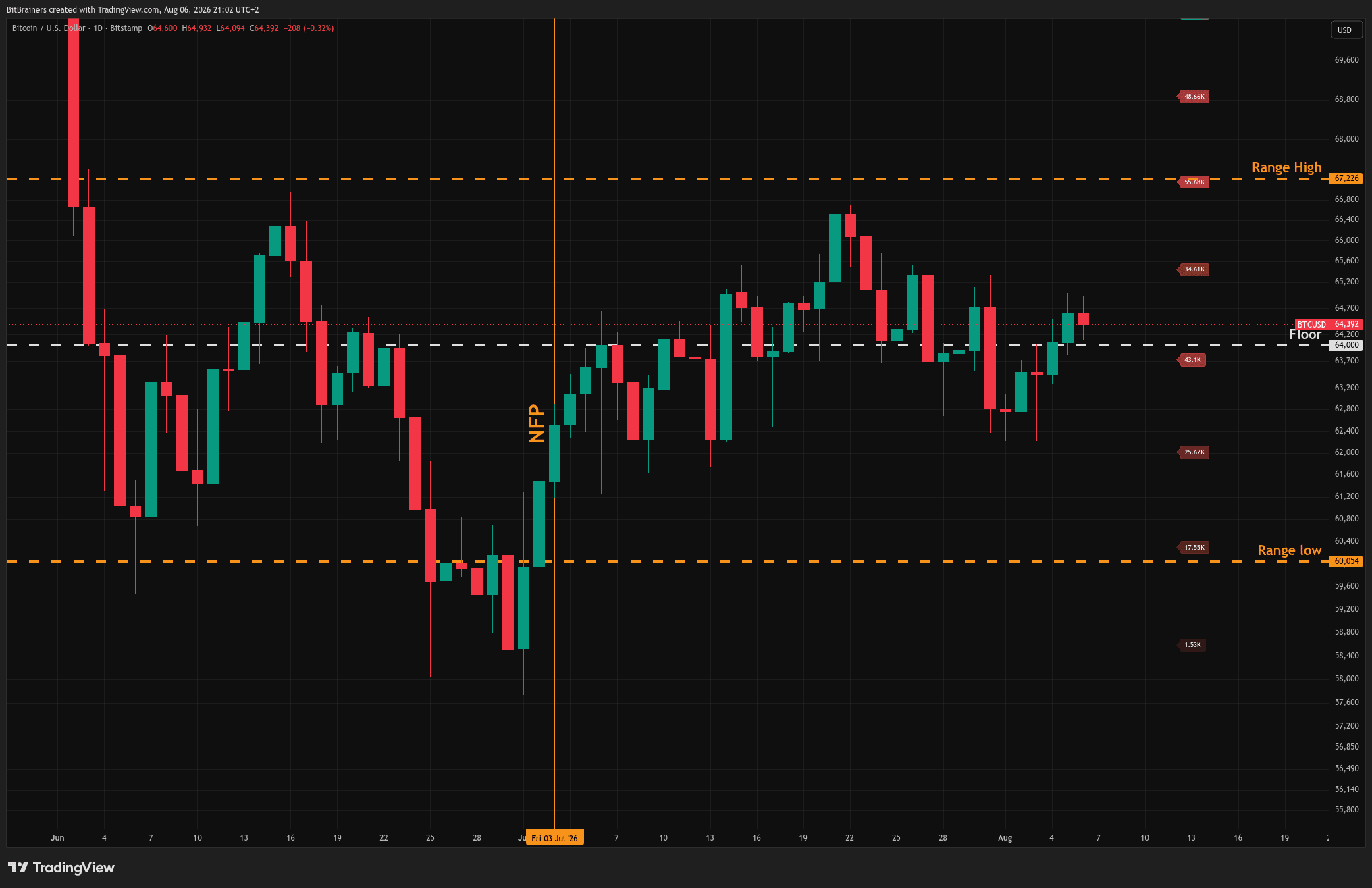
BTC/USD daily. Orange vertical line marks the July 3 NFP print. Dashed lines show the $60,000 to $67,000 range that has contained price since. Source: TradingView.

By BitBrainers Editorial

Bitcoin has traded between $60,000 and $67,000 for most of the third quarter. Spot Bitcoin ETFs took in $626 million over the first three sessions of August, with BlackRock's IBIT accounting for the bulk, after $4.5 billion in outflows during June. For readers trading these levels, Kraken offers spot and futures on BTC and ETH. The July nonfarm payrolls report lands tomorrow at 8:30 AM ET.

June's report set the current setup. Here is the last print and how Bitcoin reacted:

Month NFP Est. U Rate Part. AHE BTC Reaction
June 2026 +57,000 110,000 to 115,000 4.2% 61.5% 3.5% Dropped to $58K pre-print, then rose to $62K within 48h (+7%)

April and May were revised down by a combined 74,000 jobs. The three month average sits near 111,000.


What the Fed Did

On July 29 the FOMC held the federal funds target at 3.50% to 3.75% on a 9 to 3 vote. The three dissenters, Hammack, Kashkari, and Logan, preferred a 25 basis point hike. Chair Kevin Warsh said the Committee is positioned to wait for more data. That data is tomorrow.

Markets currently price about 55% odds of a September cut. The dissent complicates that pricing. One third of the voting committee believes policy is too loose. Warsh noted that tighter financial conditions already reflected in market rates gave the Fed room to hold, but he also said higher rates could well be part of the solution. The market heard that as a hawkish hold.


The Two Scenarios

A print below 100,000 with rising unemployment would increase cut expectations. Risk assets often sell first on recession fears before recovering on liquidity hopes. Bitcoin's $64,000 area faces its first real test since February. If the number collapses toward 80,000 or lower, the recession trade activates and the Fed faces pressure to cut 50 basis points, not 25.

A print above 150,000 with steady or falling unemployment would support the dissenters. The dollar would strengthen and the recent ETF inflows would look premature. $62,000 becomes the next level to watch. The market would reprice toward no cut in September, and the hawks would have the data they need to push again at the September meeting.


We read the filings so you can skip the timeline.

Weekly Bitcoin and macro analysis, built from primary sources.

Subscribe

What This Sets Up

Watch the headline figure relative to 100,000. That is the threshold where recession pricing overtakes soft landing pricing.

Watch the unemployment rate. A tick to 4.3% or higher would match the highest level since late 2021.

Watch average hourly earnings. Sticky wages with weak jobs create the hardest outcome for the current policy framework. The Fed cannot cut into accelerating wage inflation, and it cannot hold if the labor market is cracking.

And watch Bitcoin's reaction at $64,000. The level has held through three tests in the last month. If NFP misses and BTC drops through $62,000 on recession fear, the ETF bid will face its first real redemption test since June. If BTC holds or rallies on cut pricing, the institutional floor is real.

Jackson Hole runs August 27 to 29. This is the last major labor report before then. The ETF buyers are positioned for cuts. The three Fed dissenters are positioned for a hold or hike. Tomorrow's number settles it.

For the wider macro setup this week and the dates that matter: this week's Weekly Brief


Sources

Trading Economics United States Non Farm Payrolls

MUFG Research US Labor Update

U.S. Bank Federal Reserve Holds Rates at 3.50%-3.75% in July 2026

Texas Capital Bank No change in rates — Fed Meeting of July 29, 2026

The Wall Street Journal Fed Holds Rates Steady but Three Officials Vote for Increase

Kansas City Fed Jackson Hole Economic Policy Symposium

Tools We Use

Kraken — Spot and futures on BTC, ETH, and 200+ assets.

Trezor — Cold storage. No internet connection required.

This is market commentary, not financial advice. Nothing here is a recommendation to buy or sell any asset. Do your own research.

Weekly Brief: Bitcoin Just Broke a Two-Month Range. Here Is What Matters This Week.

By BitBrainers Editorial Bitcoin broke a two-month range with a 24% weekly candle. The Treasury buyback was the match. The squeeze di...

Weekly Brief: Bitcoin Just Broke a Two-Month Range. Here Is What Matters This Week.